
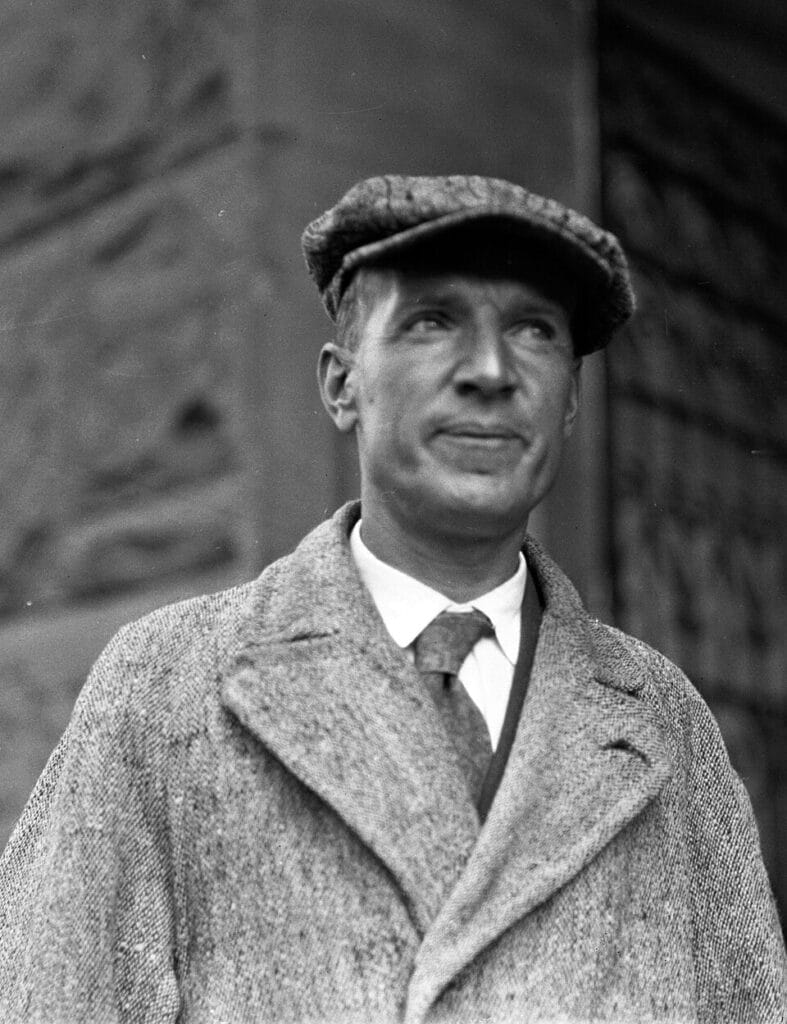
Upton Sinclair (1878–1968) stands as one of the most influential American writers of the early twentieth century, remembered less for literary elegance than for his unflinching exposure of social injustices. His novels and journalistic investigations, often described as “muckraking,” combined a deep sympathy for working people with a belief in socialism as a remedy for the inequalities of industrial capitalism. Over his long career, Sinclair published nearly one hundred books, but it was The Jungle (1906) that cemented his reputation as both a novelist and a reformer.
Born in Baltimore, Maryland, Sinclair grew up in a family oscillating between poverty and moments of relative comfort, a contrast that sharpened his awareness of social inequality. He attended the City College of New York and later Columbia University, supporting himself by writing pulp fiction stories at a remarkable pace. Even in his youth, Sinclair recognized that literature could be both a livelihood and a weapon for social change. His early flirtation with socialism and exposure to the harsh realities of industrial labor set the stage for his most famous work.
In 1904, Sinclair traveled to Chicago to investigate conditions in the stockyards. Living among immigrant workers, he observed the brutal hours, meager wages, and appalling unsanitary conditions. These experiences informed The Jungle, a novel that depicted the struggles of Jurgis Rudkus, a Lithuanian immigrant, and his family as they are ground down by poverty, corruption, and unsafe working environments.
The novel’s most famous effect was not, however, its plea for socialism, but its shocking revelations about the food industry. Readers were horrified by descriptions of rotten meat, filth, and exploitation in the packing plants. Sinclair later quipped: “I aimed at the public’s heart, and by accident I hit it in the stomach.” The public outcry led directly to the passage of the Pure Food and Drug Act and the Meat Inspection Act in 1906, landmark legislation in American consumer protection.
Though The Jungle became a bestseller, Sinclair did not rest on its success. He remained prolific, producing novels, essays, and plays that criticized economic exploitation, political corruption, and social injustice. King Coal (1917) exposed the harsh realities of the coal mining industry, while Oil! (1927), a tale about Southern California’s petroleum boom, later inspired Paul Thomas Anderson’s film There Will Be Blood.
Sinclair also ran repeatedly for public office on socialist platforms, most notably for governor of California in 1934. His “End Poverty in California” (EPIC) campaign attracted enormous attention, mobilizing unemployed workers and intellectuals. Although he lost the election, the campaign marked an important moment in Depression-era politics and foreshadowed aspects of the New Deal.
Sinclair was both idealistic and relentless. He believed in the transformative power of socialism, vegetarianism, and health reform. He experimented with fasting and alternative therapies, convinced that personal health was tied to broader social reform. His concern for the welfare of the body paralleled his concern for the welfare of society. This blend of personal conviction and public advocacy gave his work an unusual intensity, though it sometimes led critics to accuse him of preaching rather than storytelling.
Though Sinclair never achieved literary acclaim on the level of contemporaries like Theodore Dreiser or Ernest Hemingway, his influence on American society was profound. He demonstrated the potential of fiction to shape policy and provoke reform. His later series, The Lanny Budd novels, even won him the Pulitzer Prize in 1943, rewarding his attempt to weave global political history into narrative fiction.
Upton Sinclair’s career illustrates the tension between art and activism. His prose was sometimes clumsy, his characters schematic, but his moral urgency and investigative zeal gave his writing lasting power. Few authors can claim to have changed the law of the land through a novel, yet Sinclair did precisely that. By exposing hidden injustices and insisting on the dignity of working people, Sinclair used literature as a tool for reform—an achievement that secures his place in both literary and political history.