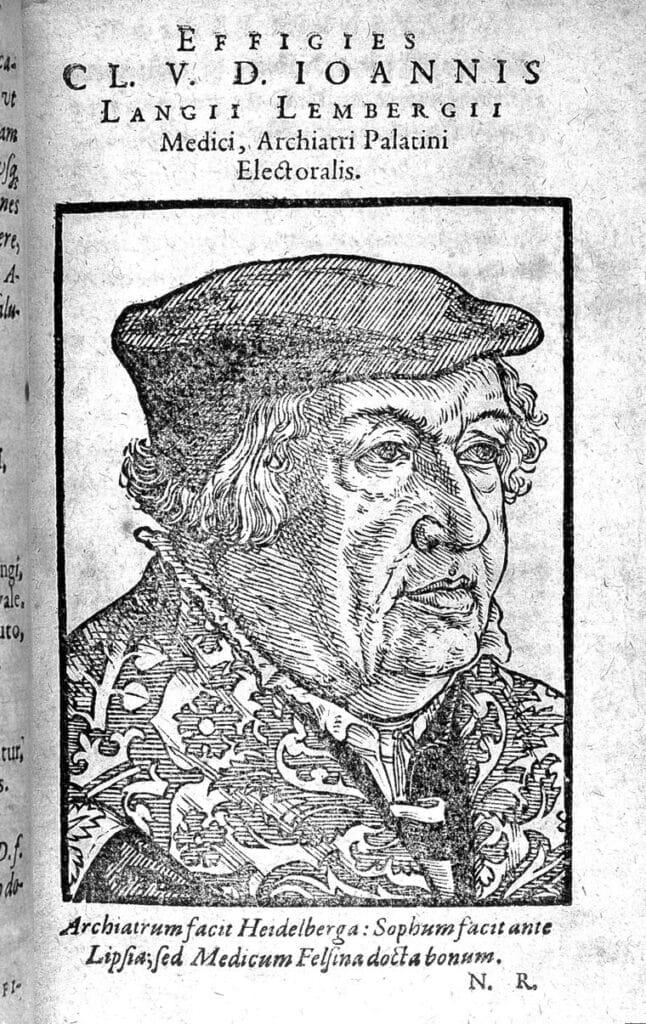
Johannes Lange of Heidelberg is sometimes credited with being the first to describe what later became known as “chlorosis” but that he called morbus virgineus, the disease of virgins. Born in Silesia in 1485, Lange went to study philosophy at the University of Leipzig, but later found he was more drawn to medicine and migrated to Italy, first to Ferrara and later to Bologna, where he studied under the distinguished anatomist Berengario da Carpi. He received his doctorate after seven years of study in Italy. On returning to Germany, he worked for the next thirty-seven years in the service of the Elector of the Palatinate, Frederic “the Wise.” He traveled with him all over Europe and accompanied him in two battles against the armies of Suleiman the Great. He was later appointed minister and privy councilor at the court of the Electors in Heidelberg and died at the age of eighty.
In Heidelberg, Lange lived in a magnificent, princely castle, where he wrote on medical matters in his Epistolarum Medicinalium. He also composed poetry and published treatises on milk and cheese (of which he was very fond and had at every meal), and also on scurvy. He was contemptuous of the “ignorants of learning” (surgeons who did not even understand how to use their surgical instruments and “mistreated their patients most shamefully”) and of physicians (who claimed they could diagnose diseases by looking at the tongue without even having read Hippocrates and Galen). He also wrote on fractures of the skull and made fun of surgeons so uninformed that they did not know the meaning of the word “trephine.”
Lange described “chlorosis,” common in his day among young women and eventually shown to be iron deficiency anemia. He maintained that “love” could cure this disease and advised his patients to marry and conceive, saying that he would be happy to attend their weddings. He advised against drinking water obtained from lead pipes, gave advice for treating what probably was typhus fever, and advised on the treatment of syphilis (which he did not believe was a new disease). He seems to have believed that demons and witches could also cause diseases, and discussed gonorrhea, insomnia, and sleepwalking. He was quite up to date and even read about the voyages of Amerigo Vespucci to America. He was evidently a learned and well-read physician, perhaps too devoted to the physicians of antiquity, but rightly suspicious of the medical charlatans of his time.
Reference
Major, Ralph H. “Johannes Lange of Heidelberg.” Annals of Medical History 7, no. 2 (March 1935): 133-140.