Arpan K. Banerjee
Solihull, England
Smallpox was a human scourge until the early nineteenth century. It had caused almost half a million deaths in Europe alone when Edward Jenner introduced vaccination into clinical practice in 1798 with his famous publication “An enquiry into the causes and effects of the variolae vaccinae” and the 1801 publication “The origin of the vaccine inoculation.”
News of this discovery soon spread and caught the interest of Spanish doctor Francisco Javier de Balmis, who today is not as well remembered as Edward Jenner. Francisco Balmis was born on December 2, 1853, in Alicante, Spain. He followed in his father’s footsteps and trained in surgery for five years at the military hospital there. He then worked in Valencia as a surgeon but traveled to the Americas in 1786, where he worked in Havana, Veracruz, and Mexico City, at that time a part of the Spanish Empire. In Mexico City, he worked in the military hospital, then traveled through Mexico in 1788 and became interested in botany and the local flora, writing a book on the plant agave and begonia published in 1794.
After hearing about Jenner’s work, Balmis persuaded the King of Spain to let him lead an expedition in 1803 to Puerto Rico, Venezuela, Ecuador, Colombia, Peru, and Mexico, where thousands of people were immunized against smallpox. Accompanying him on this mission was nurse Isabel Zendal, who is thought to be the first nurse to work on an international health campaign of this type. Her role included looking after orphans with cowpox, from whom the vaccine was prepared. In 1806, he took his vaccination campaign to the Philippines and China. Balmis also translated into Spanish Louis Jacques Moreau de La Sarthe’s French book on vaccines, Traité historique et pratique de la vaccine, which he distributed wherever he went.
This is now considered the first international public health expedition in history. Balmis might have been influenced by the knowledge that the daughter of King Charles IV of Spain died of smallpox in 1794. His philanthropic gesture was praised by none other than Edward Jenner, the discoverer of the vaccine himself.
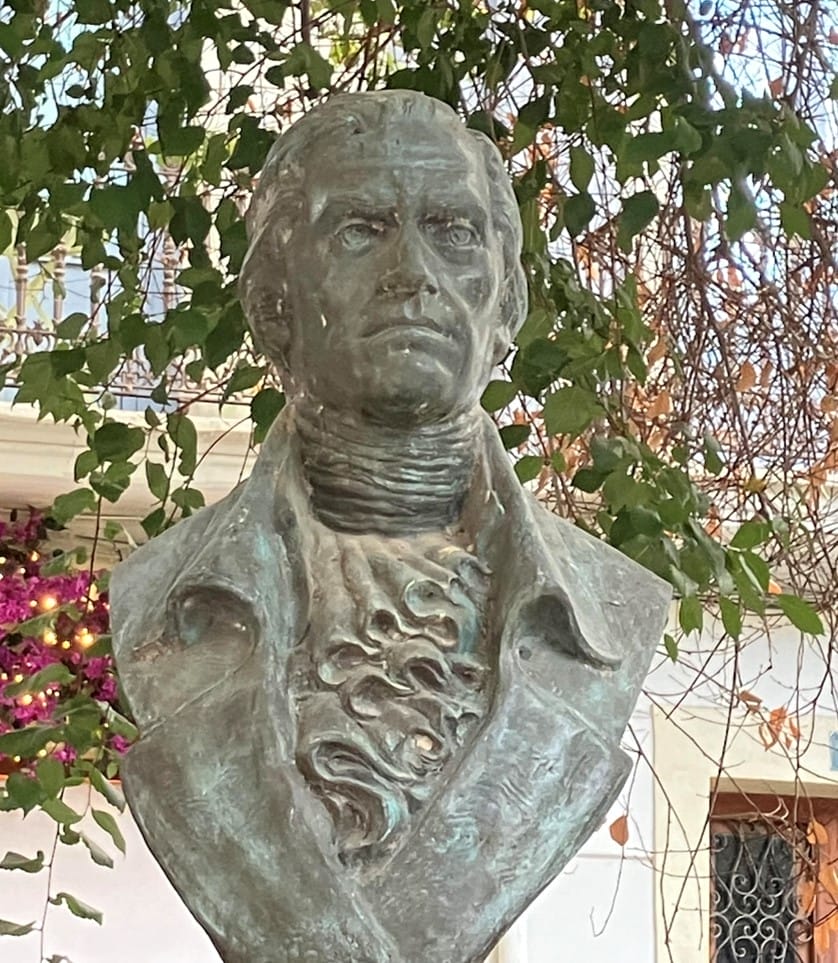
Balmis died on February 12, 1819. Today, a bust commemorating this remarkable man can be seen in Balmis Plaza in central Alicante. The university hospital in Alicante is also named after him.
References
- Francisco Javier de Balmis. Wikipedia. https://en.wikipedia.org/wiki/Francisco_Javier_de_Balmis
- Tarrago, Rafael E. “The Balmis-Salvany Smallpox Expedition: The First Public Health Vaccination Campaign in South America.” Perspectives in Health 6, no. 1 (2001). Pan-American Health Organization.
DR. ARPAN K. BANERJEE qualified in medicine at St Thomas’s Hospital Medical School. London. He was a consultant radiologist in Birmingham 1995–2019. He was President of the radiology section of the RSM 2005–2007 and on the scientific committee of the Royal College of Radiologists 2012–2016. He was Chairman of the British Society for the History of Radiology 2012–2017. He is Chairman of ISHRAD. He is author/co-author of papers on a variety of clinical, radiological, and medical historical topics and eight books, including Classic Papers in Modern Diagnostic Radiology (2005) and The History of Radiology (OUP 2013).