
Avi Ohry
Tel Aviv, Israel
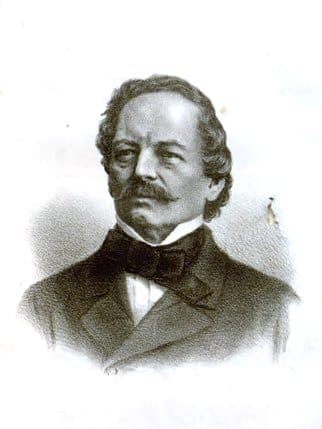
I believe not too many people have heard of the Austrian physician-botanist Friedrich Welwitsch (1806–1872; Friderik Velbic in Slovene). He studied in Vienna and practiced medicine in Slovenia and Moravia. In 1839 he gave up medicine and concentrated on botany, moving to Portugal and becoming director of the botanical gardens.
He studied first the fauna and flora of Portugal (recorded in his Welwitschii iter Lusitanicum) and then of the Canary Islands, Angola, and Namibia. In 1859, he discovered in the Desert of Namibia the unique plant Welwitschia mirabilis, “one of the longest-living plants on Earth” (~1,500–2,000 years).1
In Angola, Welwitsch discovered Rhipsalis baccifera, “the only cactus species naturally occurring outside the New World.”2 In 1861, Welwitsch returned to Portugal, then to London to the Natural History Museum, and later the Kew Gardens. He died in 1872. He left most of his precious, large collection to the London Natural History Museum, with part claimed by Portugal.2

References
- “Welwitschia.” Wikipedia. https://en.wikipedia.org/wiki/Welwitschia
- “Friedrich Welwitsch.” Wikipedia. https://en.wikipedia.org/wiki/Friedrich_Welwitsch
- “Welwitschia mirabilis.” Royal Botanic Gardens Kew. www.kew.org/plants/welwitschia-mirabilis
- Gillian A, Cooper-Driver GA. “Welwitschia mirabilis—A Dream Come True.” Arnoldia 54, no. 2 (1994): 2-10.
- TDV Swinscow. “Friedrich Welwitsch, 1806–72. A centennial memoir.” Biological Journal of the Linnean Society 4 (1972): 269-89.
AVI OHRY, MD, is married with two daughters. He is Emeritus Professor of Rehabilitation Medicine at Tel Aviv University, the former director of Rehabilitation Medicine at Reuth Medical and Rehabilitation Center in Tel Aviv, and a member of The Lancet‘s Commission on Medicine & the Holocaust. He conducts award-winning research in neurological rehabilitation, bioethics, medical humanities and history, and on long-term effects of disability and captivity. He plays the drums with a jazz band.