
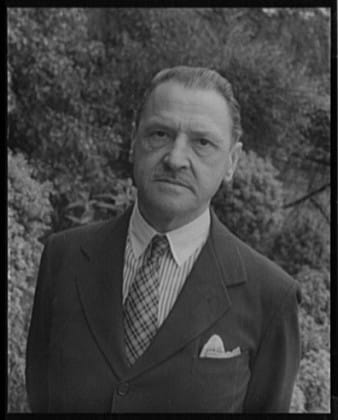
William Somerset Maugham (1874–1965) is remembered primarily as a master of the short story and as a novelist whose lucid style made him one of the most widely read writers of the twentieth century. Yet beneath his literary reputation lies another identity: that of a trained physician. Medicine was not just a stage in Maugham’s youth; it profoundly shaped his worldview, his clinical eye for character, and his enduring fascination with the frailties of the human body and mind.
Maugham studied medicine at St. Thomas’s Hospital in London, graduating with a medical degree in 1897. His early years were marked by loneliness—he lost his parents young and was raised by an uncle—but medical school gave him both discipline and a sense of professional identity. He was exposed to the full rigors of late Victorian clinical training: anatomy dissections, hospital rounds, and direct patient care among the poor of South London. His stammer and reserved temperament made him less comfortable as a physician in practice, but he absorbed the habits of close observation, detached listening, and sharp diagnosis. These habits later became hallmarks of his literary style.
During his final year at St. Thomas’s, Maugham wrote Liza of Lambeth (1897), his first novel. Set among working-class families of London, it drew heavily on his medical rounds in the slums, where he saw overcrowding, malnutrition, and the ravages of untreated disease. The novel’s candid portrayal of alcoholism, domestic abuse, and maternal mortality was rooted in what Maugham witnessed as a medical student. Critics noted its unflinching realism—an attribute inherited directly from the clinical gaze of the hospital ward.
Although Maugham never practiced medicine full-time, he never abandoned the physician’s way of seeing. His short stories are filled with cases that echo diagnostic puzzles: characters are presented, symptoms of personality are revealed, and outcomes are predicted with clinical inevitability. His detached, almost surgical style mirrors the doctor’s stance at the bedside—compassionate, but also objective.
In Of Human Bondage (1915), his most autobiographical novel, medicine plays a central role. The protagonist Philip Carey studies medicine, confronts dissection rooms and hospital wards, and navigates the tension between the call of art and the stability of a medical career. The novel captures the sensory detail of medical training—its odors, its cold cadaveric realities—and reveals how Maugham wrestled with the competing appeals of literature and medicine in his own life.
Maugham’s travels as both a writer and intelligence agent brought him into contact with tropical medicine and the colonial health environment. In stories such as Rain and The Painted Veil, he depicted epidemics, missionaries, and physicians stationed in remote colonies. The Painted Veil (1925), for instance, centers on a bacteriologist working amid a cholera epidemic in China. Maugham’s understanding of infectious disease and its human consequences gave authenticity to the novel and elevated it beyond melodrama. He portrayed the physician as both healer and existential figure, confronting not only microbes but also the moral and emotional crises of life.
Maugham’s medical studies coincided with the emergence of psychiatry and psychoanalysis as modern disciplines. His interest in psychology permeates his fiction: characters suffer from obsession, neurosis, and destructive passions that resemble case histories. Although he never formally practiced psychiatry, his clinical training made him acutely aware of how bodily ailments and mental suffering intertwine. The careful dissection of motives in his stories echoes the diagnostic methods of early psychiatric practice.
Maugham once remarked that medical school taught him everything he needed to become a writer: the importance of keen observation, the patience to listen, and the ability to distill complex realities into precise words. Though he set aside the physician’s life, medicine never left him. His literary career can be read as an extended clinical practice—one in which his patients were the characters of fiction, and his prescriptions were stories that illuminated the maladies of the human condition.
Somerset Maugham stands as a rare figure whose medical training infused a literary career of international renown. He bridged the clinic and the page, using the diagnostic eye of a doctor to probe the ailments of society and the psyche. His works remind us that the physician’s tools—observation, detachment, and compassion—can also be the writer’s, yielding insights into health, illness, and the fragile art of being human.