
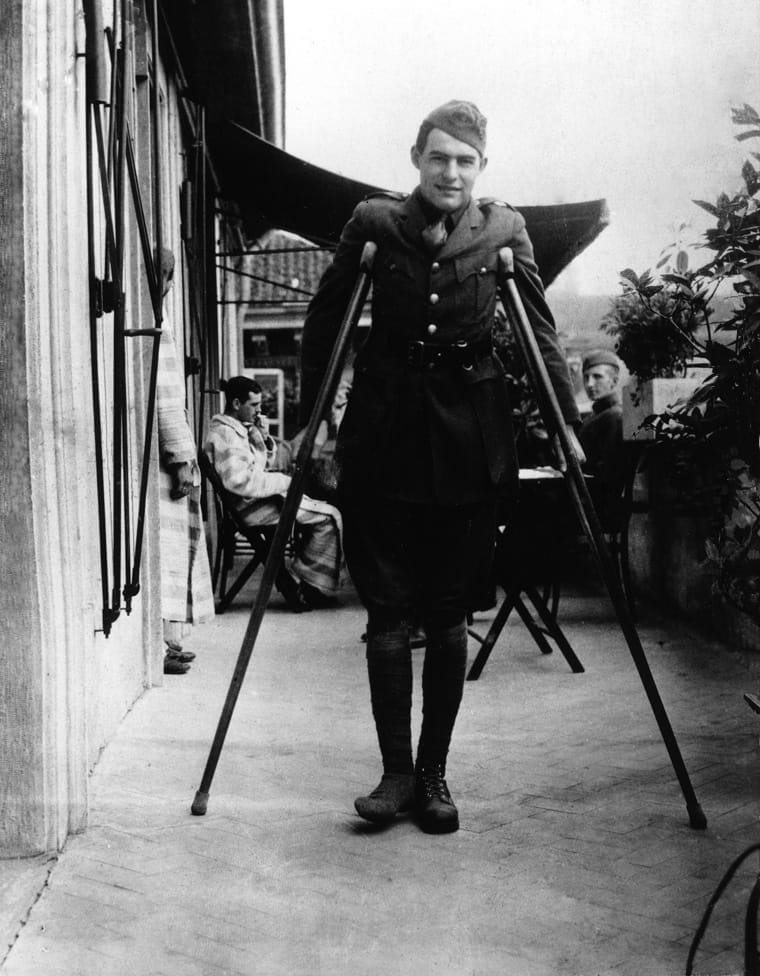
Ernest Hemingway, a figure of immense influence in the 20th century, is often remembered for his public persona as an adventurer, hunter, and war correspondent. His adventurous life, well-documented and marked by personal struggles, began with the outbreak of the First World War in 1914. As an ambulance driver on the Italian front, he was severely wounded by a mortar shell, an experience that would shape his life and his writing. This injury, and his subsequent romance with a nurse, became the foundation for his classic novel, A Farewell to Arms. His life was marked by a series of physical traumas, from a skylight falling on his head to multiple concussions from car crashes and boxing, and an anthrax boil. The culmination of these physical disasters was the two successive plane crashes in Africa in 1954. His later life was marred by hunting accidents, hypertension, cirrhosis of the liver, and depression, treated with electroshock therapy. On July 2, 1961, he tragically died by suicide, using his own shotgun.
Ernest Hemingway’s novels are distinguished by their unique and taut prose, a style that has left an indelible mark on the literary world. His works often delve into the themes of war, the fragility of the human body, its wounds and illnesses, hospitals, surgeons, and operations, all drawn from his own experiences. Some of his best-known works are The Sun Also Rises (1926), A Farewell to Arms (1929), For Whom the Bell Tolls (1940), The Old Man and the Sea (1952), A Moveable Feast (1964), The Garden of Eden (1985), and The Dangerous Summer (1985). Each of these works is a testament to his inimitable style, a style that continues to captivate readers and scholars alike.
In one of his best-known novels, A Farewell to Arms (1929), Lieutenant Frederic Henry’s leg was wounded by mortar, performed by the confident Dr. Valentini, who breezily asserts that “there is nothing worse than an operation by a timid surgeon.” Hemingway’s portrayal of surgery is stripped of sentimentality, dwelling on the use of ether, drainage tubes, and immobilization, and showing the slow grind of recovery. The love story between Frederic and Catherine Barkley unfolds primarily within hospital walls, where the intimacy of caregiving blends with romance. Catherine dies of hemorrhage and amniotic embolism despite medical intervention.
Another Country (1927) exemplifies his memorable literary style: “It was cold in the fall in Milan, and the dark came very early. Then the electric lights came on, and it was pleasant to look in the windows along the streets… The hospital was both old and beautiful, and you entered through a gate, walked across a courtyard, and exited through a gate on the other side. There were usually funerals starting from the courtyard…”
In A Natural History of the Dead (1932), he adopts an almost medical objectivity when describing casualties and death. “The only natural death I’ve ever seen, outside of loss of blood, which isn’t bad, was death from Spanish influenza. In this, you drown in mucus, choking, and how you know the patient’s dead is: at the end, he turns to be a little child again, though with his manly force, and fills the sheets as full as any diaper with one vast, final, yellow cataract that flows and dribbles on after he’s gone.”
The Sun Also Rises (1926) highlights a wound beyond the reach of medicine. Jake Barnes, injured in World War I, suffers an emasculating injury that renders him impotent. Hemingway never specifies the medical details, but the implications are clear. Jake’s wound, though invisible, dominates his life, shaping his unfulfilled love for Lady Brett Ashley. Medicine is conspicuously absent: there are no surgeons, no treatments, no cure. Jake must live with permanent disability, his body altered irreversibly. The novel thus captures the long-term consequences of war wounds,
In For Whom the Bell Tolls (1940), Hemingway again immerses readers in the medical realities of war, this time the Spanish Civil War. Robert Jordan, the protagonist, is gravely wounded by artillery fire during a mission to blow up a bridge. His injury—massive hemorrhage and loss of mobility—makes survival impossible. Hemingway describes the physiological effects of shock, the slowing pulse, and Jordan’s stoic acceptance of death. Around him, guerrilla fighters practice a rough form of battlefield medicine: makeshift amputations, rudimentary dressings, and morphine injections to ease pain.
In Death in the Afternoon, his deep dive into Spanish bullfighting, he dissects the very nature of violent death and the medical precision required of the matador. The book is part cultural critique and part anatomical study, with Hemingway analyzing the bull’s wounds and the torero’s craft in excruciating detail.
Similarly, in Green Hills of Africa, his essays on hunting big game are filled with the medical specifics of tracking and killing, from the trajectory of a bullet to the anatomy of a felled animal. This fascination with the physical mechanics of injury and death extended to his own life, as his essays often contained a detached, almost clinical analysis of the many accidents he endured.
In The Dangerous Summer, his account of following bullfighters demonstrates an intimate knowledge of injury patterns, recovery times, and the psychological toll of repeated physical trauma. His descriptions of matadors’ injuries read like medical case studies, suggesting someone who had become an expert observer of human resilience and fragility through personal experience.
In essays like A Moveable Feast, written late in his life, periods of intense creativity and euphoria alternate with descriptions of profound despair and self-doubt. His accounts of writing rituals, insomnia, and the constant need for external validation through dangerous activities (hunting, war correspondence, deep-sea fishing) align with contemporary understanding of mood disorders and their impact on creativity and risk-taking behavior.
In his later works, Hemingway’s novels move away from explicit surgical or wartime settings to focus on the body’s endurance under natural and personal strain. In The Old Man and the Sea (1952), for instance, Santiago’s battle with the marlin becomes a psychological ordeal. Hemingway records the physical toll of this battle with clinical precision, as though observing the fisherman’s body under laboratory conditions.
Similarly, Islands in the Stream (published posthumously) portray characters who drink heavily, fight infections, and struggle with wounds in remote locations where medical help is scarce. These works reveal Hemingway’s fascination with the body’s limits, its vulnerability to exhaustion, injury, and decay.
One reason why Hemingway’s medical themes are so powerful lies in his style. His prose mimics clinical observation: concise, exact, objective. He avoids florid description, favoring the kind of direct, unsentimental language one might expect from a surgical report. Just as a doctor notes symptoms and outcomes, Hemingway records physical detail without embellishment. Yet this restraint allows the emotional weight to accumulate, making his depictions of injury and illness all the more affecting.
Across Hemingway’s fiction, medicine is depicted as noble but ultimately limited. Surgeons like Dr. Valentini may save a limb, but they cannot prevent the randomness of shellfire or the inevitability of death. Nurses can comfort and heal, but childbirth may still end in tragedy. Painkillers may dull agony, but trauma can remain untreatable. Hemingway’s vision of medicine is at once respectful and unsparing: an art of partial victories, powerless against fate but essential in the struggle for human dignity.