
Stephen Martin
Thailand
Aidan Jones
United Kingdom
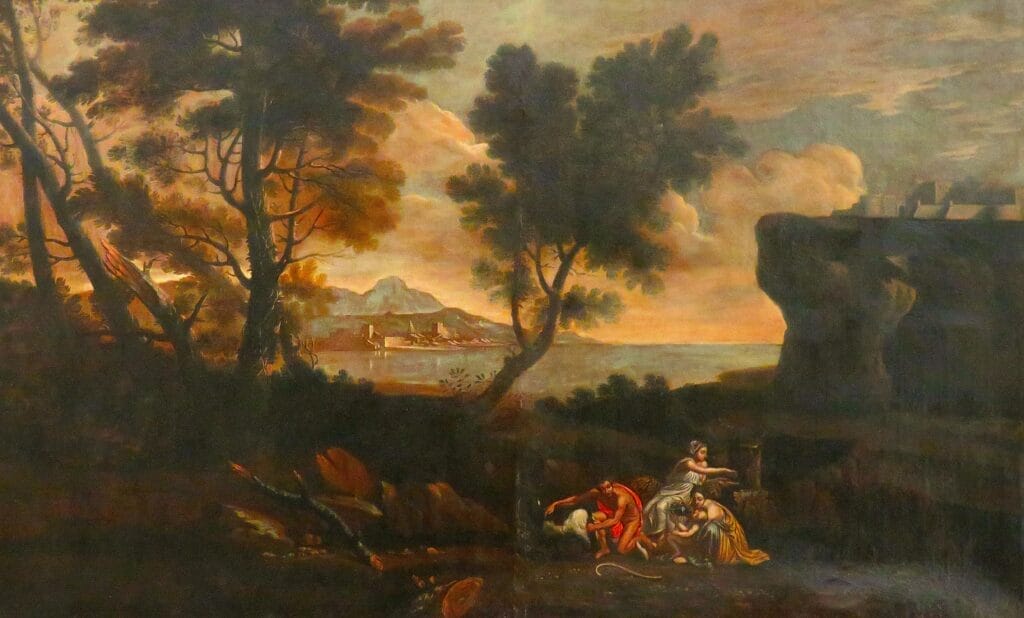
The Venetian artist Marco Ricci1 (1676–1730) painted Flight into Egypt after being in serious trouble. (Fig 1) We know it was created in England because it is on two individual yard-wide canvases, strip-glued together, and not woven in continental meters. Initialed “MR” in sepia on a cream rock in the foreground, there is an equally spaced black “S” on dark background on the right. This suggests a second, subsidiary artist, and nicely fits his equally miscreant uncle, Sebastiano Ricci, with whom he worked in England from 1711–1716.2 Their large paintings are well documented, except those for the Earl of Portland’s chapel in Bulstrode House, Buckinghamshire, all of which are untraced. This may well be one of them.3
Marco Ricci’s characteristic background is a subtly shaded, nicely proportioned, and soft-featured townscape between a shore and craggy mountains. Another hallmark of his is shiny silver bark on symbolic broken tree trunks and fallen logs, with copper-colored heartwood. His layout, trees, and foliage echo Dutch old masters. He visited the Netherlands while traveling to England. Rome also had a school of Dutch immigrant painters in the early 1600s, the Bamboccianti, who influenced landscape composition, persisting with Ricci’s teacher, Alessandro Magnasco of Genoa. One Bamboccianto son, Pieter Mulier II,4 painted earlier a strikingly similar overhanging cliff to Ricci’s, again with a fort on top.5 As the third remarkable artist in this story, Mulier worked in the Duke’s prison tower in Genoa while serving a twenty-year sentence for instigating a murder. He was acquitted completely and found innocent after eight years, released, and worked in Ricci’s Veneto region.
Threatened by the birth of Christ, whether paranoid, realistic, or both, King Herod ordered all boys two years old and younger in Bethlehem to be killed, according to St. Matthew.6 Jesus was evidently born in 4 BC, close to Herod’s death, which is firmly dated by an eclipse described by the first-century historian Flavius Josephus.7 The star of Bethlehem followed by the shepherds in Matthew’s Gospel8 was probably a comet in 5 BC, which is convincingly close. Josephus recorded Herod as dying with symptoms of fever, itch, pain, dropsy, abdominal swelling, and genital gangrene. Herod’s terminal illness could have also affected his brain with threat perception and violence, so-called organic paranoia. The Holy Family fled to Egypt9 from Bethlehem in the night after Christ’s birth, because of an angelic warning to Joseph in a dream. They returned on similar angelic instruction, once Herod was dead.10
In the painting, Joseph is milking a goat. His wreath indicates descent from King David, a lineage which troubled Herod. A woman in a white dress precariously scrapes honey from log hives, while dozens of bees swarm around. Ricci combined the New Testament story of the flight into Egypt with the recurring Old Testament idea of Israel as the land of milk and honey.11
Not mentioned in St. Matthew’s Gospel, the woman in white seems out of place, but she appears in other Flight paintings including those by Titian and Poussin, which were widely familiar from prints. She may be the maid Salome,12 representing a supportive figure, so the Holy Family does not face the forthcoming wilderness alone. A woman in black is shown in Giotto’s considerably earlier Flight in the Scrovegni Chapel, Padua, leading a donkey ridden by Mary and Christ.13 Giotto also painted Joseph carrying a jug, symbolizing sustenance. Giotto’s precipitous path edge highlights danger. Hazard in Ricci’s forest has a much darker mood, though.
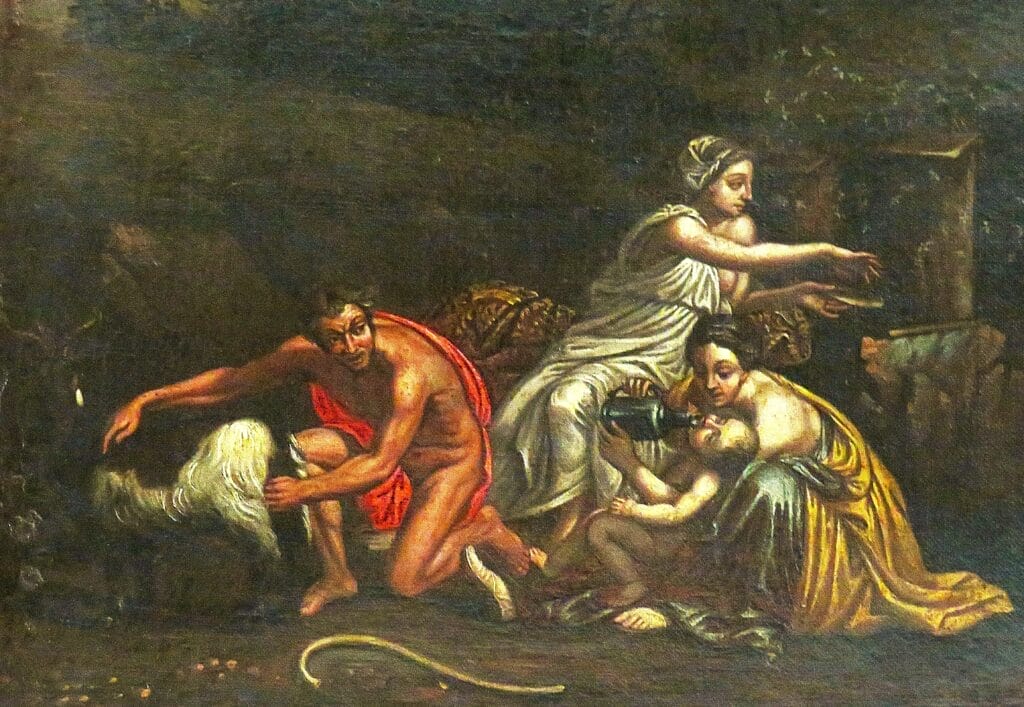
The small figures (Fig 2) lack the wiry sketchiness of Ricci’s three colleagues who usually painted them for his landscapes. They were Magnasco, Gian-Antonio Pellegrini, and Sebastiano Ricci. The Royal Collection Trust, however, has many sketches by Marco Ricci with comparable face technique, including theater-goers with boldly expressive facial lines.14 Another example is a miniature image ofthe castrato singer Nicolò Grimaldi in Rehearsal of an Opera,15 also in oil. This makes Ricci himself the best candidate for the figures. They look animated, as if acting on stage sets, which he painted in London.16
The Holy Family is on a separate background, in thickly applied oil paint, so the canvas pattern less distorts lines of expression. These include Joseph’s frantically anguished frown, Mary’s look of concern bordering on relief, and the maid’s calm neutrality. They are masterful for their size, being smaller faces than many true miniatures. More dramatic than beautiful, their expressions are discernible from a distance, ominously framed by the overhanging cliff and tree trunk.
The fort again looks separately painted, with fine architectural draftsmanship. Sebastiano Ricci painted detailed architecture, and this may be his minor contribution to the overall painting. So much work on a complex fort in a style different from the townscape means it was more than background. It must represent Herod’s palace, with its elevated, impenetrable strength. Just as in Mulier’s simpler previous picture, state power looms overhead. Mulier and the Riccis all had a common reason to get that out of their system.
More symbolism occurs around the town. With a hint of a reflected red sky, night is about to fall, and the fishing boats have all been neatly dragged high onto the beach for the night. There is no one about, so the city gates are safely locked. The ironic contrast is the risk of sneaking past Herod’s palace in a fast-darkening, rocky forest, soon to be pitch black. Hope abides in a shaft of light falling upon the figures, the only colorful forms in the forest, with the goat’s legs casting a long evening shadow. Vital nourishment is another hint of providence.
This Flight into Egypt was also darker than that of Ricci’s contemporaries. Why? And why did Ricci copy the overhanging clifftop fort of Mulier, the acquitted killer? Before this painting, in 1699, Marco Ricci was drinking in a tavern in Venice on a winter’s night. A gondolier insulted his art, and Ricci, in temper, took a jug and hit his head, killing him.17 Sebastiano helped Marco flee to the Dalmatian coast, still in the Venetian Empire over the Adriatic, but out of immediate legal reach, which could have led to Ricci being hanged. He stayed in Split, with its grand Roman ruins, where he had art lessons for four years.18 In middle age, Marco was said to self-harm with fasting, overdosing, and bizarre theatricality.19 He was sketched by his friend Anton Mario Zanetti, flexed and lean, labeled “co[n] i dolori”—“with his sorrows.”20 Venice parish records cite Ricci as dying of pneumonia.21
There are similar hints at mood disorder in Ricci’s uncle, years before Marco was in serious trouble. Sebastiano was so hypersexual with poor judgement, way beyond Catholic morals, that he went from one scandal to another.22 He made a woman pregnant in 1681, would not marry her, allegedly tried to poison her, then did marry her, disastrously. A wealthy patron got him freed from prison. In another episode of 1688, Sebastiano eloped with the daughter of an artist, was arrested, and he, too, narrowly escaped execution if a charge of forced abduction were to have stuck. His patron, the Duke of Parma, had him released that time. Zanetti drew Sebastiano in Venice in old age, looking very melancholic, in downcast posture, with a huge belly from comfort eating. Zanetti’s note says Sebastiano was depressed from losing money he invested in Venice’s Teatro San Cassiano that season.23 The recurrent themes of theater and performance may parallel behavioral facades of the Riccis following their misdeeds.
Swings of violence, recklessness, and disinhibition alternating with depression point to both the Ricci artists having bipolar disorder. Symptoms expressed in creative professions might include enhancement of awareness, visual imagination, emotional intensity, speed, and wakefulnessfrom elevated dopamine signaling.24 Dopamine surges from some present-day Parkinson’s disease medications also reportedly enhance artistic drive.25 At the other end of this spectrum, for the Riccis, the depressive neurochemistry of serotonin insufficiency can cause anger and violence, made worse with alcohol.
The figures in the painting are on a long path obstructed by fallen trees, a metaphor for staying on the right behavioral path, despite obstacles. Their placid donkey rests under his yellow carpet behind them. Ironically, this depiction of the flight into Egypt also somewhat resembles art of the infant Bacchus being nurtured by nymphs and a satyr.26 If this was hinting at a contrast27 between Christ’s glory and Bacchus’ drunken insanity,28 it is not hard to see Ricci’s instantaneous watershed event that night in Venice as a parallel.
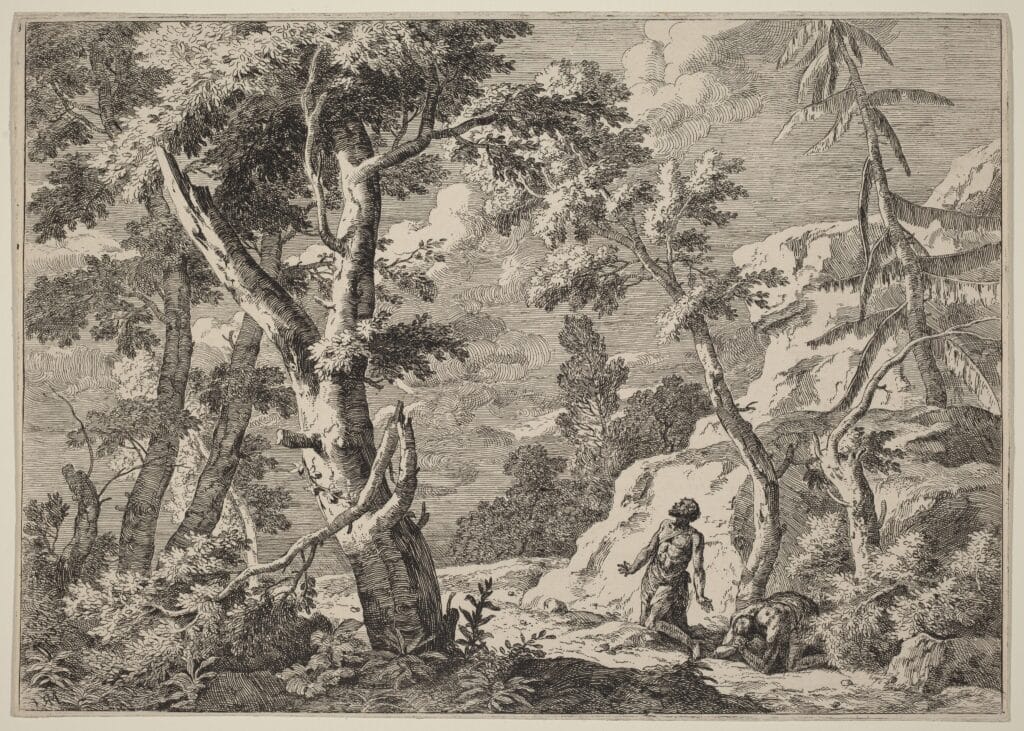
In Marco Ricci’s etching of 1723–1730, Two Men Penitent in the Wilderness,29 made late in his life, there is a figure kneeling, arms splayed, looking to Heaven in sorrowful contrition. (Fig 3) His thin, concave nose and lean build are similar to Zanetti’s drawing of Marco Ricci himself. The other, chubbier man’s face is hidden in crouched prayer, but a reasonable implication is that it is his uncle. The penitents exemplify how the pendulum swung back and forth for Sebastiano and Marco from the sacred to the profane. Themes of a path, broken branches, and an overhanging cliff are there again, not just as composition.
Marco Ricci influenced taste and style in the figures and beautiful waterfronts of Canaletto and the antiquity of Piranesi.30 There is much more to this powerful picture than immediately meets the eye in its forensic symbolism, and not just of Herod. Flight, threat, and survival must have been raw psychodynamics for Marco Ricci and his uncle long after their own flights; Marco was abroad for thirteen of the sixteen years following the killing.31 He also turned one emblem in the painting from disaster to survival: The Infant drinks from a heavily cast pewter jug, this time put to good use.
End notes
- Dulcia Meijers, “Ricci, Marco,” in Grove: The Dictionary of Art vol. 26, ed. Jane Turner (Oxford: Oxford University Press, 1996), 323–325. He was one of the first Venetians to paint in England, 1708–1710, on a previous tour with Giovanni Antonio Pellegrini, who painted at Castle Howard, Kimbolton Castle, and Manchester House.
- Dulcia Meijers, “Ricci, Sebastiano,” in Grove: The Dictionary of Art, 319–323. Unsuccessful in the commission for the dome of St. Paul’s Cathedral, he painted a Resurrection for the apse in the Chapel of the Royal Hospital, Chelsea, assisted by Marco, and paid for by Queen Anne.
- Bulstrode House was redeveloped in the 1860s, losing the chapel. The picture has provenance from nearby. See: Audrey M. Baker, “The Portland Family and Bulstrode Park,” Records of Buckinghamshire 43 (2003): 159–176. The Earl had toured Tuscany with his tutor, the historian Paul de Rapin, and supported the Royal Academy of Music’s operas. He lent Josiah Wedgwood his famous Roman glass “Portland Vase” to model.
- Mulier, 1637–1701. In Marco Carminati, “Peter Mulier: Il Cavalier Tempesta,” Emotion Art Magazine (Milan: Broker Insurance Group, 2020), 42–49.
- “Pieter Mulier paesaggio dipinto olio su tela,” Gabriele Gogna listing, https://www.gognasrl.it/en/antiquariato/magazzino/dipinti-antichi-arazzi-tappeti/quadri-antichi/pieter-mulier-paesaggio-dipinto-olio-su-tela/ It sold in Galleria Sacerdoti, Milan, and is now untraceable. Considering the outline of the mountains, the layout of the town, and the elements of the fort, the setting of Ricci’s Flight may be loosely based on Genoa under Mulier and Magnasco’s influence.
- Matthew 2:16, King James Version, “from two years old and under.” Herod died soon after Christ’s birth and flight.
- Flavius Josephus’ history Ἰουδαϊκὴ ἀρχαιολογία, c. 93–94 AD, medieval Latin translation Antiquitates Iudaicae, Book 17, chapters 6–8. Herod’s death is dated from the eclipse Josephus described before Passover. His account details Herod’s symptoms.
- Matthew 2:2, 2:9.
- The village of Matarieh Al Matariyyah near Heliopolis is the traditional place of refuge, a straight 190 miles from Bethlehem. It lies just east of Cairo where they would have emerged from the desert. Notably, five churches there are dedicated to the Virgin.
- Matthew 2:13-23.
- Exodus 3:8; Numbers 14:8; Deuteronomy 31:20; Ezekiel 20:15.
- Salome the maid and other additional characters in Flight into Egypt paintings originated not in St. Matthew’s Gospel, but an embellished Frankish text probably from the seventh century, the Gospel of Pseudo-Matthew. Mary’s mother, St. Anne, is another possibility specified in some paintings, stemming from the second-century elaborative apocryphal Gospel of St. James.
- Painted around 1305. Giotto’s figures make a helpful early comparator and show the popular endurance over seven centuries of the apocryphal texts excluded from the New Testament. Matthew’s Gospel does not mention any donkey on the flight.
- Ex Joseph Smith collection, Royal Collection Trust, viewable by searching “Marco Ricci” at https://www.rct.uk/collection/search. Smith was a British diplomat, opera fan, and collector in Ricci’s Venice. Most of Ricci’s works now in the UK were imported from Venice by Smith. See: Edward Croft-Murray, “Ricci, Marco,” The Dictionary of British Eighteenth Century Painters, ed. Ellis Waterhouse (Antique Collector’s Club Ltd., Woodbridge, Suffolk, England, 1981): 307.
- Yale Centre for British Art, Acq. no. B1981.25.523. The soprano in this painting, Catherine Tofts, was Smith’s wife.
- Ricci and Pellegrini painted opera sets in The Queen’s Theatre, Haymarket, London for Alessandro Scarlatti’s opera Pyrrhus and Demetrius. Other helpful comparators of Marco Ricci’s style of faces are in a 1753 selection of his works engraved and published by Jacobus (Giacomo) Billy.
- Tomasso Temanza, Zibaldon, ed. & trans. Nicola Ivanoff, (Venice and Rome: Istituto per la collaborazione Culturale, 1963).From the original archived manuscript: Zibaldon de’ memorie storiche appartenenti a’ professori delle belle arti del designo, 1763, Biblioteca Seminario Patriarcale, Venice. Temanza was an outstanding architect and early art historian.
- Carminati, “Peter Mulier: Il Cavalier Tempesta,” states the master in Split was possibly Antonio Francesco Peruzzini.
- Temanza, Zibaldon.
- Anton Zanetti, Fig. 178, “Marco Ricci,” in ed. Alessandro Bettagno, Caricature di Anton Maria Zanetti (Neri Pozza Editore, Vicenza, 1969), posted on Willym, “Cantrice, Castrati, Amici e Altre Bestie – Part I*,” Willy Or Won’t He blog, August 2, 2014, https://willyorwonthe.wordpress.com/2014/02/08/cantrice-castrati-amici-e-altre-bestie-part-i/. Zanetti’s “i” plural suffix, also like woes, implies a psychiatric meaning; physical pain is less likely.
- Meijers, “Ricci, Marco.”
- Meijers, “Ricci, Sebastiano.”
- Zanetti, Fig. 279, “Bastian Ricci [sic].”
- Simon Kyaga et al., “Creativity and mental disorder: Family study of 300,000 people with severe mental disorder,” Br J Psychiatry 199, no. 5 (Nov 2011): 373–379.
- S. López-Pousa et al., “Dopaminergic Dysregulation, Artistic Expressiveness, and Parkinson’s Disease,” Case Reports in Neurology, 4, no. 3 (Nov 3, 2012): 159–166.
- Sebastiano Ricci painted a Meeting of Bacchus and Ariadne for Burlington House, 1713–1714, after Annibale Carracci’s for the Farnese family, as well as a Bacchus and Ariadne (National Gallery, London, NG 851), in which the satyr has elvish, pointed ears and goat’s feet.
- Going against “Bacchus” are: the wreathed “satyr” looking human with toes, but no lordosis, hooves, tail ,or horns; the group characters fitting Mary, Joseph, Salome/St. Anne; the dress colors fitting many biblical images despite unusual exposed shoulders which may still reflect haste; the stick on the ground as a common emblem of travel in the biblical pictures; no other miniature Bacchus figures on canvas were found, while small figures are common in large paintings of the Flight; it is a rest on a journey with a donkey, her head bent down, ears to right, eye and harness showing low contrast; a path right across the huge canvas; and the large, detailed fort which must be Herod’s, otherwise the extensive work painting it makes no sense.
- Primary sources on the basis of Bacchus as the god of insanity include: The Bacchae by Euripides on the god’s power to induce madness driving women into a frenzy; the Homeric Hymn to Dionysus on Bacchus driving pirates mad with fear; and Livy’s History of Rome on the Roman Bacchanalia festival’s frenzied revelry.
- National Gallery of Art, Washington DC, Acc. No. 2001.26.1. https://www.nga.gov/artworks/117770-two-men-penitent-wilderness. Ricci’s initials of “MR” are in the same “font” as his Flight, but in the print they are back to front. That suggests diminished left-right awareness when he engraved what should have been a mirror image, an occasional soft sign in organic bipolar patients, whose brain lateralization can have a higher rate of non-right-handedness compared to the general population. See: Cecylia Nowakowska et al., “Increased rate of non-right handedness in patients with bipolar disorder,” J Clin Psychiatry, 69 no. 5 (May 2008): 866–867.
- Meiers, “Ricci, Marco.”
- Though there were commercial benefits, keeping out of the way is persuasive.
STEPHEN MARTIN graduated in medicine in Newcastle upon Tyne where he also studied art history on a scholarship. He is Honorary Professor of Psychiatry at Chiang Mai University and Specialist Lecturer at Kalasin Arts College, Thailand. He was previously Professor in the Faculty of Arts, Mahasarakham University and co-founded Baan Dong Bang Museum, teaching and writing particularly about eighteenth-century portraits.
AIDAN JONES is a consultant in clinical neuropsychology. Semi-retired from clinical work, he is an expert witness for UK Courts. He headed the NHS neurorehabilitation clinical psychology service in Oxford, holding a doctorate in clinical psychology, and a mental health epidemiology research Ph.D. He also studied anthropology at Trinity College, Oxford, and psychology at University College of North Wales, Bangor.