
Ahmed Nadeem
Chicago, Illinois, United States

Earl Bakken was an electrical engineer who developed the external, battery-operated, wearable pacemaker. He was born in Minnesota in 1924 and received his Bachelor of Science and Master of Science degrees in electrical engineering from the University of Minnesota. In 1949, he founded a company called Medtronic with his brother-in-law, Palmer Hermundslie, to manage and maintain electrical devices in the Minnesota hospital where he worked.
Bakken developed the external-battery pacemaker after cardiac surgeon Clarence Walton Lillehei lost a patient during a 1957 power blackout in the Twin Cities.1 Dr. Lillehei was a pioneer in repairing congenital heart defects in children. At that time, complete heart block developed in 10–20% of patients undergoing the procedure, usually from injury to the heart’s conduction system during the surgery itself.2 This complication was essentially eliminated when Lillehei began using a myocardial electrode with an external, plug-in electric stimulator. However, these systems were large and depended on the integrity of an external power supply and cord. Lillehei approached Bakken and asked him to develop a more reliable pacemaker.
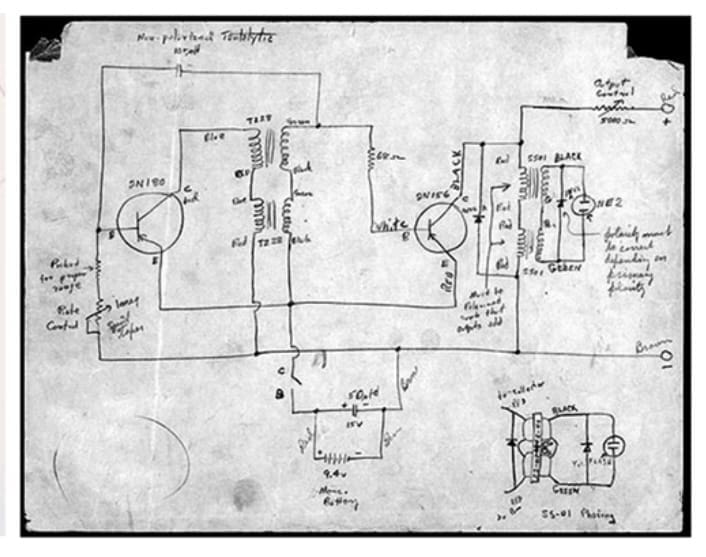
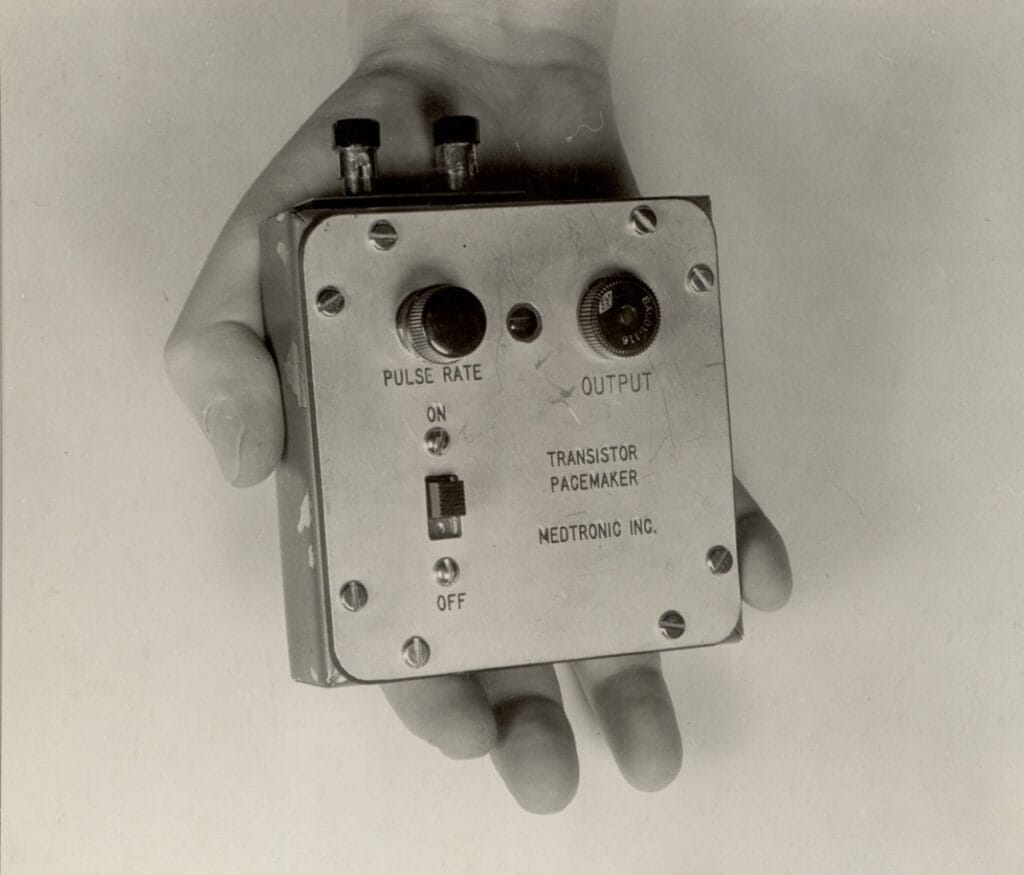
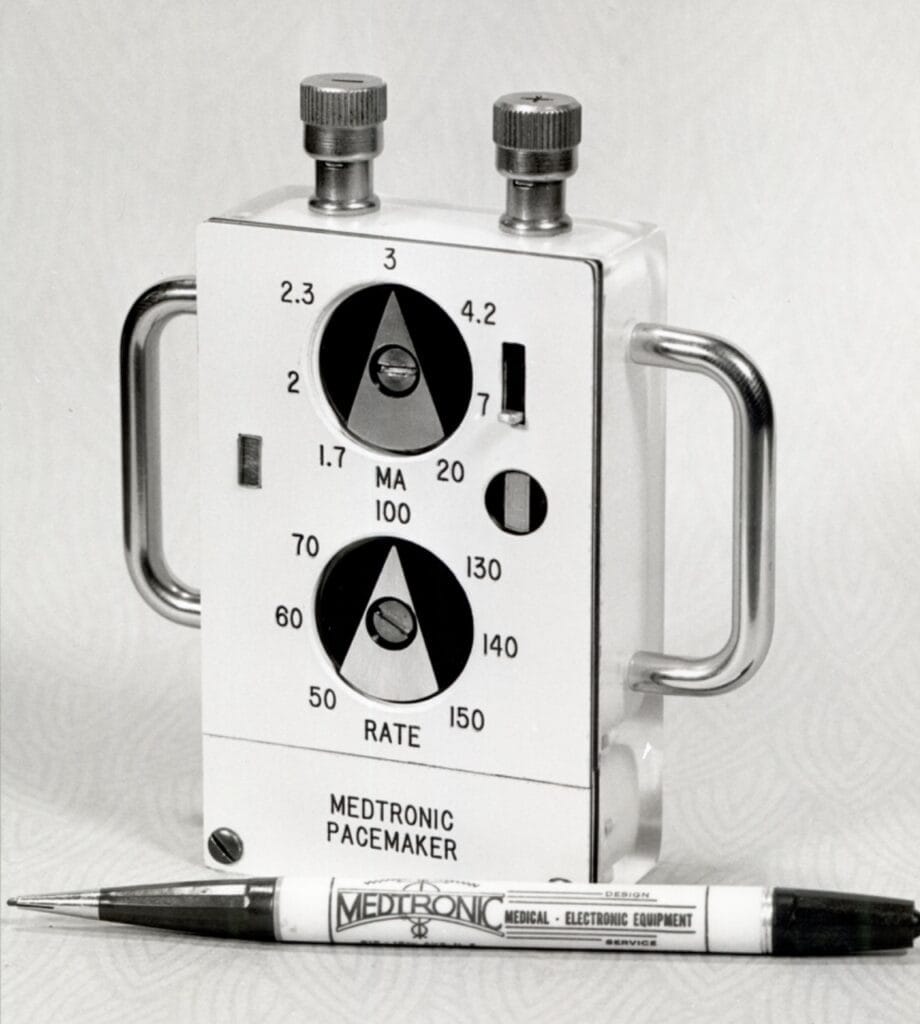
Bakken designed a circuit that was modified from a transistorized metronome he had seen in an issue of Popular Electronics magazine.3,4 The metronome circuit transmitted clicks through a loudspeaker, and the rate could be adjusted to fit the music using a block transistor oscillator circuit. Bakken’s design eliminated the loudspeaker and was powered by a 9.4-volt mercury battery housed in a 4 x 4 x 0.5-inch aluminum box with external terminals and switches. Transistors were unique because they either blocked current or allowed it to pass. This made them useful for pacemakers, which utilize periodic doses of electrical current to stimulate heart tissue and pace the heart, rather than provide a continuous flow of current. Transistors also allowed the device to be portable and efficient enough to run on batteries. The pacemaker had control knobs for heart rate, stimulus, and amplitude. It was tested in an animal lab and used successfully the next day in a child. In 1958, Model 5800 was updated with pediatric-specific modifications and metal handles so it could be worn.
Bakken wrote in his autobiography, “I was simply awestruck by the fact that electricity, properly applied, could do a great deal more than light up a room or ring a doorbell. I realized that electricity defines life.”5 The next generation of pacemakers, which were implantable, would not have been possible if not for Bakken’s ingenuity. Medtronic, the company he founded in a garage, developed many more applications under his leadership and is now one of the largest therapeutic companies in the world with annual revenues exceeding $30 billion.
In 1989, Bakken retired as Medtronic chairman. He received many honors, including the M.D. Honoris Causa from the University of Minnesota Medical School, the Eli Lilly Award in Medical and Biological Engineering from the Institute of Electrical and Electronics Engineers, the Laufman-Greatbatch Award from the Association for the Advancement of Medical Instrumentation Foundation, and a Trailblazer Award from the Scripps Center for Integrative Medicine. In 1999, the Society of Thoracic Surgeons received a grant to establish the Bakken Scientific Achievement Award to honor individuals who have made outstanding scientific contributions that enhance the practice of cardiothoracic surgery and patients’ quality of life.
Each year in December, Medtronic invites patients from all over the world to share stories with employees about how medical technology has changed their lives. Bakken established this tradition to inspire the next generation of engineers.
Bakken died in 2018 at the age of ninety-four, leaving a legacy that continues to empower biomedical engineers today.
References
- Chaikhouni K. “The magnificent century of cardiothoracic surgery part 8: reviving the dead,” Heart Views 2010 Jun;(11)2:85-91.
- Lillehei CW, Cohen M, Warden HE, Varko RL. “The direct-vision intracardiac correction of congenital anomalies by controlled cross circulation: results in thirty-two patients with ventricular septal defects, tetralogy of Fallot and atrioventricularis communis defects.” Surgery 1955; 38:11.
- Tofield A. “Earl E bakken and Medtronic,” European Heart Journal 2018 Jun;(39)22:2029-2030.
- Aquilina O. “A brief history of cardiac pacing.” Paediatr Cardiology 2006 Apr-Jun;8(2):17-81.
- Bakken E. One man’s full life. Medtronic 1999.
DR. AHMED NADEEM is a board-certified emergency physician and assistant professor of emergency medicine at Loyola University Medical Center in Maywood, Illinois. He also holds master’s degrees in both electrical and bioengineering, working as an artificial heart and balloon pump engineer and in stent design before his career as a physician.
One response
Communicating knowledge in clear, simple language is a valuable service in the modern era. The article “Earl Bakken: Pacemaker pioneer and founder of Medtronic” in Hektoen International Journal exemplifies this beautifully. It recounts the creation of the first wearable external pacemaker by Earl Bakken—a breakthrough that paved the way for today’s implantable pacemakers. Fittingly, Dr. Ahmed Nadeem is a most natural and qualified author for this narrative, given his background in engineering and academic research on the artificial heart.