Stephen McWilliams
Dublin, Ireland
Aficionados of Hercule Poirot and Miss Marple could do worse than read Carla Valentine’s Murder Isn’t Easy: The Forensics of Agatha Christie.1 In the book’s introduction, we’re reminded that Christie, the “Queen of Crime,” remains the world’s all-time bestselling novelist, outsold only by the Bible and Shakespeare. Valentine describes Christie’s dedication to lifelong learning, meaning that she kept up with ever-evolving scientific developments in forensic pathology over the course of more than half a century. Her sixty-six or so crime novels are replete with fingerprints, trace evidence, ballistics, handwriting expertise, wound impressions, bloodstain pattern analysis, and forensic toxicology. And we must not forget the all-important post-mortem examination or autopsy, whose purpose is to discover the cause of death.
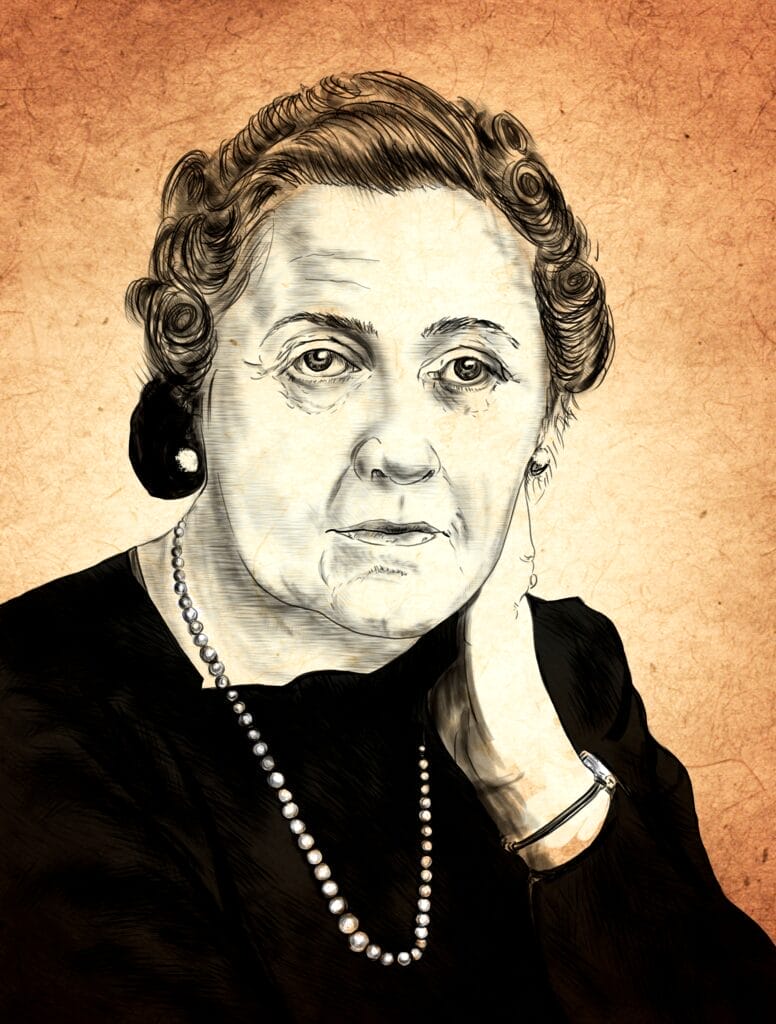
Born Agatha Miller in Devon, UK, in 1890, Christie would grow up to serve first as a nurse and then as a pharmacist during World War I and again in World War II. Her literary debut, The Mysterious Affair at Styles (1920), was the first of thirty-three novels and many short stories to feature her now-famous Belgian detective, Hercule Poirot.2 Of course, Edgar Allen Poe had already given us Detective Dupin in The Murders in the Rue Morgue (1841), while Sir Arthur Conan Doyle had offered up the inimitable Sherlock Holmes. But it was Christie’s first novel that heralded the onset of the “Golden Age” of detective fiction, with its extraordinary crimes in ordinary settings, carefully constructed central puzzles, gradually revealed secrets, finite suspect pools, and strong detective characters.3
Christie’s life was not devoid of its own puzzles. After the demise of her marriage to Archie Christie in 1926, she went missing for eleven days, eventually turning up in the town of Harrogate, Yorkshire, with an alleged case of amnesia.1 It made international headlines at the time, but Christie rarely, if ever, referred to it in her subsequent fifty years. She married the archaeologist Max Mallowan in 1930, and his work in northern Africa and the Middle East would influence many of her later novels. In 1952, her play The Mousetrap began the longest theatrical run in West End history. It took the Covid-19 pandemic to halt it in 2020. Christie was made a Dame of the British Empire in 1971 and died in 1976.
In The Mysterious Affair at Styles, Christie starts as she means to go on. Set in a Sussex country house barely a hundred miles away from the horror and chaos of the Western Front, the story sees the lady of the manor, Mrs. Emily Inglethorp, succumb dramatically in her bed to strychnine poisoning. Captain Hastings narrates the details of the murder and Poirot’s subsequent investigation, much as Dr. Watson does for Holmes. Christie’s esoteric knowledge of pharmacy, poisons, and inquests instantly brings the macabre story to life. For example, when Hastings visits the young Cynthia Murcoch at the Red Cross Hospital dispensary in Tadminster, he exclaims, “What a lot of bottles!” to which Ms. Murdoch groans, “Say something original,” adding, “Every single person who comes up here says that. We are really thinking of bestowing a prize on the first individual who does not say: ‘What a lot of bottles!’”4
The same is true of post-mortems. When they realize Mrs. Inglethorp is dead, two physicians—Dr. Wilkins, the local general practitioner and Dr. Bauerstein, “one of the greatest living experts on poisons” who just happens to be staying nearby—call for a post-mortem.5 Indeed, Dr. Bauerstein insists that “neither Dr. Wilkins nor myself could give a death certificate under the circumstances.”6 Later, at the inquest chaired by Coroner Wells and held at a local hotel, Christie’s esoteric knowledge is evident in Dr. Baurstein’s expert testimony: “In a few brief words, he summed up the result of the post-mortem. Shorn of its medical phraseology and technicalities, it amounted to the fact that Mrs. Inglethorp had met her death as a result of strychnine poisoning. Judging from the quantity recovered, she must have taken not less than three-quarters of a grain of strychnine, but probably one grain or slightly over.”7 Throughout the book, Christie educates the reader on strychnine, its uses, and its effects on the body. Like any apothecary, she knew all about poisons, which may be why at least thirty-five of her novels featured it as a means of murder.
In all her work, Christie consistently avoided graphic bodily description, surgical detail, or sensational forensic imagery, but instead focused on logic, testimony, timing, and human psychology. Post-mortems and inquests were also key, but they were not especially new. Although the post-mortem came into its own in the late eighteenth century, we could go back much further in history to trace its origins.
Dissections purely for the purpose of scientific discovery date back millennia, even though they were outlawed under Roman law.8 They were eventually legalized in some regions of Europe around the thirteenth century, and gained further popularity in the seventeenth century as people began to question the assumptive teachings of Hippocrates and Galen. Prominent seventeenth-century physicians who conducted post-mortems included the Italian anatomist and surgeon Marco Aurelio Severino (1580–1656) and the Dutch surgeon (and mayor of Amsterdam) Nicolaes Tulp (1593–1674). In 1761, the Italian anatomist Giovanni Batista Morgagni (1682–1771) published a report that described over 640 autopsies, entitled De Sedibus et Causis Morborum per Anatomen Indagatis [On the Seats and Causes of Diseases as Investigated by Anatomy]. His endeavor spawned the modern concept of pathology, where diseases are associated with abnormalities of bodily organs rather than an imbalance of fluids, humors, and so forth.
The mid-nineteenth century saw the scientific study of disease advance further with the work of the Austrian physician Karl von Rokitansky (1804–1878), who advocated strongly in favor of methodical dissection resulting in a documented autopsy report. He relied on gross inspection and dissection of the cadaver but did not use a microscope, unlike the German pathologist Rudolph Virchow who is often considered to be “the father of modern pathology.” Born on October 13, 1821 in Schivelbein, Pomerania, in what was then the Kingdom of Prussia, Virchow studied medicine at Friedrich Wilhelm University. Although his political activities sometimes got him into trouble, he ultimately became Chair of Pathological Anatomy at the University of Würzburg in 1849 and was heavily involved in the Institute for Pathology at the Charité Hospital in Berlin.
Virchow was a prolific writer who published some 2,000 papers during his lifetime and was the founder of various scientific journals.9 In 1847, he first coined the term leukaemia to describe a group of blood cancers that were observed to be associated with an excess of white blood cells. He also made the discovery that blood clots (thrombosis and embolism) were caused by changes in the stasis of blood flow (or turbulence), blood composition (hypercoagulability), and the walls of the blood vessels (endothelial injury) which, as any medical student will tell you, became known as Virchow’s Triad. He coined many other medical terms including neuroglia, agenesis, amyloid degeneration, and spina bifida.
Virchow normalized the use of microscopes to examine bodily tissues and in 1855 published a paper entitled Omnis Cellula e Cellula [Every Cell Stems from Another Cell]. As cellular pathology became established as a subspecialist field, Virchow described how tumors grow, expanding the concept that malignant tumors might one day be treatable. Virchow published his magnum opus in 1858, entitled Die Cellularpathologie, in which he asserted that many diseases arise from abnormal changes within cells that then divide and multiply. As such, the prevailing theory of disease moved from that of organs to that of cells. He died on September 5, 1902, aged eighty.
The late nineteenth century saw a student of Virchow make his mark on pathology. Friedrich von Recklinghausen (1833–1910) conducted further research on thrombosis, embolism, and infarction. In 1883, the German-Swiss pathologist and microbiologist Edwin Klebs (1834–1913)—also a student of Virchow—identified Corynebacterium diphthariae (sometimes called the Klebs-Lӧffler bacillus) as the bacterium that causes diphtheria. He also researched tuberculosis and typhoid, and the bacterial genus Klebsiella is named after him. It was the German pathologist Julius Cohnheim (1839–1884)—yet another student of Virchow—who came up with the idea of freezing and slicing tissues wafer-thin for examination under the microscope, something commonly done today (with added dyes and stains to enhance certain microstructures). Finally, Cohnheim’s student Carl Weigert (1845–1904) described the processes of degeneration and necrosis.
All of these discoveries paved the way for modern post-mortem examinations. So, next time you settle down to watch an episode of Poirot and witness David Suchet pontificating over some dead body on a golf course or in a well-appointed study, consider a journey that began with Marco Aurelio Severino and continues with the modern forensic pathology seen in television shows such as Crime Scene Investigation (CSI). It has taken the diligence and hard work of a long list of brilliant minds over the centuries to tell us how the average person today met their untimely end. But the public fascination with post-mortem that still exists owes more than a little to the crime novels of Agatha Christie.
End notes
- Carla Valentine, Murder Isn’t Easy: The Forensics of Agatha Christie (London: Sphere, 2022), 2–3.
- Agatha Christie, The Mysterious Affair at Styles (London: HarperCollins, 1920).
- Edgar Allen Poe, “The Murders in the Rue Morgue,” in Selected Tales (Oxford: Oxford University Press, 1980), 105–135.
- Christie, The Mysterious Affair at Styles, 20.
- Christie, The Mysterious Affair at Styles, 15.
- Christie, The Mysterious Affair at Styles, 36.
- Christie, The Mysterious Affair at Styles, 99.
- Steve Parker, Medicine: The Definitive Illustrated History (London: Dorling Kindersley 2016), 152–153.
- Jane Buikstra and Charlotte Roberts, The Global History of Paleopathology: Pioneers and Prospects (Oxford: Oxford University Press, 2012), 388–390.
STEPHEN MCWILLIAMS is a consultant psychiatrist at Saint John of God University Hospital Dublin, associate professor at UCD School of Medicine, and honorary senior lecturer at RCSI University of Medicine and Health Sciences. His books include Fiction and Physicians: Medicine through the Eyes of Writers (Liffey Press, 2012) and Psychopath? Why We Are Charmed by the Anti-Hero (Mercier Press, 2020).