
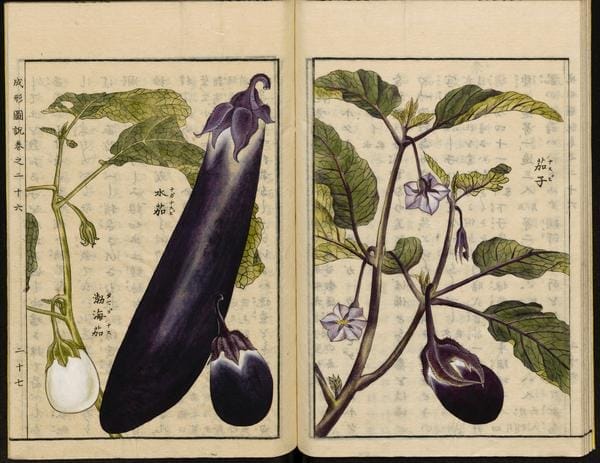
The eggplant belongs to the genus Solanum of the nightshade family Solanaceae, along with the tomato and potato. Botanically it is a fruit, specifically a berry, though it is treated like a vegetable in the kitchen. Also belonging to the Solanum genus are chili peppers, as well as the poisonous Atropa belladonna and Datura stramonium (jimson weed). Eggplants contain small and pharmacologically insignificant amounts of nicotine, requiring about 10 kg of eggplant to obtain the equivalent of one cigarette. The Italian word for eggplant is melanzana, derived from “mela insana” or “mad apple,” because it was thought capable of causing insanity or “melancholia.” Its Linnaean name is Solanum melongena.
Historically, the eggplant originated in ancient India and China, where it first grew wild and was later cultivated for culinary and medicinal uses. Around the 9th to 10th centuries, Arab traders took eggplants to the Mediterranean, especially to Spain and Italy. From there, they were introduced to other parts of Europe. They reached America in the 1700s, were cultivated by Thomas Jefferson among others, and are still growing at Monticello.
The eggplant is so called because early American varieties were small and round like goose eggs. In England the eggplant is called aubergine, a name derived from Sanskrit and Arabic. Elsewhere, eggplants have been called melitzana, albergínia, baingan, brinjal, vinette, or patagial. Throughout the world, in all kinds of restaurants and ethnic settings, eggplants are served and eaten as eggplant parmigiana, moussaka, ratatouille, caponata, imam baildi, or zacusca. Baba ghanoush is a variety of eggplant salad or spread made with tahini and possibly other ingredients.
According to purists, plain eggplant salad or spread should be served with tomatoes and olives, salted and with olive oil and perhaps onions, but nothing else added. My mother used to serve it when I was a child, and my father would complain that it never tasted quite like that made by my grandmother. Disagreements often arise on whether eggplants should be valued for their own flavor or for the spices added to them.
Eggplants are low in calories (about 25 calories per cup) and are primarily a source of carbohydrates, with a little protein and moderate amounts of fiber, vitamins, and minerals. Their usual deep color and bitter taste is due to a substance found in their skin and is called nasunin, a pigment in the anthocyanin family believed to protect the brain against oxidative damage. Also found in the eggplant is chlorogenic acid, which appears to have antimicrobial, antiviral, and anti-cancer properties, at least in laboratory studies. Eggplants also contain oxalates, which could contribute to kidney stone formation in susceptible individuals.
The eggplant’s reputation is believed to have shifted in the ninth century from poisonous to prestigious thanks to Buran, the wife of the caliph al-Ma’mun. At their lavish wedding banquet, she served a delicious dish of fried eggplant. The dish was so successful that many eggplant recipes known as burraniyat are still named in her honor in the Arab world. Several versions of salad dips can now be bought conveniently packaged. They often have various ingredients added to them, which according to purists does not bring out the flavor of the eggplant fruit itself.