Matthew Hill
Abdullah Mubarik
Julius Bonello
Peoria, Illinois, United States
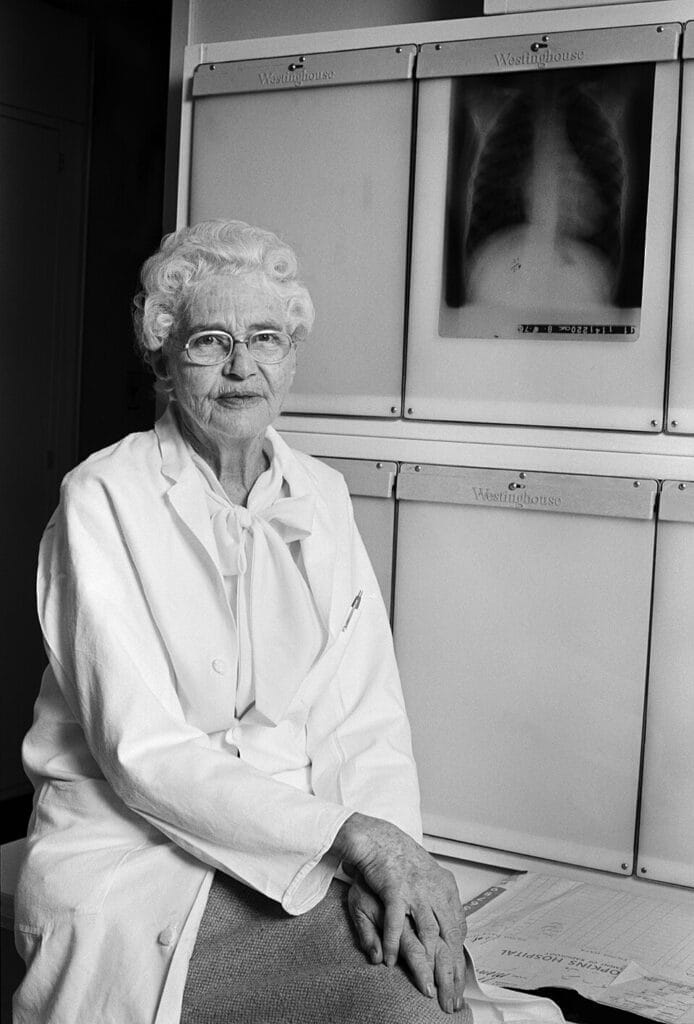

Standing outside of the operating room, Helen Taussig was beside herself. Fifteen-month-old Eileen Saxon, a “blue baby” born with a congenital heart malformation that deprived the body of oxygenated blood, was undergoing a procedure that Taussig had conceived and recommended to the surgeon. Despite the surgeon’s success with the procedure in the dog lab, this would be the first time it would be attempted on a human being. After several tense hours, she was able to see the infant in the recovery area. To her delight, the child, who was previously pale and cyanotic, now appeared healthy and well oxygenated. Relieved, she knew she had been right. The procedure was a success.
Helen Taussig (1898–1986) was born on May 4, 1898, in Cambridge, Massachusetts. She was the fourth child born to Frank and Edith Taussig. Her mother was one of the first graduates of Radcliffe College, where she majored in biology and zoology. Her father, a distinguished economics professor at Harvard University, served as a financial advisor to President Woodrow Wilson. At the age of eight, Helen’s mother died of tuberculosis (TB), leaving her father to raise her. Her own childhood was marked by mediastinal TB, dyslexia, and deafness secondary to a middle ear infection. Her father played a significant role in helping her manage and overcome her dyslexia, collaborating closely with her throughout childhood. This help allowed her to overcome mediocre grades and matriculate into Radcliffe College in 1917. She later enrolled at the University of California at Berkeley, graduating in 1921 with a BA and induction into the Phi Beta Kappa honor society.
Returning to New England, she wished to continue her education at Harvard but was denied admission: Harvard did not admit women until 1945. Instead, following her father’s wishes, she enrolled in the Harvard School of Public Health, but soon realized she would be denied a degree. She left and entered Boston University to study biological sciences. There she took classes in microbiology, histology, and anatomy, always sitting in the back row and separated from the male students. In anatomy, while studying a bovine heart, she was amazed at the thickness of the ventricular walls. Her written treatise and presentation were so detailed and comprehensive that her impressed professor advised her to apply to medical school at Johns Hopkins in Baltimore, the only major American medical school that had accepted women since its founding in 1893.
She obtained her MD from Johns Hopkins in 1927 at the age of twenty-nine. She wanted to be an internist, but all the medical residency spots had already been filled. She opted instead for a pediatrics residency at Johns Hopkins. During this time, she came under the mentorship of Dr. Edward Park, the new chair of pediatrics.
Dr. Park had left Hopkins in 1921 to establish a pediatric residency program at Yale. Upon returning to Baltimore, he began to institute outpatient pediatric subspecialty clinics, a novel concept at the time. Because rheumatic fever was the most common cause of cardiac disease in children, New York had the first pediatric clinic for rheumatic heart disease, but Baltimore had none. Park recognized the need for a dedicated pediatric cardiac clinic in Baltimore. His longstanding interest in congenital heart disease had also led him to collaborate with Maude Abbott, the foremost authority on cardiac malformations.
During her residency, Taussig rotated through the newly established cardiac clinic, then directed by Dr. Clifton Leech. The experience sparked her interest in pediatric cardiology, though she still felt inexperienced. In the summer of 1929, she traveled to New York City for additional training in communicable diseases at Willard Parker Hospital. While she was away, Dr. Park wrote to her, encouraging her to return to Hopkins to take over leadership of the cardiac clinic after Dr. Leech stepped down. She hesitated, writing back with a characteristically frank and modest reply: “I fear it is not for the best interest of any concern for me to accept your offer. In the first place, I realize my own limitations too keenly, and I need more hospital experience. My experience in dealing with acute cardiac conditions in children is virtually nil.”
Shortly afterward, Taussig traveled to Boston Children’s Hospital for another extramural educational experience. She later spoke highly of her time there with cardiologists such as Paul Dudley White and of meeting Maude Abbott, who demonstrated congenital cardiac malformations during her famous “wet clinics.” Park again wrote, “I am filled with enthusiasm at the thought of your being here in charge of the heart clinic … I shall let you re-organize things in any way that seems best. I have the greatest confidence in you and believe you are your father’s daughter.”
The meeting with Maude Abbott was a turning point in Taussig’s life. Six days later, she wrote to Dr. Park: “The dye [sic] was cast last night in favor of Baltimore. You know without me telling you that professionally I am tremendously glad to come back to your department and very much appreciate the opportunity you offer me. I hope and shall try hard to make the most of my opportunities and not disappoint you.”
In 1930, Taussig accepted the role as head of the children’s cardiac clinic at the Harriet Lane Home, which Dr. Park had established at Hopkins. Because of her worsening deafness from her childhood ear infection, she could not rely on her stethoscope alone to diagnose heart conditions. Though she initially got by with hearing aids, she knew her hearing was worsening. As she listened with the stethoscope, she also would feel the chest. She eventually developed the skill of “listening with her fingertips,” allowing her to detect conditions as accurately as physicians with normal hearing.

While the clinic was initially focused on rheumatic heart disease, Taussig had always been fascinated with congenital heart disease. She and Abott frequently attended symposiums on the topic, and in 1936, she presented “Two Cases of Congenital Malformation of the Heart Due to Defective Development of the Right Ventricle” at the International Association of Medical Museums. Hence, the clinic quickly became an epicenter for treating children with congenital heart malformations. One condition, tetralogy of Fallot, particularly interested Taussig. In this condition, the pulmonary artery is narrowed, causing inadequate blood flow to the lungs and therefore low oxygen in the bloodstream. A common cause of “blue baby syndrome,” infants with this condition appear blue after birth. Taussig noted that while these children often died quickly, some survived for years. As she pondered why, one particular child caught her interest. This child had an exceptionally large patent ductus arteriosus (PDA), a vessel only found in newborns that usually closes shortly after birth. This artery bypasses the pulmonary artery and allows for blood from the body to be diverted into the lungs. She quickly became fascinated with the role of the PDA children with tetralogy of Fallot and theorized that having a PDA allowed certain children to survive for longer periods of time. This proved to be Taussig’s first big breakthrough, as she used autopsies and research to identify the critical role of the PDA in bringing blood to the lungs of children with tetralogy of Fallot. She theorized that surgically building a permanent shunt like a PDA in these children could solve the issue of oxygenation of the blood.
At this time, Hopkins had just appointed Dr. Alfred Blalock as the new chief of the department of surgery. Previously at Vanderbilt University, he and his technician Vivien Thomas created an animal model to study pulmonary hypertension. Taussig approached the two, asking if they could surgically create an artificial shunt in the blue babies. This was a novel idea at the time, as there had never been an operation done on the heart for a congenital pediatric heart condition. However, Blalock and Thomas saw the vision Taussig had and took on the project. After successfully constructing a model for tetralogy of Fallot in dogs, they surgically added a shunt between the subclavian and pulmonary arteries. After doing this, blood oxygenation increased appropriately. A success!
Eileen Saxon’s success story soon followed, and the Blalock-Taussig shunt became world famous. The two spent time touring the world, teaching experts in cardiology and surgery about the procedure at many conferences and lectures.
While the Blalock-Taussig shunt was possibly the biggest breakthrough in her career, it was not the only contribution Taussig made. She would continue clinical practice and research for many years on congenital heart disease. In 1947, she published Congenital Malformations of the Heart, which became the standard textbook for pediatric cardiology and surgery. In the early 1960s, Taussig also played a vital role in establishing the link between thalidomide, a medication mothers in Europe were taking for morning sickness, and severe limb deformities in children. Her testimony before the US Congress helped prevent the drug’s approval in the United States, protecting an entire generation from being born with devastating congenital limb defects.
Upon formally retiring from Hopkins in 1963, she continued to teach for another decade and later moved to Pennsylvania. There, she pursued studies of avian cardiac development well into her eighties. She would continue to visit Hopkins after her retirement, including a visit in 1983 when the cardiac clinic was renamed the “Helen B. Taussig Children’s Heart Center”. The clinic continues under this name today. She earned many honors, including the Albert Lasker Award (1954), Presidential Medal of Freedom (1964), and becoming the first woman president of the American Heart Association (1965).
On May 20, 1986, while driving with a friend after casting her vote in the Pennsylvania primary election, Taussig failed to see an oncoming car while turning onto Route 1. She sadly died of her injuries shortly afterwards, just four days shy of her 88th birthday. Taussig never married and had no children, but she trained generations of cardiologists around the world. Her legacy endures in the Helen B. Taussig Division of Pediatric Cardiology at Johns Hopkins, a memorial lecture in her name, and ongoing awards and research that carry forward her dedication to children’s heart health.
References
- Dunn PM. Dr Helen Taussig (1898–1986): pioneering American pediatric cardiologist. Arch Dis Child Fetal Neonatal Ed. 2008;93:F74–6.
- Evans W. Helen Taussig and Edwards Allen Park: the early years (1927–1930). Cardiol Young. 2010;20:387–95.
- Evans WN. The relationship between Maude Abbott and Helen Taussig: connecting the historical dots. Cardiol Young. 2008 Dec;18(6):557–64. doi: 10.1017/S1047951108002771. Epub 2008 Oct 9. PMID: 18842160.
- Meisol P. Helen B. Taussig, MD (1898–1986). Cardiology. 2022;147(2):230–2. doi: 10.1159/000520908. Epub 2021 Nov 15. PMID: 34991095.
- Van Robays J. Helen B. Taussig (1898–1986). Facts Views Vis Obgyn. 2016 Sep;8(3):183–7. PMID: 28003874; PMCID: PMC5172576.
MATTHEW HILL is a third-year medical student at the University of Illinois College of Medicine Peoria (UICOMP). His career interests include gastroenterology, internal medicine, and surgery.
ABDULLAH MUBARIK is a third-year medical student at the University of Illinois College of Medicine Peoria (UICOMP). He is interested in pursuing a career in surgery.
JULIUS BONELLO, MD, is Professor Emeritus at the University of Illinois. He has been teaching students for 50 years