Jayant Radhakrishnan
Chicago, Illinois, United States
“You’ve probably never heard of Dr. Yellapragada SubbaRow. Yet because he lived you may be alive and well today. Because he lived you may live longer.”
—Doron Kemp Antrim, April 19501
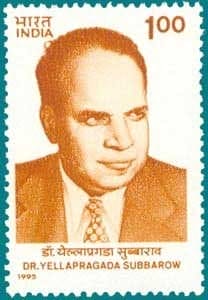
The first of Yellăprăgădā SubbăRow’s seminal contributions at Harvard was the colorimetric Fiske-SubbaRow assay for phosphorous in tissues. It led to the discovery of phosphocreatine and adenosine triphosphate (ATP)2 and refuted the Nobel prizewinning theory that glycogen provided energy for muscular contraction.3 The assay is used today to monitor renal failure, vitamin D deficiency, hypo- and hyper-parathyroidism, Fanconi syndrome, and prostate cancer. Next, SubbaRow turned his attention to the actions of liver extract in various diseases. He determined that pernicious anemia of pregnancy was due to folic acid deficiency, while malabsorption of folates (vitamin B9) and cyanocobalamin (vitamin B12) in tropical sprue resulted from overgrowth of harmful intestinal bacteria. He also recognized that black tongue disease in dogs and pellagra in humans occur due to deficiency of niacin (nicotinic acid/vitamin B3).4,5 Then he developed antifolates, such as aminopterin, to treat acute lymphoblastic leukemia.6 Later he modified aminopterin into the less toxic methotrexate, which is used today to treat malignancies, rheumatoid arthritis, psoriasis, for palliation of Crohn’s disease, and as an abortifacient in ending ectopic pregnancies. It may also help reduce the dose of steroids in asthma.
Upon moving from Harvard to Lederle Laboratories (now part of Pfizer), SubbaRow and his associates worked feverishly for three years and developed numerous vitamins, but they failed to circumvent preexisting patents and Lederle lost out to other manufacturers. Next, he moved on to antibiotics. René Dubos, a soil microbiologist at the Rockefeller Institute, had isolated a spore-forming bacillus that destroyed most Gram-positive bacteria. To honor Hans Christian Gram of Gram stain fame, Dubos named it gramicidin without realizing that it could mean “kill Gram” (Latin cide = to kill). Although effective, it was extremely toxic when administered intravenously.7 After purification by SubbaRow and Henry Piersma, it was usable when applied topically for superficial infections and post-surgical wounds, but it caused problems when used to treat mastitis in cows.
SubbaRow then set up a penicillin production plant that became very profitable for Lederle. When American forces were exposed to filariasis in the Pacific theater during World War II, he tested 517 compounds and found one, derived from piperazine, effective against the larval stage, but not the adult worm. He added a second ethyl fraction and rendered it effective against both stages, and in 1947 Redginal Hewitt presented hetrazan to the world.8 In combination with ivermectin, it is still the drug of choice for filariasis. By studying numerous soil samples from around the country, SubbaRow found Bacillus polymyxa. And Dr. Perrin Long at Johns Hopkins found polymyxin, the antibiotic derived from it, to be more effective against Gram-negative bacteria than streptomycin. It was also effective against undulant fever, whooping cough, and meningitis, but SubbaRow abandoned it because of its renal toxicity. As the antibiotic search continued, Benjamin Minge Duggar isolated the first broad spectrum antibiotic, aureomycin (chlortetracycline).9 It was administered orally and was effective against Gram-positive and Gram-negative organisms, rickettsia, chlamydia, and lymphogranuloma venereum. In its latest iteration as doxycycline, it is also effective against malaria and plague.
SubbaRow’s scientific achievements are documented, but little is known about him personally. The first biography was published decades after his death based upon information obtained from family and friends by Gupta and Milford.10 All other publications use the same information.11,12,13
He was born into a very poor family on January 12, 1895 in Bhimăvărăm in the Madras Presidency of British India (now in Andhra Pradesh). He died in bed on Sunday night, August 8, 1948 in Pearl River, New York after a full day at work. At thirteen years of age, he convinced a cousin to run away with him to the holy city of Kāshi (Vārānăsi), where he planned to become rich by selling bananas to pilgrims while eating free meals at various dhărămshālās (Sanskrit dhărăm = religious, shālā = abode). His mother got wind of the plan and dispatched emissaries who intercepted and brought the boys home. When asked why he ran away he answered, “I must win a name in the world. Then only would life be worthwhile. If it comes to that, one must even be prepared to do something evil and win fame.”14 She forced him to study against his will, and he repeatedly failed to graduate from high school. Just before his third attempt, his father died. When he went home for the funeral, his mother had to sell jewelry to buy railway tickets for him to go back to Madras (now Chennai) to complete his examinations.
His next two years at Presidency College in Madras were academically uneventful but he developed an interest in a religious institution, the Rāmăkrishnā Mission, and wanted to become a sănyāsi (Sanskrit, monk). His mother was adamantly against it, so the monks advised him to become a doctor to serve people. He signed up at the Madras Medical College in 1915 without any interest in medicine. His education was initially subsidized by a friend who informed him in 1919 that he could no longer help, so SubbaRow married the granddaughter of a rich man who supported him financially. Subsequent events indicate a distinct lack of interest in domestic life, but he did pay back the money with interest. In time he became disenchanted with the Ramakrishna Mission’s basic concept15 and applied himself to his studies. He graduated in 1921 with the lesser degree of LMS (Licentiate in Medicine & Surgery) instead of the standard MBBS (Bachelor of Medicine, Bachelor of Surgery).
Legend has it that, having joined Mahatma Gandhi’s swădēshi (Hindi svă = self, dēsh = country) movement of self-reliance and boycotting of British products including clothes, he began wearing scrubs made of home-spun cotton (Khādi). This bothered the professor of surgery, M.C. Bradfield, who told him, “Wait until Gandhi becomes Viceroy.” SubbaRow answered, “Gandhiji will not condescend to be Viceroy.” This resulted in poor marks on the surgery final examination.16 The anecdote could definitely be true except that there is no record of a professor of surgery named M.C. Bradfield. Ernest William Charles Bradfield was appointed professor of surgery at Madras Medical College, but not until 1924, three years after SubbaRow graduated,17 and he was well respected by his students.18 It is doubtful that SubbaRow would have graduated at all if he had failed in surgery, as reported in the other biography.19
While studying medicine, SubbaRow was afflicted with severe tropical sprue but survived upon treatment with Āyŭrvēdic (Sanskrit Āyŭs = life or longevity, vēdă = science) medicines. Two of his brothers who suffered from it died15 (it was not only his older brother Pŭrŭshottăm who died20). His older brother Purushottam’s death was an especially severe blow, for SubbaRow idolized him and he was also trying to finance SubbaRow’s trip to the United States. Once these plans fell through, SubbaRow applied for a job in the Madras Provincial Medical Service, but he was not hired. Therefore, he took a job as lecturer in anatomy and physiology at the Madras Ayurvedic College, where he compiled a 427-page manuscript on the herbal drugs of North India, but soon realized that he could not carry out any significant research there. He met James Frank Kendrick21 (not John Fox Kendrick22), a hookworm researcher in the tea estates of South India, who suggested that he apply for admission at the Harvard School of Tropical Medicine. Dr. Richard Pearson Strong, of Philippine plague epidemic notoriety,23 accepted SubbaRow in the program provided he would give up his plans to study herbs and would finance his own travel to the US. Upon obtaining the necessary finances and convincing his pregnant wife that he would return in three years, SubbaRow left for the US, apparently after taking a verbal swipe at an Englishman at the customs office in Bombay (now Mumbai). The officer asked him, “What do you want to get an American education for?” He replied, “I am going to come back and take your job.”24
He was destitute when he landed in Boston on October 26, 1923, so he cleaned bed pans and urinals at Peter Bent Brigham Hospital (now Brigham and Women’s Hospital) for three hours every night to earn money. Strong helped financially and also tried, unsuccessfully, to find SubbaRow a better paying job. Others who were aware of his abilities chipped in, but dire circumstances persisted until the phosphocreatine study was published. That is when “Subbarow” became “SubbaRow”, and his financial status improved somewhat as he received a Rockefeller Fellowship. However, Harvard’s rigid hierarchy prevented his moving up in the system, and President Woodrow Wilson’s Immigration Act of 1918 labeled him an undesirable alien. He had to carry his alien registration card even when developing medicines for the US government during World War II. After President Harry Truman signed the Emanuel Celler Act (PL-483) in July 1946 lifting the ban on Indians from becoming citizens, he filled out citizenship papers but never submitted them.
Interestingly, contrary to his earlier statement to his mother, “Without money, we can do nothing good for anyone,”25 when William Brown Bell recruited him to Lederle with a salary increase amounting to more than five times his remuneration at Harvard, he told Bell that he would come for half the amount if Lederle built him a state-of-the-art laboratory. To Bell’s credit, he built the laboratory and gave SubbaRow the originally promised salary. SubbaRow also became less interested in achieving fame and gave credit to others. He tried unsuccessfully to help Charles Hartwell Fiske get promoted in 1935 by stating that the Fiske-SubbaRow method was all Fiske’s idea and that he had only been an “extra pair of hands.”26 There is some question whether Fiske returned the generosity, as a colleague of theirs, Nobel laureate George Hitchings, is reported to have stated that “some of the nucleotides isolated by Subbarow had to be rediscovered years later by other workers because Fiske, apparently out of jealousy, did not let Subbarow’s contributions see the light of the day.”27 SubbaRow even let others decide whether to append his name on presentations and in what order, as he now believed, “The victories of science are rarely won singlehandedly. No man should get the entire credit.”28
SubbaRow’s unorthodox thinking was obvious from his childhood escapade. Another later example was his trapping street cats at night while at Harvard, as there was no money to buy animals for experiments. His self-confidence was such that if an associate had a problem in a project, he took it over and solved it himself instead of looking for an expert. He believed there was always more than one way to achieve an objective, and he made researchers try different methods simultaneously, expecting one of them to work.
His capacity to work extremely hard after deciding on a course of action got him through his medical education, even after frittering away the initial years. In the US, he worked all day every day, including on weekends and holidays, and he expected the same of “Sub’s boys” whose wives were known locally as “SubbaRow’s widows.”29 He looked beyond credentials to find associates who could solve problems. To develop aureomycin he convinced Duggar, a retired authority on mushrooms and fungal diseases of plants who was more than seventy years old, to come out of retirement and paired him with Joseph G. Niedercorn, a leather technologist, to carry out the fermentation. When Niedercorn protested, “What do I know about microbes?” SubbaRow retorted, “You can at least try.”30 Charles Pidacks, an organic chemist, was added to the team to isolate antibiotics from the fermented fluids, and George Krupka, who had a degree in mathematics and joined the laboratory as a janitor after working in his uncle’s construction company, was instructed to assist Pidacks.
When he left India, he possibly meant to return in three years. He checked on and rejected a job in Calcutta (now Kolkata) at the All-India Institute of Hygiene and Public Health because it did not give him unfettered freedom to pursue research. When his family pressed him repeatedly to return, he informed them that he had annulled the marriage and was remarried. Only after his death did they find out that this was untrue. He did have close relationships with three women in the US. The first was Dr. Vilma Prochownick, who had escaped from Germany and landed in his laboratory. She was brilliant and improved the efficiency of his laboratory for three years. Unfortunately, she developed pneumonia and relocated to Colorado for rehabilitation. While recovering, she developed an interest in literature and library science and became a medical librarian. He never reconciled to her abandoning scientific research. The second was Anne Schivek-Mowat, who discovered biotin. She too fell ill and had to leave its development to others. The third was Doris McKenzie, who got him involved with the Emmanuel Baptist Church of Ridgewood, New Jersey and the social life of New York.
While he was no longer enamored with the Ramakrishna Mission, he was not averse to attending a church or donating to it without converting to Christianity.31 It is incorrect to label him a nocturnal recluse who was “befriended only by other nocturnal recluses” or that he “huffed off to join Lederle Labs” because he was denied tenure at Harvard.32 Obviously his work left little free time, but he had meals with his colleagues when possible, spent time with their children in various activities, learned boxing, tennis, golf, archery, horseback riding, and swimming, tried bowling until he was informed that it was “open only to the Caucasian race,” and bought an airplane that he learned to fly.33 He even went deep sea fishing with his Harvard colleagues and endured terrible sea sickness.34 His colleagues clearly liked and respected him because when he was recruited to Lederle, some accompanied him, and others joined him later.
References
- Antrim DK (1950). Miracle man of the miracle drugs. Argosy 330(4):52-54, 90-92. Cited in Yellapragada SubbaRow – Miracle Man of Miracle Drugs, Evelyn Publishers, https://web.archive.org/web/20230601164504/http://www.ysubbarow.info/www/index.php.
- Simoni RD, Hill RL, Vaughan M (2002). The determination of phosphorous and the discovery of phosphocreatine and ATP: The work of Fiske and SubbaRow. J Biol Chem. 277(32):e1-e2.
- The Nobel Prize in Physiology or Medicine 1922. NobelPrize.org. Nobel Prize Outreach 2025. Accessed Sept 28, 2025. https://www.nobelprize.org/prizes/medicine/1922/summary/
- Jacobson BM, Subbarow Y (1937). Studies of the principles in liver effective in pernicious anemia IV. The therapeutic activity of its multiple factors. J Clin Invest. 16(4):573-585. https://doi.org/10.1172/JCI100884
- Miner RW (Ed), SubbaRow Y (Consulting Ed), Demarest M (Associate Ed) (1946). Folic acid. Ann New York Acad Sci. 48(5):255-350.
- Radhakrishnan J (2025). Leukemia: White blood. Hektoen International Blood Summer 2025. https://hekint.org/2025/09/08/leukemia-white-blood/
- Van Epps HL (2006). René Dubos: Unearthing antibiotics. J Experimental Med. 203(2):259. jem.org/cgi/doi/10.1084/jem.2032fta
- Santiago-Stevenson D, Oliver-Gonzalez J, Hewitt RI (1947). Treatment of filariasis bancrofti with 1-diethylcarbamyl-4-methylpiperazine hydrochloride (hetrazan). JAMA 135(11):708-712. doi: 10.1001/jama.1947.02890110026007
- Duggar BM (1948). Aureomycin: A product of the continuing search for new antibiotics. Annals: New York Acad Sci. 51(2):177-181. https://doi.org/10.1111/j.1749-6632.1948.tb27262.x
- Gupta SPK, Milford EL (2002). In quest of panacea: Successes and failures of Yellapragada SubbaRow. New Delhi, India, Evelyn publishers. Copyright 1987. 2nd edition, abridged by author.
- SPK Gupta Papers. Archives of Contemporary India. https://archives.ashoka.edu.in/paper_details/205
- Gupta SPK (1976). An Indian scientist in America: The story of Yellapragada Subba Row. Bull Indian Inst Hist Med Hyderabad. 6(2):128-143.
- Narasimhan R (2003). Yellapragada Subbarow-A life in quest of panacea. Yellapragada Subbarow Archives. Available via https://web.archive.org/web/20230601145003/http://www.ysubbarow.info/www/
- Gupta and Milford, In quest of panacea, 26-27.
- Narasimhan, Yellapragada SubbaRow, 138-141.
- Gupta and Milford, In quest of panacea, 54.
- Bradfield, Sir Ernest William Charles (1880-1963). Plarr’s Lives of the Fellows. Royal College of Surgeons of England. https://livesonline.rcseng.ac.uk/client/en_GB/lives/search/results?qu=%22RCS: E004914%22&rt=false|||IDENTIFIER|||Resource+Identifier. Accessed October 8, 2025.
- Cherian PV (1963). Lieutenant-General Sir Ernest Bradfield. Brit Med J obituary, November 30. 5369(2):1414. https://doi.org/10.1136/bmj.2.5369.1414
- Narasimhan, Yellapragada SubbaRow, 24.
- Gupta and Milford, In quest of panacea, 59.
- Kendrick JF (1929). The treatment of hookworm disease with tetrachlorethylene. American Journal of Tropical Medicine. 9(6):483-488.
- Gupta and Milford, In quest of panacea, 58.
- Campbell KA (1994). Knots in the fabric: Richard Pearson Strong and the bilibid prison vaccine trials, 1905-1906. Bull Hist Med. 68(4):600-638.
- Gupta and Milford, In quest of panacea, 67.
- Gupta and Milford, In quest of panacea, 54.
- Gupta and Milford, In quest of panacea, 112.
- Parthasarathy R (2003). Discoverer of miracle medicines- Y. Subba Row (1895-1948). The Hindu. March 13, 2003.
- Gupta and Milford, In quest of panacea, 35.
- Gupta and Milford, In quest of panacea, 127-128.
- Gupta and Milford, In quest of panacea, 187.
- Narasimhan, Yellapragada SubbaRow, 141-143.
- Mukherjee S (2010). The emperor of all maladies. A biography of cancer. Part One: “Of blacke cholor, without boyling” New York, Scribner. 31.
- Gupta and Milford, In quest of panacea, 198-206.
- Narasimhan, Yellapragada Subbarow, 49.
JAYANT RADHAKRISHNAN, MBBS, MS (Surg), FACS, FAAP, completed a Pediatric Urology Fellowship at the Massachusetts General Hospital, Boston following a Surgery Residency and Fellowship in Pediatric Surgery at the Cook County Hospital. He returned to the County Hospital and worked as an attending pediatric surgeon and served as the Chief of Pediatric Urology. Later he worked at the University of Illinois, Chicago from where he retired as Professor of Surgery & Urology, and the Chief of Pediatric Surgery & Pediatric Urology. He has been an Emeritus Professor of Surgery and Urology at the University of Illinois since 2000.