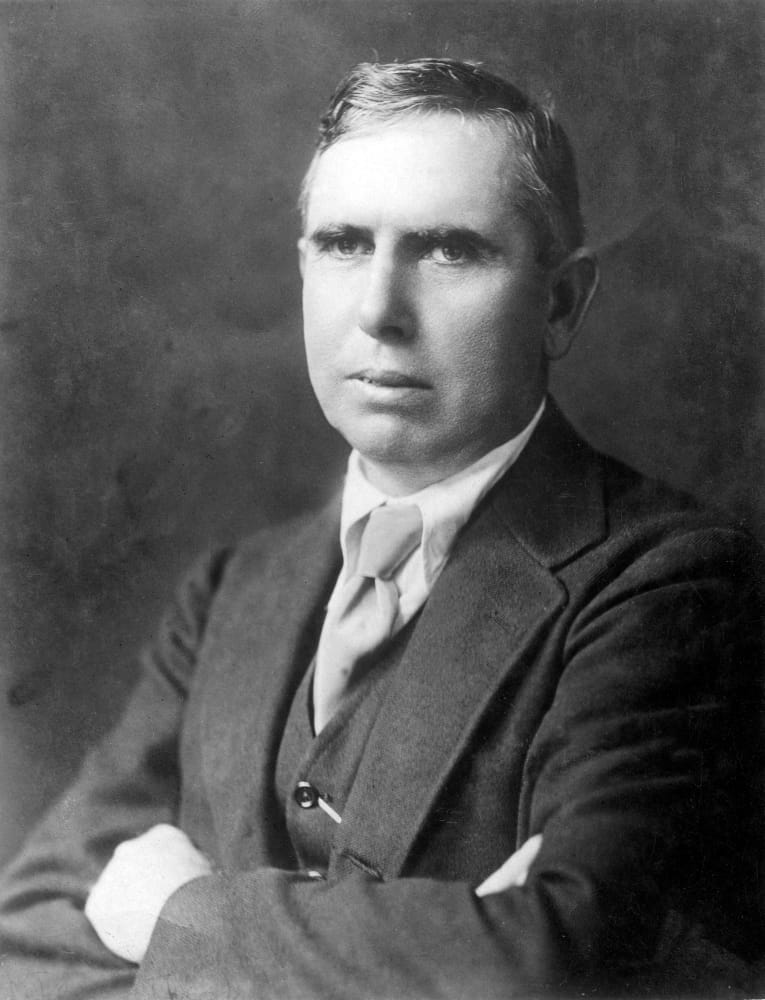

Theodore Dreiser (1871–1945) occupies a unique and often controversial place in American literature. Best remembered for his unflinching realism, his exploration of ambition, desire, and social constraint, and his massive, detail-laden novels, Dreiser was both acclaimed and censured during his lifetime. His works, particularly Sister Carrie (1900) and An American Tragedy (1925), stand as landmark contributions to naturalism in American letters, depicting human beings as products of social forces, economic conditions, and unconscious impulses. Though sometimes criticized for heavy prose and lack of polish, Dreiser’s writing pushed the boundaries of literary convention and provided a raw, almost clinical portrait of modern life.
Born in Terre Haute, Indiana, Dreiser grew up in poverty as the ninth of ten surviving children. His father, a strict Catholic of German descent, struggled to support the family, while his mother, though more gentle, endured hardship and loss. This difficult upbringing instilled in Dreiser a sense of social injustice and a fascination with the struggles of ordinary people—concerns that would animate his later work.
After attending Indiana University briefly, Dreiser left without a degree and drifted through jobs as a reporter in Chicago, St. Louis, Pittsburgh, and New York. The journalist’s eye for detail shaped his later novels, in which he chronicled city life with almost documentary precision. Exposure to the works of European naturalists, especially Émile Zola, and to American realists like William Dean Howells and Frank Norris, gave Dreiser a literary framework for understanding human life as driven by heredity and environment rather than by lofty ideals.
Dreiser’s first novel, Sister Carrie, tells the story of Caroline Meeber, a young woman from Wisconsin who moves to Chicago and later New York, navigating love affairs, economic opportunity, and moral ambiguity. Published in 1900, the novel was initially suppressed by its publisher, who considered it immoral for depicting a woman who rises socially through her relationships with men, without being punished by conventional morality.
Though commercially unsuccessful at first, Sister Carrie would later be recognized as a masterpiece of American realism. Its frank portrayal of desire, material ambition, and the restless energy of urban life broke with Victorian sentimentality. Dreiser’s refusal to pass judgment on Carrie reflected his deterministic view of human behavior—characters acted not out of moral choice but from needs, drives, and pressures beyond their control.
Dreiser went on to write several significant novels in the early 20th century, including Jennie Gerhardt (1911), The Financier (1912), The Titan (1914), and later, The Stoic (published posthumously in 1947). These works explored ambition, wealth, and the ruthless pursuit of power in industrial America. His “trilogy of desire”—The Financier, The Titan, and The Stoic—focused on the rise and fall of the unscrupulous businessman Frank Cowperwood, a thinly veiled portrait of the financier Charles T. Yerkes.
The culmination of his career came with An American Tragedy (1925), inspired by a real-life murder case. The novel follows Clyde Griffiths, a young man trapped between the pull of social aspiration and the constraints of his working-class background. His desperate attempt to escape an unwanted pregnancy by murdering his lover, and the subsequent trial and execution, dramatize the destructive force of ambition in a society obsessed with success. The novel was both a critical and commercial success, cementing Dreiser’s reputation as one of the foremost American novelists of his generation.
Dreiser’s style was often criticized for awkwardness, repetition, and a lack of elegance. Yet many readers found power in his blunt, forceful prose and his almost photographic detail. He depicted city streets, factories, offices, and courts with the same stark realism that he applied to the inner lives of his characters. His detractors accused him of sensationalism and moral laxity, while his defenders praised his courage in confronting uncomfortable truths.
Censorship dogged his career. Sister Carrie was suppressed; The Genius (1915) was banned for its sexual content; and Dreiser’s frankness about desire, greed, and hypocrisy drew attacks from moral watchdogs. Yet these very qualities made his work enduringly modern, anticipating the frank explorations of sexuality and psychology in later American literature.
Beyond fiction, Dreiser wrote essays, travel narratives, and autobiographical works such as A Book About Myself (1922). He was engaged with social and political questions, often expressing sympathy for socialism and critiquing capitalism’s inequities. Late in life, he joined the Communist Party USA, though his political commitments were inconsistent and sometimes contradictory.
Dreiser’s influence on later writers is significant. Authors such as Richard Wright, Norman Mailer, and Tom Wolfe admired his unvarnished depiction of reality and his willingness to tackle social themes head-on. His naturalistic vision paved the way for modern documentary-style fiction, while An American Tragedy directly inspired adaptations, including the celebrated 1951 film A Place in the Sun.
Theodore Dreiser was neither a stylist nor a moralist in the conventional sense; rather, he was a chronicler of life’s brute facts. His characters, caught in webs of desire, poverty, and social pressure, reflected a deterministic worldview that challenged American optimism. While his prose sometimes faltered, his vision was profound, leaving a legacy of novels that continue to resonate for their candor, scope, and uncompromising realism.
In depicting the struggles of individuals against the forces of modern society, Dreiser gave American literature some of its most searing and enduring portraits of ambition and tragedy. He remains a pivotal figure in the evolution of realism, a writer whose imperfections are inseparable from his greatness.