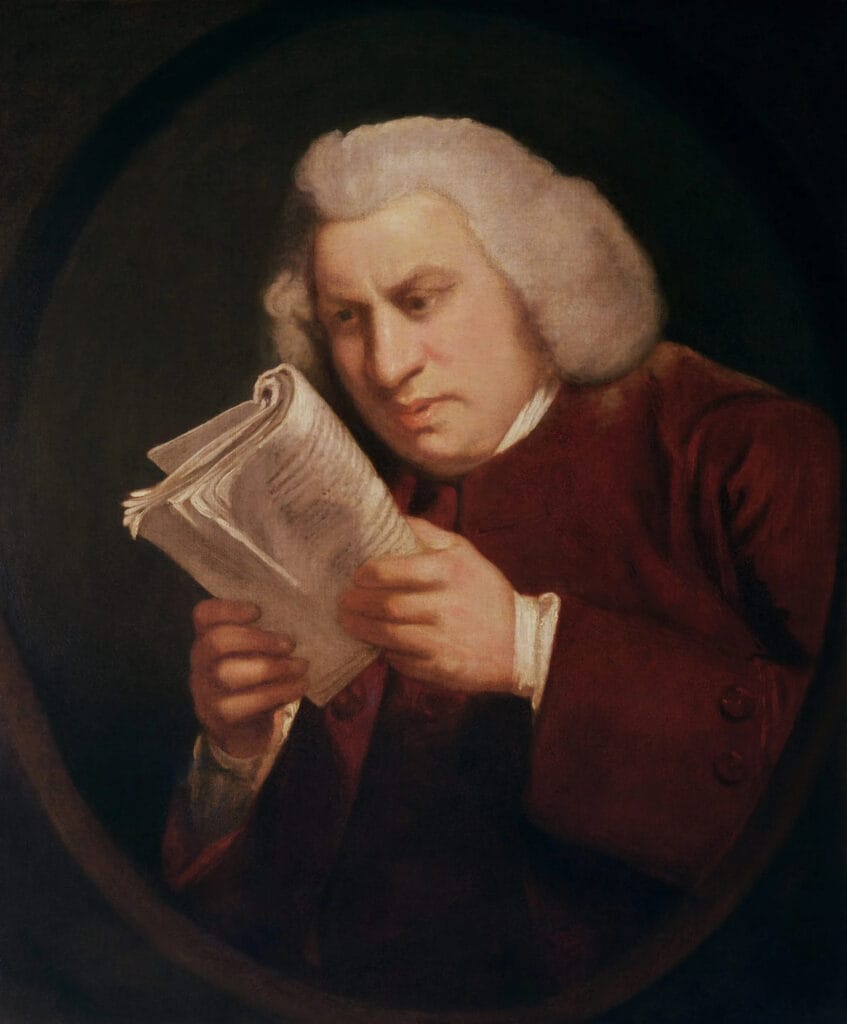
Samuel Johnson, immortalized as “Dr. Johnson,” was not only the towering man of letters of eighteenth-century England but also a figure whose life was profoundly shaped by medicine—or the lack of it. His Dictionary of the English Language (1755) cemented his place in literary history, yet behind the scholar’s wit and moral wisdom lay a life marked by chronic illness, physical deformities, and psychological afflictions that reveal much about eighteenth-century medical practice. To understand Johnson fully is to see how his ailments, and the treatments he endured, became part of his intellectual resilience and moral outlook.
Born in 1709 in Lichfield, Johnson came into the world in frail health. He contracted scrofula, or “the King’s Evil,” a form of tuberculosis affecting the lymph nodes, which left him scarred and half-blind in one eye. At that time, belief lingered that monarchs could heal scrofula by touch. As a child, Johnson was taken to Queen Anne, who ceremonially laid hands upon him in an act of royal healing. The ritual, of course, failed, and the young Johnson carried disfigurements for life. The episode reveals how medieval traditions persisted alongside early modern medicine, and how royal healing stood in for genuine therapeutic intervention.
Johnson’s contemporaries often remarked on his unusual tics, gesticulations, and compulsive movements. Today, scholars suspect he suffered from Tourette’s syndrome, a condition then unknown to physicians. His restlessness and verbal outbursts—mocked by some as eccentricities—were symptoms without medical explanation in the eighteenth century. Combined with lifelong bouts of melancholy, Johnson’s condition provides a poignant case study of how people coped with neurological and psychological disorders before modern psychiatry. Johnson himself, in essays for The Rambler, reflected on depression, calling it the “black dog” that haunted him, a metaphor later adopted by Winston Churchill for his own struggles.
Throughout his life, Johnson underwent treatments emblematic of Georgian medicine. Physicians relied on bloodletting, purges, and emetics, often to Johnson’s great discomfort. He also turned to remedies such as opiates, which offered temporary relief but no cure. His obesity, respiratory difficulties, and gout further compounded his suffering. Yet even as medicine faltered, Johnson’s resilience shone: he transformed personal struggle into moral insight, warning against despair, idleness, and excess. His body may have been frail, but his prose displayed a muscular clarity that reflected his triumph over suffering.
Johnson’s experience of disease sharpened his empathy and moral sense. His writings frequently addressed mortality, human frailty, and the inevitability of suffering. In Rasselas (1759), a tale written in a week to cover his mother’s funeral expenses, the characters search for happiness but discover its impossibility in earthly life—a philosophy born of a man acquainted with pain. Similarly, his essays in The Idler and The Rambler reveal a persistent concern with the burdens of ill-health, the temptation of despair, and the necessity of faith.
In his final years, Johnson’s health collapsed under the weight of chronic conditions. He endured asthma, dropsy (edema), and gout, and his final months saw repeated bleedings and surgical procedures that today seem barbaric. Surgeons lanced his legs to relieve swelling, a crude attempt at palliation. Despite the agony, Johnson met death in 1784 with stoic courage, fortified by his religious faith. His physicians could do little, but his writings had already provided a deeper consolation: that human dignity lies in confronting suffering with moral purpose.
Dr. Johnson’s medical history mirrors the state of eighteenth-century medicine—still tied to medieval rituals, lacking modern diagnostics, and often more harmful than healing. Yet his intellectual life demonstrates how adversity can be transmuted into wisdom. His illnesses did not silence him; rather, they deepened his reflections on human frailty, mortality, and the search for meaning. Johnson’s life is thus a testament not only to literary genius but also to the resilience of the human spirit under the weight of chronic disease. In him, we glimpse the intimate dialogue between medicine, suffering, and the creative mind.