
Stephen Martin
Thailand
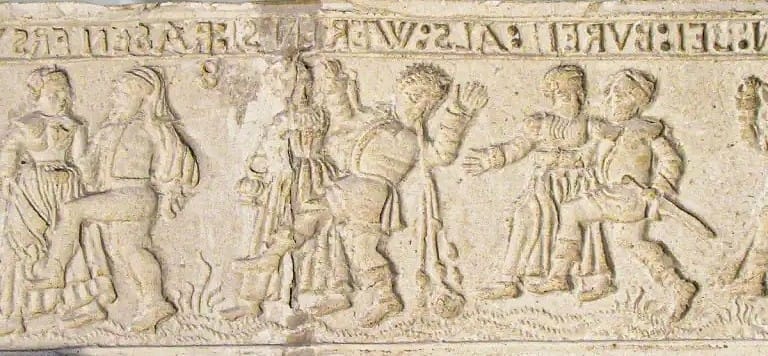
Program music is composed to give a sense of a scene or story. While Mozart in the late 1700s occasionally played tricks for laughs, such as suddenly missing bars and expected rhythms, he stuck to writing straight musical beauty for instrumental works. His Strasbourg Violin Concerto includes a folk tune of the same name. The tune is, more or less, familiar as the nursery rhyme “Incy Wincy Spider.” It does not portray Strasbourg. Decades later, in 1830, Hector Berlioz wrote his great Symphonie Fantastique based on an infatuation, which defined program music.1
In the early 1700s, examples of musical storytelling were rare, but Johann Sebastian Bach wrote at least two. When his older brother Johann Jacob left to be a musician in the Swedish Army around 1703 or 1704, J.S. Bach composed a harpsicord piece with a commentary in German. It is the Capriccio on the departure of a beloved brother.2 It marked his brother going off to war, with Bach’s comments attempting to dissuade him and noting the dangers at a time when military bands performed under fire on the battlefield. The movement “Fugue in imitation of the postillion’s horn”is particularly beautiful as his brother’s coach departs. Philip Jones’ version for brass, though not Bach’s own arrangement, is highly recommended listening and illustrates Bach’s lamentative thinking about the post horn.3
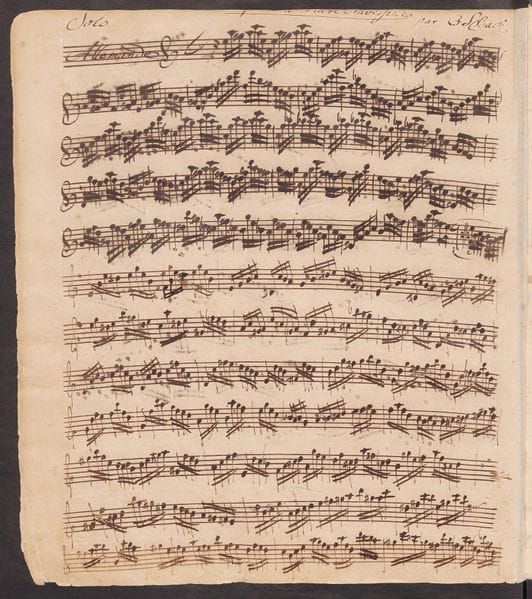
Another of Bach’s program passages appears to be in his Flute Partita in A minor for transverse flute.4 It starts with an “Allemande,” which was a slow, quadruple-meter dance popular at Saxon and Westphalian village festivals. The choreography was to stomp each beat in rustic boots and hold up the foot on the fourth beat. It could not have been better designed for hilarity after the umpteenth round of Bierstein stoneware mugs from the circulating trays. Jugs could double as mugs, as cognitive impairment and physical incoordination ensued. From 1500, the peasants’ dance was a common scene molded in relief around the body of stoneware jugs made in Raeren.5 With the Dutch East and West India Companies, those pots ended up all over the world four hundred years ago. Many survive intact. Their relief-molded inscriptions suggest the deeply engrained culture of “raging” peasant dances.6
The elder Bach brother, Johann Jacob, started as an oboist but was also a flute player, having learned it in Istanbul on deployment. His teacher there was the virtuoso Buffardin, renowned for fast playing, factors which may have influenced his brother’s flute composition. The Partita was probably first performed by a flutist in the Grosses Konzert, the forerunner of the Gewandhaus Orchestra in Leipzig. Most of Bach’s works were performed in church, but his secular pieces were played in Leipzig’s coffee houses and a pavilion in a riverside park. His “Coffee Cantata,” BWV 211, praised coffee’s mildness over Muscat wine.Despite that, Bach wrote a paraphrase of Niedt’s Musical Guide, that all of his music should honor God and enrich people, “or it is only a devilish noise and racket.”7
Bach’s flute “Allemande” is not actually slow to play, because each beat has four bold semiquavers, demanding in-breathing and phrasing. It is very mathematical in note progression and geometric on the page, until two sudden changes into harmonic and rhythmical chaos occur. (Fig. 2) Each of these passages has six beats, but syncopated off the beat, with overlapping and descending note couplets and continual half-note chromatic key changes. This goes on for twenty-four notes in total.8 It almost certainly means that the festival dancers are falling over drunk. This would explain the peculiar tumbling of the music, even though simple key changes were one of Bach’s hallmarks.
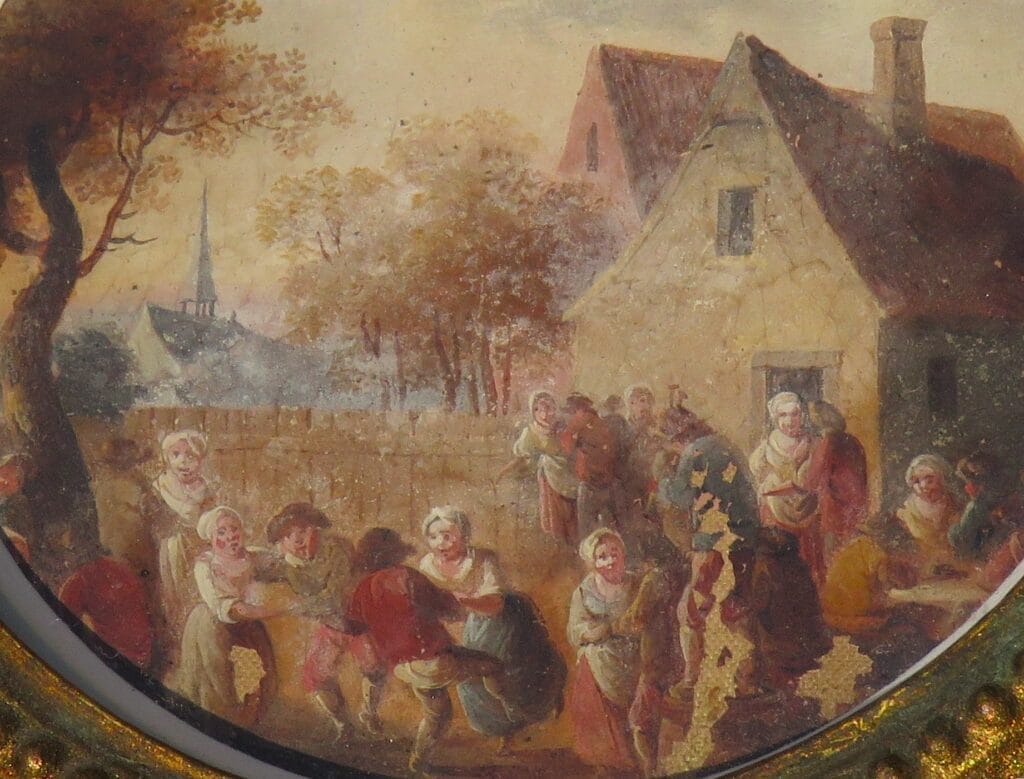
Bach might have been joking superficially. Underneath, though, he seems to have made a serious point that disinhibition or other disruptive behavior from alcohol was unacceptable. In an allegorical miniature painting of a peasant’s dance from Bach’s time, (Fig. 3) the older looking couples in the foreground dance, exerting maximum vigor. Despite some paint loss, you can see the bagpiper standing on a barrel. There are two beer glasses on a table and a Raeren brown Bierstein being lifted off a tray. Symbolically, the fence is a strong barrier from the church in the background. It is not clear what is happening with the two couples against the fence though, including the darkest and most indistinct figure of all in his tricorn, which may be what Bach was getting at.
Bach was very devout and ethical. He lived before the Enlightenment in Western Europe, and so at his time God in music was supreme.9 Bach’s own Lutheran Calov Bible, which he annotated and is now in the Concordia Seminary Library of St. Louis, shows his strong sense of divine morality. In it he wrote that all music, meaning in the church or in the coffee house, should be “mandated by God’s spirit.”10 The disintegrating note progression in the stumbling passages is a remarkable parallel to the chaotic, dysfunctional firing of nerves intoxicated with alcohol. Bach may have been sending a musical message: stay sober and stay choreographed both in steps and behavior.
End notes
- Michael Yafi. Hector Berlioz: From medical school to music conservatory. Hektoen International, Spring 2021. https://hekint.org/2021/04/21/hector-berlioz-from-medical-school-to-music-conservatory/ Arguably, all ballets and operas are programmatic, but Berlioz was pivotal.
- Capriccio spora il lontananza del suo fratello dilettissimo, BWV 992. This is Bach’s own title. In keeping with his musical ear, Bach was a real polyglot and taught himself very good Italian at school in Lüneburg.
- Baroque Brass. The Philip Jones Brass Ensemble. CD, track 11, Decca, 1990. Bach’s title for the movement was Fuga al imitatione di posta, this movement having no German commentary.
- BWV 1013. If written for a virtuoso Leipzig soloist, now forgotten, this was probably after 1723.
- Raeren is now in Liège Province, Southern Belgium, but four miles south of Aachen in modern Germany.
- Daniel Bende. “Raging farmers dancing on Raeren stoneware.” Keramiek Bende blog, August 19, 2022. https://dfb-keramiek.nl/2022/08/raging-farmers-dancing-on-raeren-stoneware/?lang=en
- Friedrich Erhard Niedt. Musicalische Handleitung, Hamburg: Johann Mattheson, 1717. Bach’s comments were recorded by his student Carl August Thieme, discussed in: Christoph Wolff. Johann Sebastian Bach. The Learned Musician. Oxford: OUP, 2001: 309.
- Please see: https://www.youtube.com/watch?v=qWhjbuFYZV8. The tumbling passages in this recording are at 0:53-0:57 and 2:02-2:06. The performance is without repeats, not least because we switched off the air conditioning in 46 °C heat to record it. The similar bars in question are 17-18 and 41-42, not identical, but in different keys.
- Trevor Pinnock. My Baroque. Episode 4, Handel’s Messiah. Deutsche Grammophon. YouTube. 2000. https://www.youtube.com/watch?v=y128c-GqZZQ&t=3s
- Christoph Wolff. Johann Sebastian Bach. The Learned Musician. Oxford: OUP, 2001: 338-339.
Further reading
Vincent P. de Luise. A musical vision: The eyes of Bach and Handel. Hektoen International, Fall 2015. https://hekint.org/2017/01/30/a-musical-vision-the-eyes-of-bach-and-handel/
STEPHEN MARTIN is Honorary Professor of Psychiatry at Chiang Mai University and Specialist Lecturer at Kalasin Arts College. He was previously Professor in the Faculty of Arts, Mahasarakham University and founded Baan Dong Bang Museum, teaching and writing particularly about eighteenth-century portraits.