
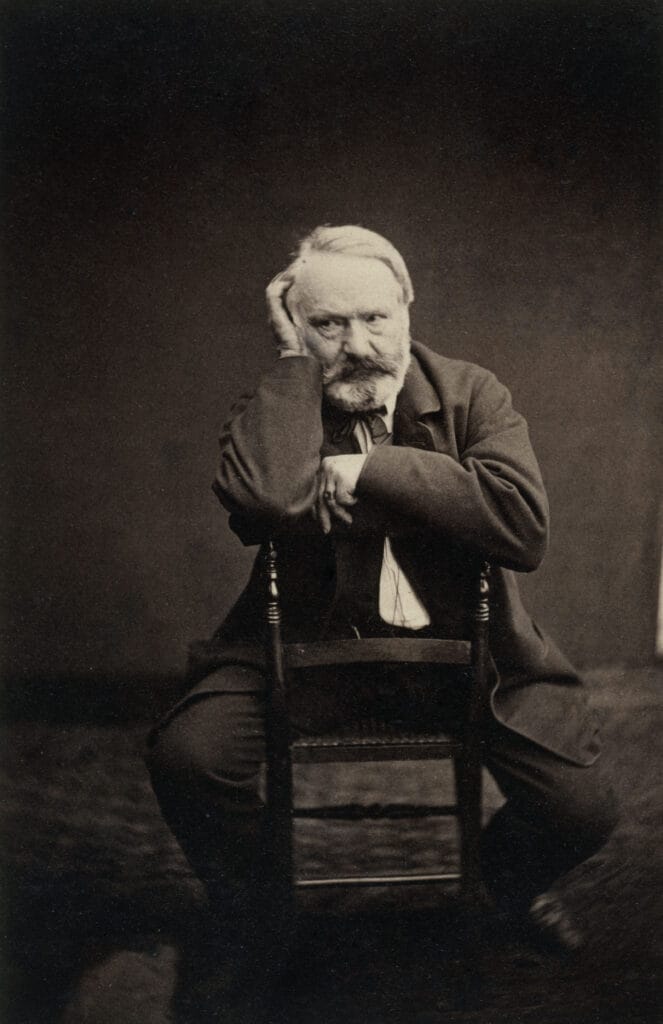

Victor Hugo (1802–1885), towering figure of French Romanticism, is remembered primarily for his vast literary achievements—Les Misérables, Notre-Dame de Paris, and countless poems that gave voice to the downtrodden and the exiled. Yet, woven into his life and works are subtle but significant medical threads. His experiences with illness, his compassion for the suffering poor, and his symbolic use of disease in literature reveal an enduring concern with medicine as both a physical and social force.
Hugo’s family life was touched repeatedly by illness and premature death, shaping his emotional and creative world. His beloved daughter Léopoldine drowned at age nineteen, an accident that devastated him, but other family members were claimed or weakened by illness: tuberculosis, cholera, and pneumonia were constant specters in 19th-century France. Hugo himself, though generally robust, endured the fevers and respiratory ailments common in an era when urban pollution, poor sanitation, and overcrowding bred disease. His long exile on the islands of Jersey and Guernsey was marked by solitude and melancholy, but also by close observation of nature and health, which he described in his poetry. These personal encounters with suffering attuned Hugo to the fragility of life and sharpened his literary empathy for characters afflicted by physical or social maladies.
Disease, deformity, and disability recur in Hugo’s fiction, often as symbols of societal neglect. In Notre-Dame de Paris (1831), the hunchback Quasimodo embodies both physical deformity and inner nobility, challenging readers to reconsider superficial judgments of health and beauty. In Les Misérables (1862), Fantine’s decline into illness and early death, worsened by poverty and prostitution, is presented as a medical tragedy inseparable from social injustice. Hugo vividly depicts her coughing, her emaciation, and her helplessness before a society that denies her care. The medical details are not incidental: they underscore the structural violence that condemns the poor to disease.
Hugo also used epidemics metaphorically. In his speeches to the French Assembly, he compared war to a plague and ignorance to a cancer devouring civilization. His language reveals an acute awareness of medicine’s vocabulary and a readiness to transpose it into social critique.
Hugo lived during a period when medicine was undergoing dramatic transformation. The cholera epidemics of 1832 and 1849 ravaged Paris, exposing the deficiencies of sanitation and igniting debates about urban reform. Hugo, an elected deputy, often spoke about the plight of the poor and the need for state responsibility in health. He argued that misery was “the disease of cities” and that education, housing, and hygiene were essential remedies. His moral vision extended medicine beyond the clinic, envisioning public health as inseparable from social justice.
In Les Misérables, he famously describes the sewers of Paris in encyclopedic detail. While many readers see this as digression, it reflects his understanding of sanitation as the hidden foundation of health. By dramatizing the underground arteries of the city, Hugo anticipates later hygienist reforms that would make clean water and sewer systems central to medical progress.
At the core of Hugo’s literary and political philosophy was the belief that compassion heals. He envisioned literature itself as a kind of medicine for society—a way to awaken empathy, alleviate indifference, and bind wounds caused by inequality. His humanitarian campaigns, such as his advocacy for the abolition of the death penalty, resonate with medical ethics in their insistence on the dignity of all human beings, regardless of illness, poverty, or crime.
Victor Hugo was not a physician, but his life and works are steeped in medical consciousness. From personal encounters with illness and loss, to literary portrayals of disease and deformity, to his public advocacy for sanitation and social reform, he consistently treated health as a mirror of society’s values. To read Hugo through a medical lens is to recognize that his vision of justice was also a vision of healing. In his world, the doctor’s art and the poet’s mission converge: both aim to restore life, dignity, and wholeness in the face of suffering.