
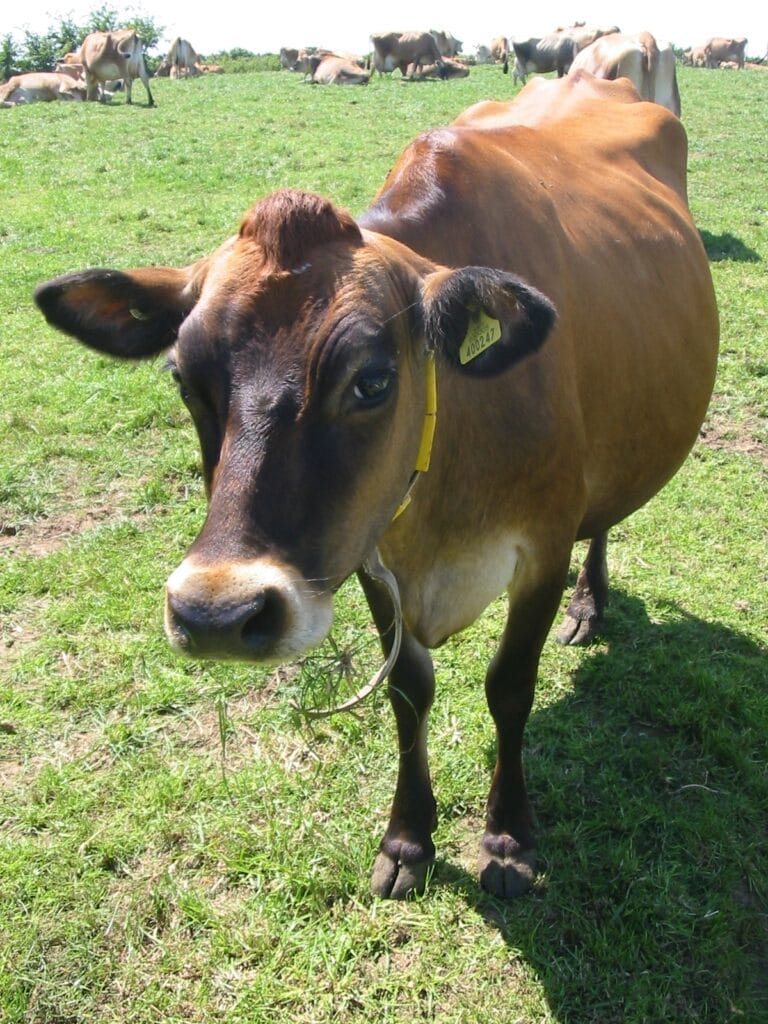

Cows are domesticated bovine animals that have been used in human agriculture for thousands of years. As ruminants they have a four-chambered stomach system that allows them to digest grass and other plant materials that humans cannot process.
There are hundreds of cattle breeds worldwide, ranging from dairy breeds like Holstein and Jersey to beef breeds like Angus and Hereford. Dairy cows can produce 6–7 gallons of milk per day on average, while beef cattle are raised primarily for meat production.
Cows are surprisingly social and intelligent animals. They form friendships, have good memories, and can even hold grudges. They communicate through various vocalizations, body language, and scents. A cow’s “moo” can convey different meanings depending on the tone and context.
From an agricultural perspective, cattle provide not only milk and meat, but also leather. Their manure serves as valuable fertilizer. They also play important roles in many cultures and religions around the world, particularly in Hinduism, but also in ancient Egyptian, Greco-Roman, Zoroastrian, and some Abrahamic traditions. Their role extends beyond mere agricultural or economic utility, embodying fertility, motherhood, patience, and sanctity.
Perhaps the most well-known religious veneration of cows occurs in Hinduism, where the cow is regarded as a sacred and inviolable animal. In the Vedas—the foundational texts of Hinduism—the cow is celebrated as a symbol of abundance and non-violence. It provides milk, ghee, curd, and dung (used as fuel and fertilizer), supporting both material and ritual life. In the Rigveda, cows are referred to as aghnya, meaning “not to be killed,” highlighting their protected status even in early religious formulations.
The cow is also associated with several deities. Lord Krishna, a cowherd in his youth, is often depicted playing the flute among cows, emphasizing divine affection and pastoral harmony. The celestial cow Kamadhenu represents the fecundity and prosperity cows bring. In the Mahabharata, the gifting of cows is portrayed as a supreme religious act of charity. The cow also became a powerful symbol of non-violence, a cardinal virtue in Hindu and later Jain and Buddhist thought. Jainism, which strongly emphasizes non-violence toward all living beings, also regards cows with respect. The strict vegetarianism of Jains and their protection of animals align with the broader tradition of cow reverence. In Buddhism, cows are often treated with care, although the religion itself does not hold the cow to be intrinsically sacred.
In ancient Egypt, the cow was associated with Hathor, the goddess of motherhood, fertility, and love. Often depicted with cow horns and a solar disk, Hathor represented maternal nourishment and cosmic balance. Cows were also linked to Isis and were symbolic of rebirth and the sustenance of the soul in the afterlife. In ancient Greece and Rome, cows were prominent in sacrificial rites to deities such as Hera, Zeus, and Juno. The cow, often a white heifer, symbolized purity and fertility. The myth of Io, a priestess transformed into a cow by Zeus, links bovine imagery with themes of transformation and divine intervention.
In Zoroastrianism, the cow holds a cosmological importance. According to the sacred texts of Zoroastrianism, the primordial cow was one of the first creations of Ahura Mazda and its killing of the cow by evil forces is mourned and its spiritual essence is protected by divine beings. The destruction of purity by evil —represented by the cow—is a central cosmic struggle.
In the Hebrew Bible, the “golden calf” becomes a powerful symbol of idolatry and spiritual failure when the Israelites worship it in Moses’ absence (Exodus 32). This incident marks a sharp departure from earlier agricultural and fertility cults where cattle played prominent religious roles. Red heifers were used in purification rituals (Numbers 19), and cows appear frequently in pastoral and sacrificial contexts. In Christianity and Islam, cows are generally not sacred, though they may be involved in dietary laws or ritual sacrifice. For example, in Islam, cows are sacrificed during Eid al-Adha in remembrance of Abraham’s willingness to sacrifice his son.
In conclusion, across diverse religious traditions, the cow has served as a symbol of nourishment, fertility, motherhood, and sanctity. While Hinduism elevates the cow to an explicitly sacred status, other religions reflect more nuanced symbolic, ritual, or mythological roles for this animal. The veneration of cows speaks to a deeper human recognition of the interconnectedness of life, the importance of agriculture, and the moral imperative to show compassion to other beings.