
Stephen McWilliams
Dublin, Ireland
In modern literature, historical psychiatrists and neurologists sometimes appear as fictional characters. A case in point is found in Jed Rubenfeld’s novel The Interpretation of Murder, which opens with Sigmund Freud, Carl Jung, and Sándor Ferenczi arriving in New York in 1909 to deliver a series of lectures on the controversial subject of psychoanalysis.1 Barely have they disembarked when they are called upon to act as amateur detectives. The affair in question involves a brutal attack upon the seventeen-year-old daughter of a couple of high-society Manhattanites. So traumatized is the poor girl that she is left with total amnesia and rendered mute. And so, Freud agrees to supervise the attempts of the main protagonist, Dr. Stratham Younger, to successfully use psychoanalysis to trace the perpetrator.
Mesmer
Franz Anton Mesmer, the eighteenth-century German physician, also appears in several modern works. Mesmer is remembered for devising a theory of “animal magnetism,” in which an unseen energy, subject to the laws of magnetism, flowed through all living things and could be used as a source of healing.2 His theory does not stand up to modern scientific scrutiny, but the term has taken on the broader meaning of capturing someone’s complete and undivided attention. It inspired Alan Rickman to play Mesmer in the film bearing his name (1994), directed by Roger Spottiswoode. Mesmer was also portrayed by Charles Goldner in Black Magic (1949), directed by Gregory Ratoff and starring Orson Welles. The film was an adaptation of Alexandre Dumas’ 1848 novel Joseph Balsamo.
Charcot
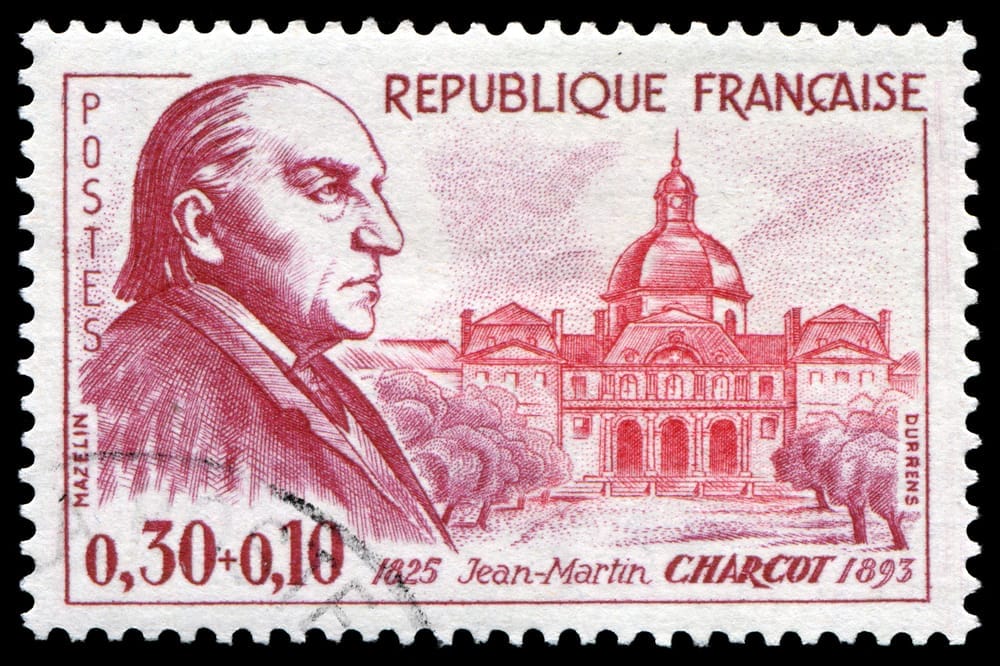
Jean-Martin Charcot in Sebastian Faulks’s 2005 novel Human Traces is perhaps the finest example of a doctor-turned-hypnotist.3 Charcot, the founder of modern neurology, was appointed Physician to the Hospitals of Paris in 1856 and Professor of Pathological Anatomy in 1872.4 He was the first to describe multiple sclerosis, Charcot’s triad, and the hereditary neurological disorder Charcot-Marie-Tooth disease. His work on hypnosis and hysteria means that his reputation in popular culture is not entirely unlike that of Mesmer. Early on, Charcot thought that hysteria was likely a neurological condition, but he later changed his mind in favor of it being predominantly psychological in nature.
Human Traces
Sebastian Faulks skilfully portrays Charcot in Human Traces, the story of two ideologically divergent psychiatrists during the decades leading up to World War I. Both psychiatrists—Thomas Midwater and Jacques Rebière—were born around 1860 and possess a fundamental curiosity about the workings of the human mind. In other ways, however, they could not be more different. Thomas’s upbringing is a privileged one; he resides with his family in Torrington House, Lincolnshire, His initial path into medicine is reluctantly taken; a romantic at heart, he would far rather study poetry. But his father disapproves, and Thomas eventually concedes that even “Keats, after all, had been apprenticed to an apothecary and qualified as a surgeon.”5
Jacques, on the other hand, hails from a socially deprived rural community in Brittany, northern France. His older brother has the symptoms of what will eventually be termed schizophrenia. Keen to find treatment for his brother, Jacques is taken under the wing of the local curé and guided into the study of medicine. Faulks describes schizophrenia with great attention to detail, not simply its signs and symptoms, but also the reactions of relatives and friends to an illness that will not be named until the Swiss psychiatrist Eugen Bleuler finally coined the term in 1911. Thomas and Jacques meet by chance at the fashionable resort of Deauville, Normandy. They are just twenty years of age and still at medical school, yet they immediately detect in one another a shared fascination with the human psyche. The two young doctors eventually co-establish the Schloss Seeblick sanitorium in the Austrian Alps and live out their lives pioneering biopsychosocial treatment for people with severe and enduring mental illness.
So, where does Faulks’ description of Charcot come into it? It lies in a vivid description of one of his lectures, an event that is to have a profound effect on Jacques’ views within his evolving field. His postgraduate psychiatric training contrasts sharply with Thomas’s. The latter is attached to a Dickensian lunatic asylum, with its grand classical façade and its six miles of corridors. His tutor is the charismatic Dr. Faverill, “a man of science and learning, rather grandiloquent, filled with the optimism of our time.”6 Yet, with two thousand rudimentarily diagnosed patients in the asylum, the doctors are clearly overwhelmed by the magnitude of the task. Thomas’ raw experience of nineteenth-century psychiatry involves brutal and pointless treatments behind closed doors.
Conversely, Jacques’s mentor is Professor Charcot at the Salpêtrière. By the mid-1880s, Charcot has already established himself as a father figure in the study of neurology, hysteria and hypnosis. As Jacques attends one of Charcot’s demonstrations to an audience of four hundred, Faulks paints a picture of a proud, punctual, and pedantic professor who never fails to excite the crowd in a manner uncaptured by any other work of fiction.
According to Faulks, “sightseers, journalists and hangers-on…lined the amphitheater. … The professor started on time whether the audience was assembled or not.”7,8 Indeed, we are told that, on one occasion, “The distinguished neurologist had left the church at a wedding because the bride—the daughter of a close friend—was late.”8 As Jacques watches in awe, “Charcot himself emerged, wearing a black frock coat and top hat, which he removed and placed carefully on a table behind him. He turned to look at his audience, unsmiling, unspeaking; his pale, clean-shaved face caught the light beneath the lank grey hair, swept back and hanging in a straight line over his collar, almost touching his shoulders.”7 As Charcot puts a hand between the buttons of his coat, Jacques fancies he resembles Napoleon. Then, “Charcot spoke without rhetorical flourish, though this merely intensified the drama. … No word escaped him that did not bend each syllable to work.”7,9
And so, Sebastian Faulks brings to life someone who is otherwise only described academically in the annals of history and medicine. In matters of neurology and psychiatry, Charcot believed in both the biological and the psychological. In contrast, Human Traces pits psychoanalysis against biological psychiatry as it explores the treatment of complex psychiatric illness. But the highlight is undoubtedly the chapter evoking one of the most charismatic medical teachers the world has ever seen.
References
- Rubenfeld, J (2006). The Interpretation of Murder. London: Headline.
- Crabtree, A (1988). Animal Magnetism, Early Hypnotism, and Psychical Research, 1766–1925. New York: Kraus International. Introduction.
- Faulks, S (2005). Human Traces. London: Hutchinson.
- Parker, S (2016). Medicine: The Definitive Illustrated History. London: Dorling Kindersley, 160–161.
- Faulks, 47.
- Faulks, 93.
- Faulks, 158.
- Faulks, 157.
- Faulks, 161.
STEPHEN MCWILLIAMS is a consultant psychiatrist at Saint John of God University Hospital Dublin, associate professor at UCD School of Medicine, and honorary senior lecturer at RCSI University of Medicine and Health Sciences. His books include Fiction and Physicians: Medicine through the Eyes of Writers (Liffey Press, 2012) and Psychopath? Why We Are Charmed by the Anti-Hero (Mercier Press, 2020).