
Arpan K. Banerjee
Solihull, UK

Herman Boerhaave was born on December 13, 1668, in Voorhout, a small village north of Leiden, Holland, an area known for its tulip-growing. He initially studied divinity, intending to be a priest, then continued his philosophy studies in Leiden on a scholarship when his father died. He then studied medicine at the University of Harderwijk in the Netherlands, which also boasts Carl Linnaeus, the great Swedish taxonomist, amongst its alumni.
He became a lecturer in Leiden in 1701, telling his students to study Hippocrates and make him their role model. He became a professor of both botany and medicine in 1709. His botanical garden still survives today, much expanded, and is a major tourist attraction sited nearer the original sixteenth-century university building. Boerhaave made many botanical advances but is best remembered today for bringing bedside clinical teaching to his students. He was also one of the first physicians to use the thermometer in clinical practice.
He introduced measurement into the practice of medicine, deepened his interest in physiology, and challenged the dogma of ancient medical writers such as Galen. In addition to his medical roles, he became a professor of chemistry in 1718, having already been appointed rector of the university in 1714. He met Voltaire, the French writer, and was also influenced by philosopher René Descartes, another Leiden University alumnus. Boerhaave believed that a sound knowledge of anatomy and anatomical research were important for practicing medicine and for ensuring its advancement. Boerhaave was hugely influential in his time in the development of British medical education, with many of the founders of the Edinburgh Medical School (founded in 1726 as part of the Scottish Enlightenment) having been his former pupils who followed his style of bedside teaching in their new medical school.
Boerhaave was a prolific writer and produced his first major medical work Institutiones Medicae in 1708, which was widely translated and ran for many editions. It was based on his 1701 lectures and boasted an extensive historical bibliography. He wrote textbooks on botany and chemistry. He was also famous for his aphorisms, including “Simplicity is the sign of truth” and “God was the paymaster” for his poor patients. He published his collection of aphorisms in 1709, written long before works on similar themes such as Aequanimitas, the 1904 collection of essays by Sir William Osler, a notable Canadian-British physician. In 1730, Boerhaave became a Fellow of the Royal Society of London.
Today, Boerhaave is remembered worldwide for an eponymous condition that describes a ruptured distal esophagus from increased intraesophageal pressure after continued forceful vomiting. The case that Boerhaave described in 1724 was that of the Dutch Admiral Baron Jan von Wassenaer, who died of this condition.
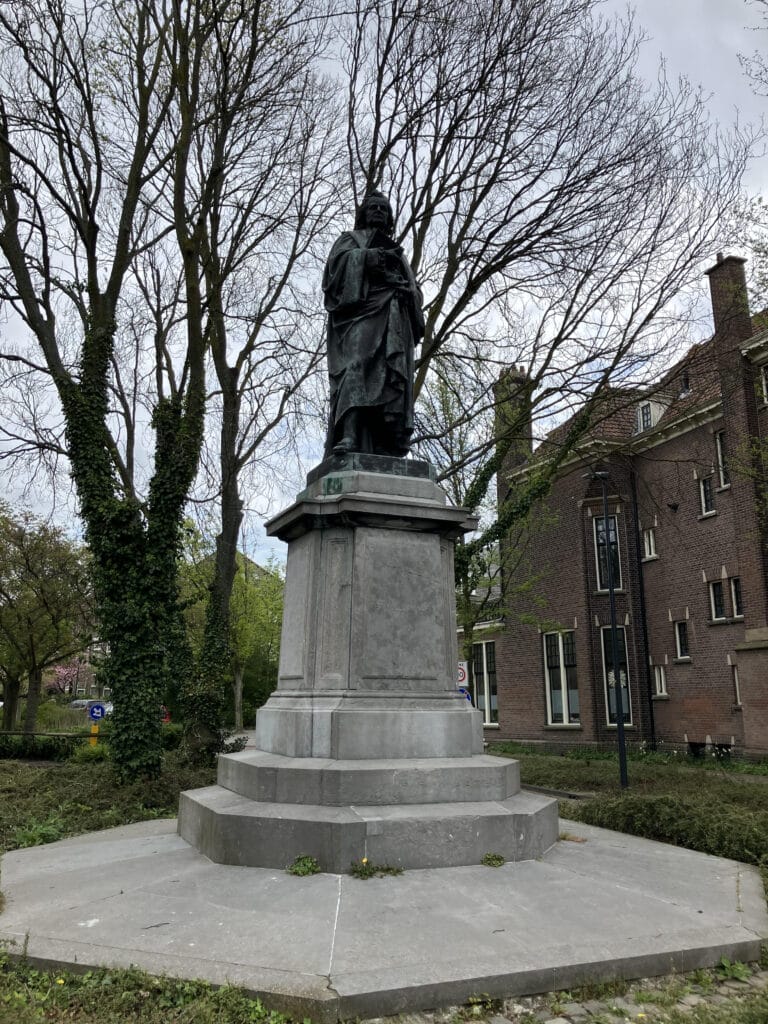
There is a museum named after him in Leiden, now a museum of medical and science history. A statue commissioned in 1872, built by Jan Stracke, can be seen in Leiden just off the main road, Rijnsburgerweg, near the central railway station.
Boerhaave died from a lung abscess on September 23, 1738, in his home city, and was buried at St. Peter’s Church. He is considered by many to be the Hippocrates of Holland.
References
- Boerhaave H. Institutiones medicae in usus annuae exercitationis domesticos digestae. Leiden: J. van der Linden, 1708.
- Boerhaave H. Aphorismi de cognoscendis et curandis morbis. (Leiden, 1709).
- Boerhaave H. Atrocis, nec descripti prius, morbis historia: Secundum medicae artis leges conscripta. (1724) Lugduni Batavorum; Ex officine Boutesteniana.
- “Herman Boerhaave.” Wikipedia. https://en.wikipedia.org/wiki/Herman_Boerhaave.
DR. ARPAN K. BANERJEE qualified in medicine at St Thomas’s Hospital Medical School. London. He was a consultant radiologist in Birmingham 1995–2019. He was President of the radiology section of the RSM 2005–2007 and on the scientific committee of the Royal College of Radiologists 2012–2016. He was Chairman of the British Society for the History of Radiology 2012–2017. He is Chairman of ISHRAD. He is author/co-author of papers on a variety of clinical, radiological, and medical historical topics and eight books, including Classic Papers in Modern Diagnostic Radiology (2005) and The History of Radiology (OUP 2013).