
Paul Williams
Beaconsfield, United Kingdom
Associations between color and states of mind are a familiar aspect of everyday experience. Depression is referred to as “the blues,” someone may be “green with envy,” and “seeing red” is widely associated with aggression and anger; these anecdotal associations are supported by a significant body of empirical evidence.1 Artists have used such associations to create visual representations of mental states, such as the work of American abstract artist Brice Marden (1938–2023), who used color to represent the supposed mental states of the Virgin Mary while she was visited by the Angel Gabriel and told that she was to become the mother of the Son of God. In the Christian tradition, this episode—a favorite subject for medieval and Renaissance artists2—is known as the Annunciation (Luke 1:26–38).
For much of art history, the role of color was largely confined to description, the colors used in a painting being chosen to match the real-world colors of the subject being portrayed. Since the late nineteenth century, however, the role of color in art has become much broader: colors are used independently, for their own sake, and because they convey meaning. As art historian James Fox points out, colors are not inherently meaningful, but meanings become attached to them by historical association, social convention, or psychological significance.3 An extreme view of the association between color and mental state was expressed by the artist Wassily Kandinsky (1866–1944), who said that yellow “would be capable of the color representation of madness—not melancholy or hypochondriacal mania but rather an attack of violent, raving lunacy.”4
Artists have used color to represent their own mental state. A well-known example is Pablo Picasso’s “Blue Period,” precipitated by his prolonged and profound grief following the violent suicide of his close friend Carlos Casagemas in 1901. For some three years, Picasso’s paintings consisted exclusively of black, blue, and blue-green images of somber subjects.5 Similarly, Brice Marden used color to represent his own state of mind in painting a series of uniform, unmodulated grey canvases during a period of depression in the mid-1960s.6
Brice Marden trained in Boston and at Yale, and apart from a brief spell in Paris, he lived and worked in New York from the mid‑1960s onwards. He was one of many American abstract artists of that period who were making artworks with no obvious content—”pictures of nothing.”7 For some of these artists, the art object was complete in itself with no embodied meaning (hence Frank Stella’s famous remark that “only what can be seen there is there…what you see is what you get”8); in contrast, meaning was vitally important to Marden and other artists, a group referred to by critic Harold Rosenberg as the “theological branch” of abstract expressionism.9
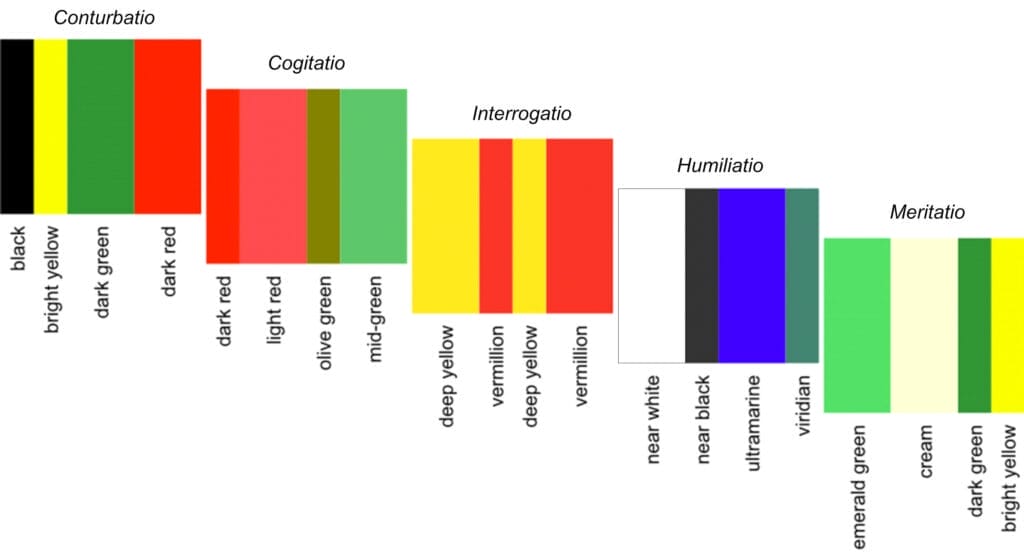
Brice Marden was considered “the premier abstract painter of his generation”10 and his work now commands prices of up to $30 million.11 Marden’s work in the 1960s and 1970s led to him be labeled “the master of the monochrome panel.”12 In 1978, he completed the Annunciation Series, a set of five large paintings (213 x 244 cm) each consisting of four vertical colored strips in different arrangements of narrow and broad, and with different combinations of colors in the different paintings.
In these paintings Marden used color to represent not his own mental state, but the supposed mental states of his subject, the Virgin Mary. He was inspired by a sermon preached in 1489, in which Franciscan friar Roberto Caracciolo described a sequence of five successive states of mind experienced by Mary in response to Gabriel’s message. “Conturbatio (disquiet)…when the Virgin heard the Angel’s salutation…she was troubled; Cogitatio (reflection)—she cast in her mind what manner of salutation this should be; Interrogatio (inquiry)…how shall this be, seeing I know not a man?; Humiliatio (submission)…be it unto me according to thy word; Meritatio (merit)…the Angel departed from her…we can justly suppose that in the moment when the Virgin Mary conceived Christ her soul rose to such lofty and sublime contemplation.”13
Marden used Caracciolo’s designations—Conturbatio, Cogitatio, Interrogatio, Humiliatio, and Meritatio—as the titles for the five artworks in his series. As noted earlier, each consists of four vertical, colored strips with different combinations of widths in the different paintings. The colors are not simple flat blocks, but consist of many layers of oil paint mixed with beeswax and turpentine, giving the surface a rich, shimmering appearance. While it is possible to list names for the colors in the panels (Figure 1), a small-scale printed or digitized reproduction cannot convey anything of the experience of seeing Marden’s paintings. As critic Michael Zakian has observed, “Our language is not complex enough to accurately describe a Marden color. It must be seen. Even color reproductions are not sufficient to fully appreciate a Marden painting, for the oil and wax paint creates a beautifully impenetrable dense surface that has to be experienced first‑hand.”14
Laura Garrard, in her monograph on the work of Brice Marden, confirms that color is the principal carrier of meaning in the Annunciation Series, in particular the color contrasts between adjacent strips. For her, these mean that “the rhythm of the dialogue between Gabriel and Mary is evoked at every moment of the narrative.”15 As for the colors themselves, Garrard associates the red in the first three paintings with Mary’s heightened emotional state, and the yellow is “flash of the creation, a light shining out of nowhere.” This is followed by the “slowness of the green, as if the narrative is the fleet‑footed motion of the Archangel encountering some resistance.”16
For Garrard, the title of the second painting (Cogitatio) “suggests a stream of thought, so that one thought modulates the preceding one, which is what Marden depicts with his dark then lighter reds and greens.”17 Furthermore, the question‑response inherent in the subject of the third painting (Interrogatio) is reflected in the contrasts between the yellow and red strips. She notes also that the colors are muted in Humiliatio, while in Meritatio the wide cream‑colored strip “provides a balance of the spiritual forces…[and] offers a point of resolution.”18
How did the art world respond to Marden’s Annunciation Series? At face value, “what could be less obviously evocative of the Virgin Mary’s traditional and successive states of mind than a succession of tall panels of oil paint mixed with wax that varied only in breadth and color as they moved across canvases seven feet high and eight feet wide?”19 Perhaps unsurprisingly, commentators’ opinions have ranged widely. The positive view is exemplified by John Russell, writing in the New York Times: “It would be difficult to imagine, let alone to paint, pictures more distinguished of their kind than Brice Marden’s. When his Annunciation Series of 1977 was shown at the Pace Gallery…it established itself at once as one of the richest, clearest and most fulfilled of our century’s grand designs.”19 Similarly, Laura Garrard, whose analysis of the colors in the paintings was discussed above, observed that “[Renaissance painters] were trying to convey a particular spiritual feeling…Marden showed that he was no less successful in conveying this complex of feelings in his Annunciation Series paintings.”20 In contrast, the negative view is exemplified by British critic Peter Fuller, who considered Marden’s work to be spiritually bankrupt,21 and US critic Michael Zakian considered that “these works should not be thought of as representations of or symbols for the Annunciation.”14
There is, of course, no possibility of reaching a consensus on matters of this kind. To make up our own minds, we would need to view the five paintings in the series as they were intended to be viewed—together, in sequence, from left to right. Sadly, this is not possible: Humiliatio is in the Museum Ludwig (Cologne, Germany),22 Meritatio in the Virginia Museum of Fine Arts (Richmond, VA, USA)23 and the other three are in private collections. Maybe, one day, all five will be exhibited together again so they can be seen as their creator intended.
References
- Damiano C, Gayen P, Rezanejad M et al. Anger is red, sadness is blue: emotion depictions in abstract visual art by artists and non-artists. J. Vis.2023;23(4):1-16. doi.org/10.1167/jov.23.4.1.
- Altmann S. Gabriel and the Virgin: the secret of the Annunciation. European Review 2016;24:149-58.
- Fox J. The World According to Colour. Dublin: Penguin Books, 2023: 8-9.
- Kandinsky W. On the Spiritual in Art, first complete English translation. New York: Solomon R. Guggenheim Foundation; 1946: 64. Accessed April 5, 2026. https://dn720102.ca.archive.org/0/items/onspiritualinart00kand/onspiritualinart00kand_bw.pdf
- The Blue and Pink Periods. Musée National Picasso, Paris. Accessed April 5, 2026. https://www.museepicassoparis.fr/en/blue-and-pink-periods
- Garrard L. Brice Marden. Maidstone: Crescent Moon Publishing, 4th edition; 2012: 68.
- A designation applied in 1816 by William Hazlitt to the work of JMW Turner and subsequently applied to American abstract art (Varnedoe K. Pictures of Nothing: Abstract Art since Pollock. Princeton NJ: Princeton University Press; 2006: 44, note 1).
- Glaser B. Questions to Stella and Judd. In: Batcock G, ed. Minimal Art: a Critical Anthology. Berkeley: University of California Press; 1995: 158.
- McEvilley T. The Exile’s Return: Toward a Redefinition of Painting for the Post‑modern Era. New York: Cambridge University Press; 1993: 82.
- Richardson J. Brice Marden’s abstract heart. Vanity Fair, May 1999: 168-77. Accessed April 5, 2026. https://archive.vanityfair.com/article/1999/5/brice-mardens-abstract-heart
- A Global Sale of the 20th Century – Brice Marden (b. 1938): Complements. Christie’s. Published July 10, 2020. Accessed April 5, 2026. https://www.christies.com/en/lot/lot-6269990
- Smith R. Art View: Brice Marden moves ahead by turning back. New York Times. October 20, 1991: 2, 37. Accessed April 5, 2026. http://www.nytimes.com/1991/10/20/arts/art-view-brice-marden-moves-ahead-by-turning-back.html
- English translation of the original Italian text. Baxandall M. Painting and Experience in Fifteenth Century Italy. Oxford: Oxford University Press, 2nd. edition; 1988: 51, 55.
- Zakian, M. Brice Marden: visions of colored rectangles. Columbia Daily Spectator, September 27, 1978: 7. Accessed April 5, 2026. https://archive-publications.library.columbia.edu/?a=d&d=cs19780927-01.2.13&e=——-en-20–1–txt-txIN——-
- Garrard, 58.
- Garrard, 62.
- Garrard, 59.
- Garrard, 60.
- Russell J. Art: Marden on marble, on canvas and on paper. New York Times, November 12, 1982: C20. Accessed April 5, 2026. http://www.nytimes.com/1982/11/12/arts/art-marden-on-marble-on-canvas-and-on-paper.html
- Garrard, 65.
- Garrard, 50.
- Marden, Brice: Humiliatio. Kulturelles Erbe Köln. Accessed April 4, 2026. https://www.kulturelles-erbe-koeln.de/documents/obj/05020134
- Meritatio: 1978. Virginia Museum of Fine Arts, 2025. Accessed April 4, 2026. https://www.vmfa.museum/artworks/meritatio-60457
PAUL WILLIAMS is a retired psychiatrist and pharmaceutical industry executive. He has a postgraduate degree in art history.