
Sally Metzler
Chicago, Illinois, United States

The fame and adoration of French Impressionist painter Claude Monet rests primarily on his landscapes, bathed in sunlight and nourished with a soothing palette. Much of his oeuvre evokes a peaceful, harmonious, and fleeting moment in nature. But one very personal work, Camille Doncieux on her Deathbed, featuring his first wife, diverges from his characteristic dictum of genre and aesthetics (Fig. 1).1
The precise circumstance of how the couple met remains inchoate. They may have first encountered one another in 1865, in the Paris neighborhood of Batignolles, where an artist’s colony thrived. Camille at that time was eighteen years old and earned a living as an artist’s model; thus they traveled in similar circles, and indeed Camille modeled for Monet’s friends Pierre-Auguste Renoir and Édouard Manet, among others. Monet, at twenty-five years old, fell under the spell of Camille’s ravishing beauty, intensified by her dark hair and beautiful eyes. Adding to her appeal was a noted grace, charm, and kindness.2
She became his favorite model, and they fell deeply in love. Monet’s oeuvre would feature the likeness of Camille throughout her brief life, and many of his works incorporate Camille as one of the actors on his artistic stage. Unlike the group paintings, Camille with a Small Dog (Fig. 2) spotlights her visage in a realistic manner uncharacteristic of Monet’s burgeoning impressionistic, sketchy mode of artistic expression.
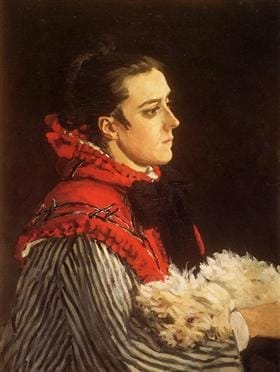
The poverty and stress associated with Monet’s early career struggles took its toll on the health of Camille. Monet agonized that his financial predicaments prevented him from giving her the care and medicine she required.3 About three weeks before her death, Monet wrote to his friend that Camille, her belly and face swollen, could no longer stand, walk, or keep nourishment down.4 The specific cause of death remains unknown. She suffered for years from dyspepsia. Uterine cancer or a negligent abortion has often been suggested as the source of her final demise. Monet himself alluded to this in one of the few letters he wrote to her family doctor: “I can’t tell you the exact name of her illness, but it seems to be an ulceration of the uterus.”5 Apparently, doctors advised Camille to undergo an operation, presumably a hysterectomy, treatment which Monet and his wife ignored. Rather than undergoing an operation, which terrified her, she became pregnant and amazingly, though feeble and ill, carried her second son Michel to full term and delivered him healthy in 1878.6
After his birth, Camille rapidly deteriorated, and the next year she died. Dr. John Lurain, Chief of Gynecology at Northwestern Medical, posited another opinion as to the cause of her death: a malignancy on her cervix that spread throughout her body. He based this on the three-year duration of her illness and the onset of her symptoms in her late twenties.7
Camille on Her Deathbed illustrates the genius of Monet at the easel, illustrating his acuity in depicting illness and affection. He applied a disciplined and calibrated palette of blues, greys, and nuances of lilac. A hint of red appears, chiefly present in the vaporous bouquet of flowers resting on her chest. The portrait radiates immediacy as it captures Camille hovering between life and death. Upon close examination, she is not alone. Barely discernible, a faint, evanescent figure hovers in the right background, staring out at the viewer. It has been suggested that the figure is none other than Monet’s eldest son, Jean, then twelve years old.8
Some have likened the portrait to a shroud, Camille appearing “almost like a bride asleep.”9 Indeed, Monet shrouds her in a physical and metaphorical veil of mourning, her misty visage embracing the Impressionist credo. The billowy, cloud-like blanket enveloping her announces a duality of earthly and heavenly existence. An ethereal impression dominates.
Witnessing Camille devolve from illness to death would understandably emotionally drain Monet, and painting the event presented a heightened, heartbreaking task. Capturing on canvas the death of Camille explored myriad artistic and psychological phenomena. Decades after the event, Monet reflected on the experience and wrote to a friend: “I found myself staring at [my wife’s] tragic countenance, automatically trying to identify the sequence, the proportion of light and shade in the colors that death had imposed on [her] immobile face. Shades of blue, yellow, gray, and I don’t know what. . . . In spite of myself, my reflexes drew me into the unconscious operation that is but the daily order of my life.”10 He never actually signed the work; the black stamped signature at the bottom right was added later.11 Monet kept the painting in his possession for the remainder of his life, hanging it in his bedroom, thus allowing only the privileged few to view this highly personal narrative of his grief.12
References
- Camille Doncieux on Her Deathbed, 1879. Oil on canvas, 90 x 68 cm. Musée d’Orsay, Paris. Provenance: collection Michel Monet, Giverny, fils de l’artiste, until 1963, thereafter in the collection of Katia Granoff, Paris, who donated it to the National Museums for the Musée du Jeu de Paume. Entered the Musée d’Orsay, Paris in 1986.
- Jonathan5485, “Camille Doncieux and Claude Monet,” My Daily Art Display blog, January 30, 2012, https://mydailyartdisplay.uk/2012/01/.
- Mary Mathews Gedo, “Mme Monet on Her Deathbed,” JAMA 288 (August 28, 2002): 928.
- Gedo, 928.
- Gedo, 928.
- Gedo, 928
- Gedo, 928.
- Héran Emmanuel, Le dernier portrait [cat. exp.] (Réunion des Musées Nationaux, 2002): 63.
- See p. 95, Kate Christensen, “Married to the Muse,” a book review of Hidden in the Shadow of the Master: The Model-Wives of Cézanne, Monet, and Rodin by Ruth Butler, The Wilson Quarterly 32, no. 4 (Autumn 2008): 92–95.
- Gedo, 928.
- Gedo, 928.
- Nicolas Galley, Voile de mort, Unspectre médial chez Claude Monet, Academia (2016): 25, https://www.academia.edu/26020448/Voile_de_Mort_Un_spectre_m%C3%A9dial_chez_Claude_Monet.
DR. SALLY METZLER is an art historian and currently the Commission Chair of the Hektoen COVID-19 Monument of Honor, Remembrance, & Resilience.