
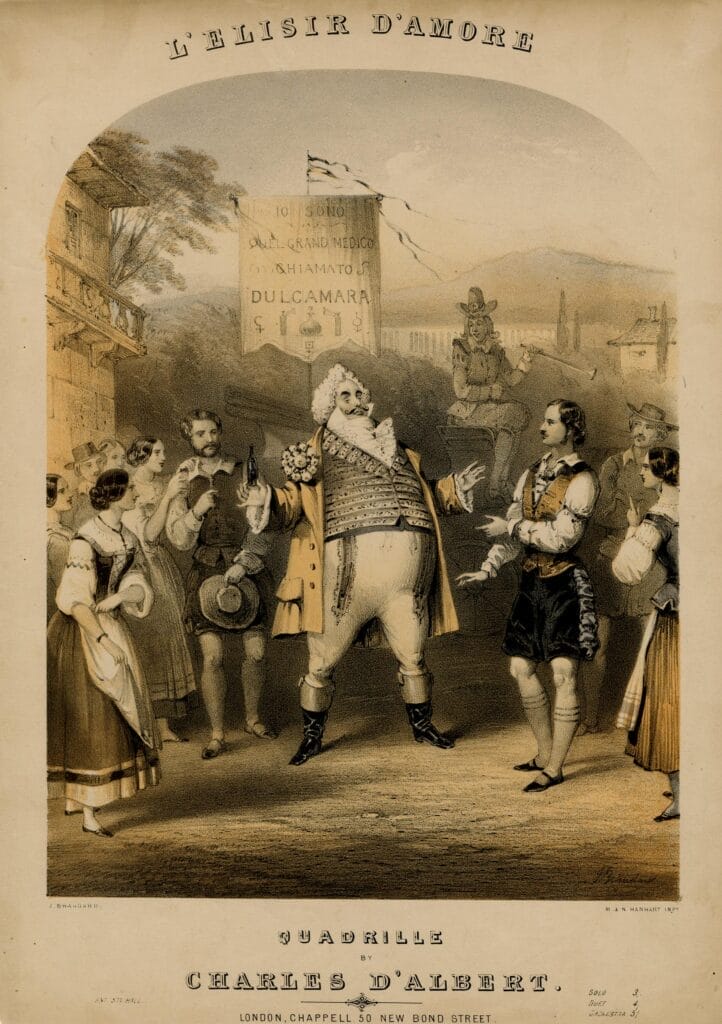
Donizetti’s comic opera L’elisir d’amore (1832) is more than a charming love story set in the Italian countryside. At its core is one of opera’s most memorable charlatans: Doctor Dulcamara. He is a traveling medicine vendor whose snake-oil salesmanship reveals the human desire for magical solutions. Through Dulcamara, Donizetti and his librettist Felice Romani offer a sharp critique of medical quackery—a common phenomenon in early nineteenth-century Europe.
Dulcamara arrives in the village square with theatrical fanfare, announcing himself as a universal doctor whose miraculous elixir can cure everything from toothache to old age. His entrance aria, “Udite, udite, o rustici,” is a masterclass in the rhetoric of the charlatan. Building on this introduction, Dulcamara adopts the pseudo-learned language of medicine, piling up ailments and remedies with the breathless confidence of a man who has never been contradicted, or at least has always moved on before he could be. His very name signals Donizetti’s satirical intent: dulcamara is the Italian name for bittersweet nightshade, a plant historically used in folk remedies but actually toxic. The doctor is, in name alone, both sweet and poisonous.
The opera’s plot turns on the gullible young Nemorino, who purchases a bottle of Dulcamara’s elixir in hopes of winning the affection of the beautiful and independent Adina. Dulcamara, sensing easy money, tells him the bottle is the “Elixir of Love”—the very potion from the legend of Tristan and Isolde. It is simply a cheap Bordeaux wine. This deception captures a central feature of historical quackery: the exploitation of literary and mythological authority to lend fraudulent products an aura of ancient, proven power. Nineteenth-century patent medicine advertisements routinely invoked classical antiquity, royal endorsements, and miraculous testimonials to part credulous consumers from their money. Dulcamara is simply performing, with operatic exaggeration, what real vendors did every day at market fairs across Europe.
What makes the opera’s treatment of quackery sophisticated is that it refuses simple moral condemnation. The elixir “works”—though not for any chemical reason. Nemorino, emboldened by the wine and the false confidence it instills, begins to act more freely. When he unexpectedly inherits his uncle’s fortune, and women suddenly flock to him, he attributes the miracle to the potion. Donizetti is making a subtle point about the placebo effect long before this concept had a clinical name. The elixir works because Nemorino believes it will work, and because external circumstances conspire to confirm that belief. The medicine is fraudulent; the healing, in some sense, is real.
Further complicating this dynamic, Dulcamara is a figure of comic ambiguity. He is a fraud and a coward. Ready to flee when things get complicated, he is also witty and self-aware. When Adina, wiser than Nemorino, sees through him, he adapts instantly. He is a spin doctor, influencer, and self-promoter. Romani’s libretto suggests that quackery endures not only because of ignorance but also because charlatans are entertaining and useful. They fill the gap between what science provides and what people wish for.
Ultimately, L’elisir d’amore survives as more than a showpiece for beautiful melodies. It is a comedy with intellectual bite. Its depiction of medical quackery is affectionate but clear-eyed. People will always want something that promises love, and there will always be a Dulcamara, grinning from his carriage, ready to sell it.