
Yogesh Salphale
Chandrapur, India
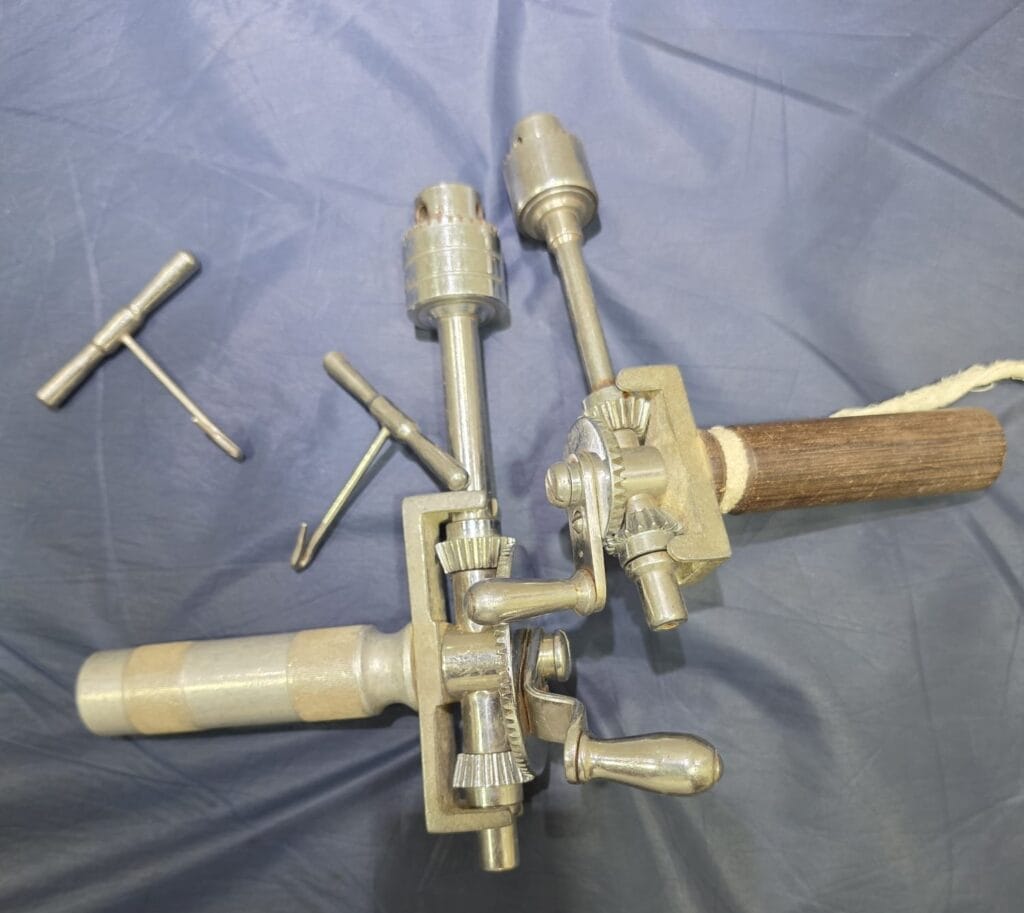
In the modern operating theater, the soundtrack is one of high-frequency whines and digital pings. We have entered the era of the “power-driven” surgeon, where battery-operated drills, robotic arms, and navigated arrays have turned the once visceral act of orthopedics into a clean, almost detached geometry. But as I look at the sleek, disposable kits that arrive at my hospital in Chandrapur, I find myself mourning the quiet disappearance of the “analogue” tools—the heavy, stainless-steel instruments that required not just a hand, but a soul.
I started my career when the “feel” of the bone was the primary diagnostic data. My hands still carry the muscle memory of the old manual T-handle reamer. Unlike the silent, high-RPM efficiency of today’s equipment, the T-handle was an extension of the surgeon’s own nervous system. As I turned it, the resistance of the medullary canal was not a number on a screen; it was a vibration that traveled through the steel, into my palms, and up my forearms.
The old steel told a story. It spoke of the density of a young man’s femur, the brittle fragility of an osteoporotic hip, or the hidden “give” of a brewing infection. There was a dialogue between the metal and the marrow. When we use a power tool, we are dictating terms to the bone. When we used the manual reamer, we were listening to it.
We are told that automation increases safety, and in many ways, it does. But there is a subtle, dangerous trade-off: the loss of the “surgical instinct.” When an instrument is power-driven, the feedback loop is severed. The speed of the machine outpaces the speed of human tactile perception. By the time the machine “feels” the resistance, the heat has already been generated, or the cortex has already been breached.
I remember my mentor handing me a hand-cranked drill early in my residency. It looked like something from a Victorian carpenter’s workshop. “This drill,” he told me, “will teach you when to stop before your brain does.” He was right. There is a specific “snap” of the bone when a manual bit breaks through the far cortex—a physical release that informs the hand to cease pressure instantaneously. It is a lesson in restraint that a foot-pedal-controlled motor can never replicate.
There is also the matter of the “ghosts” in the steel. The old instruments were not disposable; they were companions. They were autoclaved, polished, and laid out thousands of times. A particular Charnley retractor might have been held by three generations of surgeons in the same hospital. It carried the microscopic scratches of a thousand successful closures and perhaps a few failures. There was a sense of stewardship—a feeling that you were merely the current custodian of a craft that preceded you and would outlive you.
Today’s disposable culture suggests that the tool is merely a commodity. If it is used once and discarded, it loses its narrative. It becomes a ghostless object.
As a surgeon who also holds a degree in law, I often think of the “duty of care” as something that resides in the hand. If we lose the ability to “feel” the surgery, do we also lose a layer of our ethical connection to the patient? When the surgery becomes a series of digital inputs, the patient risks becoming a set of coordinates rather than a living, breathing architecture of bone and blood.
I still keep a few of the “old guards” in my cabinet. Occasionally, when a power tool fails or a battery dies, I see the younger residents look at these manual instruments with a mix of curiosity and fear. They see an obsolete relic; I see a bridge. I see a tool that demands my full attention, my physical strength, and my total presence.
We must embrace the future, of course. Robotics and navigation will save lives and improve outcomes. But as we move forward, we must find a way to preserve the “analogue heart” of our craft. We must remind the next generation that the most important instrument in the room is not the one plugged into the wall—it is the hand that knows how to listen to the steel.
DR. YOGESH S. SALPHALE is a consultant orthopaedic and trauma surgeon in Chandrapur, India. Alongside clinical practice in a resource-constrained setting, he writes on medicine, ethics, and the human stories that unfold around injury, healing, and surgical care.