Nicholas Chong
Boston, Massachusetts, United States
“I will hurt you if you touch my legs.”
My hand stopped midair, hovering inches from his shin. The patient lay rigid in bed, eyes fixed on the ceiling, his voice edged with pain and warning. For a moment, I was unsure whether he was speaking out of anger or desperation. My body responded before my mind could catch up—heart quickening, shoulders tightening, thoughts stalling. I was a medical student on an inpatient medicine rotation at a Veterans Affairs hospital, and for the first time, I could not step away from a difficult encounter.
Earlier in my training, while working as a medical assistant in radiation oncology, I had learned to retreat from hostility. When patients raised their voices or responded with sarcasm, I deferred to another provider. I told myself this was professionalism—recognizing my limits and preserving the therapeutic relationship. In truth, it was avoidance. Fear and surprise would cloud my thoughts until I froze, unable to respond clearly. The encounter would end, but the discomfort lingered, unresolved.
Now, as a student doctor on the ward team, retreat was no longer an option. I could not transfer care simply because a relationship began poorly. Standing at the bedside, I was acutely aware of my inexperience and felt the imbalance of power carried by a white coat I was still learning to wear.
The patient was an older veteran admitted after multiple falls. He lived with chronic pain and severe peripheral neuropathy following years of cancer treatment. During my interview, he frequently changed his answers, sometimes contradicting himself within the same sentence. When I attempted to examine him, he recoiled. “Don’t touch my legs,” he warned again, raising his voice. His pain was real, but so was the urgency of understanding the medical situation.
When the team returned, my attending physician explained the need to assess his strength and sensation. As she examined him, he groaned, gripping the bed rails. “I told you not to touch my legs,” he said sharply. She apologized and explained that the examination was necessary to understand what was happening and how best to care for him. The words were careful and kind, but they landed on a patient already bracing himself.
Then, almost as an afterthought, he added that he had not eaten all morning.
The comment felt jarring in its simplicity. I stepped out of the room and returned with crackers and applesauce from the pantry. As he ate, his shoulders relaxed and the tension in his face softened. The change was subtle but unmistakable. Standing there, an uncomfortable realization took hold. Before we could expect cooperation or consent, he had to be able to trust us with his needs. We had overlooked something basic: his hunger had crowded out everything else.
That afternoon, I returned with the resident to reassess him. He refused an MRI, despite new lower extremity weakness and urinary symptoms concerning for spinal cord compression. Rather than pressing forward, the resident pulled up a chair and sat down to be eye-level with the patient.
“It’s you and me,” he said. “Not you versus me. Can you tell us what worries you about the MRI?”
The shift in posture changed the tone of the room. The patient explained that he feared contrast. Years of repeated imaging for cancer surveillance had left him dreading the familiar discomfort—the warmth spreading through his body, the loss of control. When we reassured him that this study would not require contrast, he agreed almost immediately. The barrier had not been stubbornness, but an unspoken fear we had not yet asked about.
Later that day, laboratory results returned with an elevated D-dimer, raising concern for a pulmonary embolism. We returned to explain the finding and the need for a CT pulmonary angiogram—this time, with contrast. The calm we had built evaporated.
“Why do you keep finding new things and testing for them without telling me?” he demanded.
As he spoke, I recognized something familiar. In oncology clinics, I had seen how patients learned to brace themselves against bad news. Anxiety often surfaced as anger, fear disguised as hostility. This time, instead of retreating inward, I stayed present. I tried to hear what sat beneath his words: a desire for control in a body that had betrayed him repeatedly.
We apologized for overwhelming him and explained why the test mattered. He listened, arms crossed, unconvinced. Then he turned toward me.
“I want to know what the student thinks.”
The question caught me off guard. I was not the decision-maker, yet I was suddenly visible. I hesitated, aware of the balance I needed to strike—between validating his fear and supporting the team’s assessment. Speaking too forcefully felt inappropriate; saying nothing felt like retreat.
“Sometimes the tests are uncomfortable,” I said. “But in medicine, we weigh the risks and benefits. In your case, I think the benefit of knowing and treating something fatal outweighs the discomfort.”
He studied my face for a moment, then laughed. “Do you work for the United Nations?”
I laughed too. It was the first time I had seen him smile.
He agreed to the testing.
I did not solve his fear or erase his frustration. But something shifted—not in the plan, but in the posture of the encounter. When I stayed present instead of stepping back, the conversation softened. We were seeing eye-to-eye yet side-by-side.
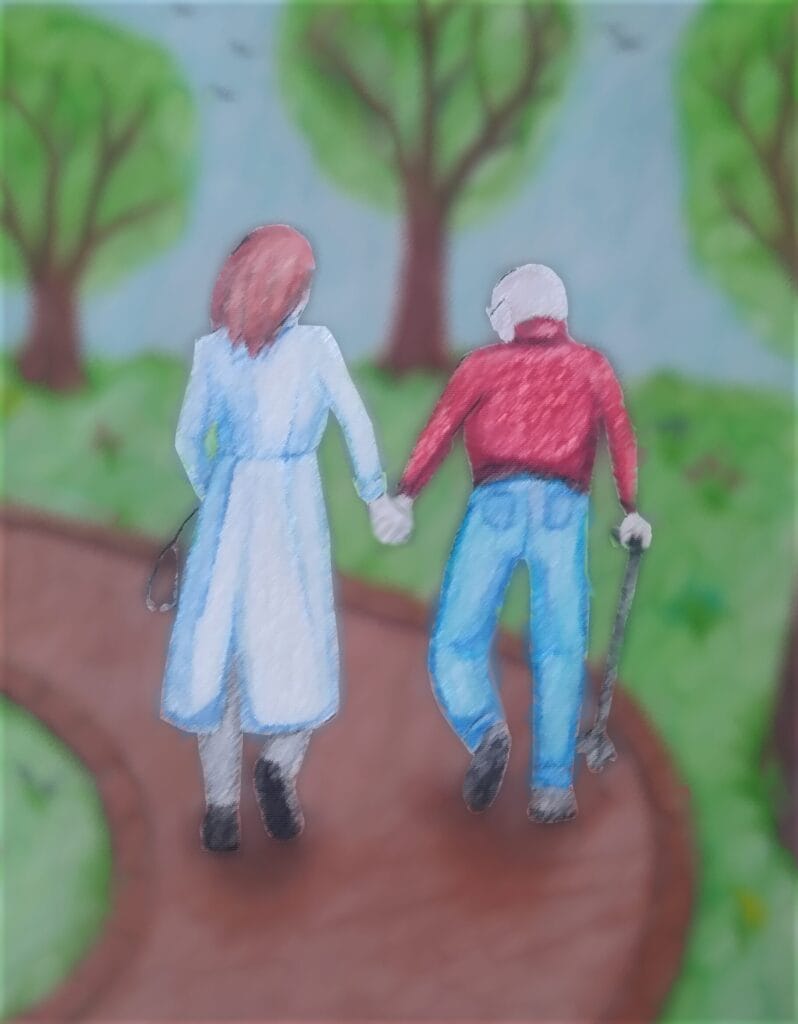
As a student, my role was limited. I could not order tests or make final decisions. Still, I found that presence carries weight. In a system that often moves quickly past discomfort, slowing down long enough to meet a patient where they are can change the course of care. Oftentimes, patients want to be seen and not just managed. Convincing them that we are on the same side shows sincerity and allows them to trust and hold our hand on a path too treacherous to walk alone. Ultimately, while patients need someone to walk ahead of them, they also need someone to walk beside them.
NICHOLAS Y.K. CHONG is a third-year medical student at Boston University Chobanian & Avedisian School of Medicine. His interests include narrative medicine, ethics, and the human dimensions of clinical care. His writing explores identity formation, physician–patient relationships, and subtle dynamics of bedside practice. He is particularly drawn to how proximity, language, and presence shape the experience of illness and healing.