
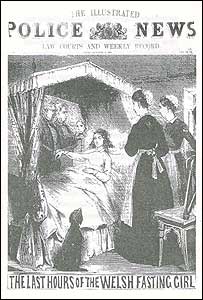
In 1869, a twelve-year-old Welsh girl named Sarah Jacob became famous for claiming she had eaten nothing for two years. Crowds came to visit her at her family farm, and many made donations. She lay in a decorated bed wearing a crown of flowers, serene and apparently healthy—the “Welsh Fasting Girl.”
There had been several similar cases of young women who claimed to have lived without food for months or years. Some acquired devoted followings, drawing on a long tradition of women who had also refused nourishment.
The reaction to Sarah’s claim was divided. Some people were convinced; others smelled fraud. It was the practice to investigate such cases by arranging a period of independent supervision. In Sarah’s case, a formal medical watch was arranged in November 1869. Nurses from Guy’s Hospital attended. Under strict observation, Sarah deteriorated rapidly. Her family refused to authorize feeding even as she weakened. Within two weeks, she was dead. Her parents were tried for manslaughter and convicted.
Some authorities have interpreted Sarah’s case as an early instance of anorexia nervosa, described by William Gull in 1873. The case also illustrated the medical profession’s discomfort and uncertainty about how to interpret the situation.