Crimea, on the Black Sea, has been successively inhabited by Cimmerians, Scythians, and Greeks. Around the sixth century BCE, colonists from Greece established important settlements in Crimea, such as Chersonesus (near modern Sevastopol) and Pantikapaion (modern Kerch). The Greek influence during the classical period is reflected in plays such as Euripides’ Iphigenia at Tauris, the distant town in Crimea to which Agamemnon’s daughter was taken to serve as the priestess of Artemis. Crimea came under Roman rule later, and during the Byzantine period served as an important outpost of Eastern Christianity.
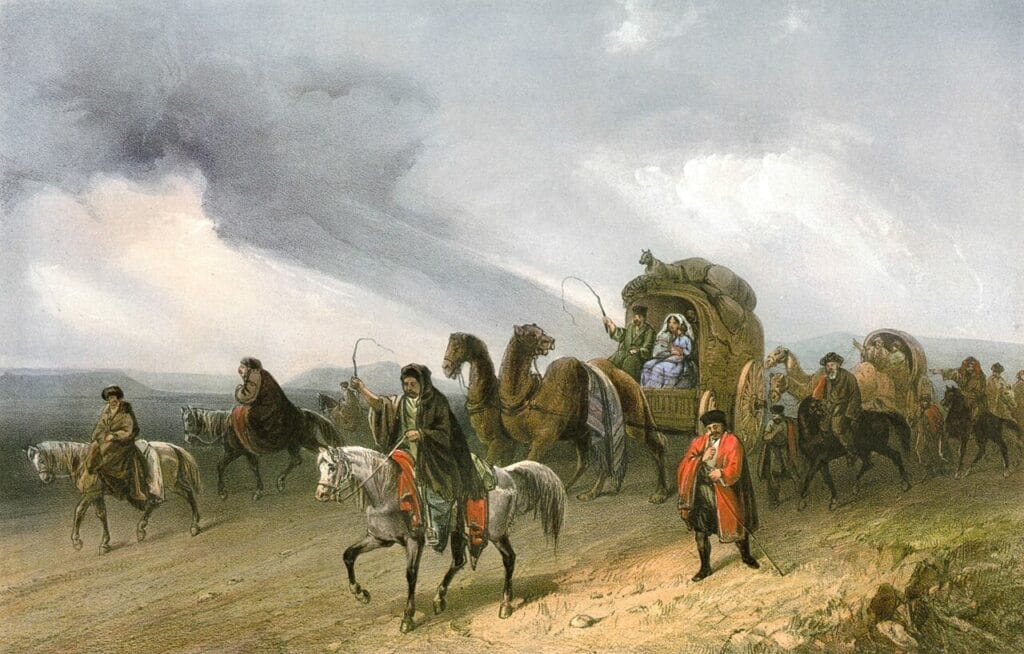
During the Middle Ages, Crimea became part of the Khazar empire. In the 13th century, the Mongol’s Golden Horde occupied it, and later Italian merchants from Genoa and Venice established trading posts along the coast. In 1475, the Ottoman Turks conquered the area. They established the Crimean Khanate as a semi-autonomous vassal state. For nearly three centuries, the Crimean Tatars dominated the peninsula and conducted lucrative trade.
In 1783, Catherine the Great annexed Crimea. The Russian Empire developed Sevastopol as a major naval base and encouraged Russian and other Slavic settlements. During the Crimean War (1853–1856), the armies of England and France besieged Sevastopol as part of their war against Russia. The War is memorable for revolutionizing nursing through Florence Nightingale’s work of treating wounded soldiers in field hospitals, establishing modern nursing practices, and emphasizing sanitation’s role in preventing disease, which killed far more soldiers than combat wounds. The Crimean War also spurred innovations in field surgery, hospital organization, and the treatment of infections, influencing medical practice for generations.
In the 20th century Civil War that followed the Russian Revolution, the Soviets prevailed and in 1921 incorporated Crimea into the Soviet Union. Nazi Germany occupied Crimea from 1941 to 1944. After World War Two, Stalin deported the entire Crimean Tatar population to Central Asia, accusing them of collaboration with Germany.
In 1954, Soviet leader Nikita Khrushchev transferred Crimea to the Ukrainian Soviet administration. This seemed to be a mere administrative change at the time, but it would have profound consequences decades later. When the Soviet Union dissolved in 1991, Crimea became part of an independent Ukraine, though it retained its autonomous status and maintained strong cultural and economic ties to Russia. The Russian Black Sea Fleet remained based in Sevastopol under lease agreements, a unique situation of divided sovereignty.
Problems came to a head in 2014 during Ukraine’s Euromaidan revolution. Following the ousting of the pro-Russian President Viktor Yanukovych, Russia occupied Crimea and subsequently annexed it. Infrastructure was developed through projects such as the Kerch Bridge, which connects it to mainland Russia. Crimea’s population now includes Russians, Ukrainians, and Crimean Tatars who have gradually resettled after their deportation. The region’s future status remains one of the most contentious geopolitical issues in Europe, especially intensified by Russia’s invasion in 2022.