Lorenz Heister (or Laurentius Heister in his Latin works) was a prominent German general, eye surgeon, and professor of anatomy and surgery at the University of Altdorf, Germany. Heister contributed significantly to surgical practice, particularly through his influential surgical books, which hold a place in medical literature comparable to that of Ambroise Paré.
Born to a lumber merchant, he attended Frankfurt Gymnasium and had private lessons in languages. From 1702–1703, he studied at the University of Giessen, where he conducted his initial dissection of a male corpse. Later, he studied in Leiden and Amsterdam, immersing himself in botany and anatomy studies.
He subsequently moved to the University of Wetzlar, completing his medical education in 1706. The next year, Heister served as an assistant physician during the War of the Spanish Succession, gaining valuable surgical experience. He obtained his MD from the University of Harderwijk in 1708 and furthered his studies in Leiden, learning from renowned scholars such as Bernard Albinus. Returning to Amsterdam, Heister provided anatomy lessons with cadaver demonstrations, catering to French and German-speaking students.
In 1711, he was appointed professor of anatomy and surgery at the University of Altdorf, and later, in 1720, at Helmstädt. His teaching roles encompassed theoretical medicine, botany, and practical medicine, leaving a profound impact on his students.
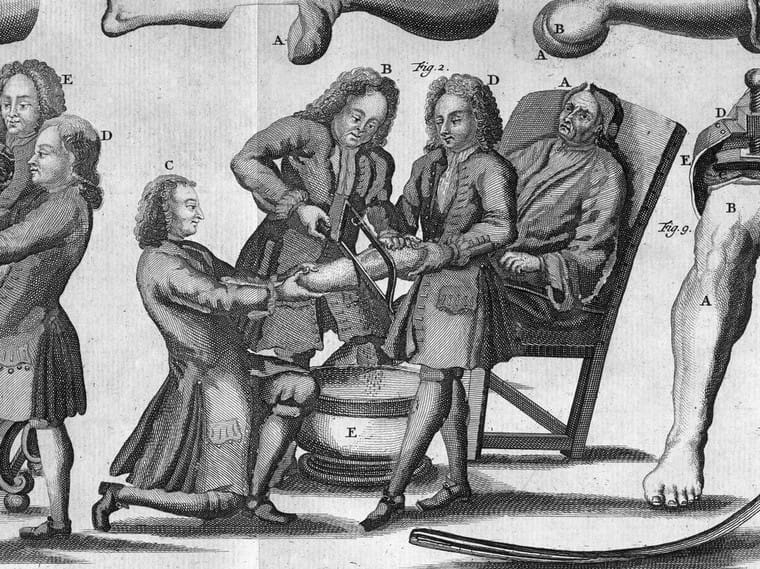
His comprehensive work Chirurgie was widely translated into all major European languages, Latin, and even Japanese. It went through numerous editions between 1719 and 1814, becoming a standard reference for generations of surgeons and physicians worldwide well into the nineteenth century.
He introduced the use of spinal braces, pioneered the use of tracheotomy, and conducted the first post-mortem examination of appendicitis.1 His vast collection included a library of over 12,000 volumes, an herbarium spanning ninety volumes, and 470 surgical instruments, many crafted from silver.
End note
- For more on the history of appendicitis and the role of Heister, see Jayant Radhakrishnan and Nathaniel Koo, “The appendicitis conundrum,” Hektoen International Spring 2022, https://hekint.org/2022/04/07/the-appendicitis-conundrum.