
Cristóbal S. Berry-Cabán
Fort Bragg, North Carolina, United States

Rudyard Kipling’s writing is inseparable from the British Empire in India, offering a vivid examination at how imperial power, military life, and disease collided. Among the many diseases that plagued the region, cholera was especially terrifying.
Kipling’s “Cholera Camp” is a grim narrative poem told from the perspective of British soldiers in India, where the mass mortality from cholera overshadowed all military discipline and pomp. It powerfully conveys the harsh, unromanticized reality of colonial life, showing the working-class troops resorting to dark humor and unconventional solace to cope with an unfamiliar environment and an epidemic worse than war.1
Kipling’s Indian lens
To understand Kipling’s poetry, one must first grasp the world that shaped him. Born in Bombay in 1865 to English parents, his early years unfolded amid the sights, sounds, and languages of India. Raised largely by Indian servants, he spoke vernacular Urdu with ease and formed a deep, instinctive bond with the country. That connection was later tempered by twelve years of what he would call “exile” at school in England. Returning to India as a young journalist for The Civil and Military Gazette in Lahore, he gained a singular perspective, reporting on the pageantry of the British Raj by day while venturing into the “shadier side” of Indian life on nocturnal prowls. In a letter, he confessed his love for the land in all its complexity: its “heat and smells of oil and spices, and puffs of temple incense, and sweat, and darkness, and dirt and lust and cruelty.”2 This tension—between imperial order and simmering chaos—became a defining feature of his work.3
Kipling’s keen journalistic eye was matched by a lifelong fascination with medicine. For a time, he even contemplated becoming a physician, an ambition cut short after a harrowing encounter with a post-mortem that left him so shaken his sister remembered him saying, “I believe I threw up my immortal soul.”4 Though he recoiled from the practice itself, his interest in illness, sanitation, and public health never waned. As a journalist, he sparred with Lahore’s municipal authorities over sanitation policies and later wrote blistering critiques of Calcutta’s public hygiene. This grounding lent his poetry and fiction an unusual authenticity. Whether depicting smallpox, fever, or the mental toll of insomnia, his poetry and fiction are strikingly vivid, rooted in what he described as a “blotting-paper mind” that absorbed every detail he saw or heard.5
Cholera: Invisible enemy of empire
Cholera was the signature disease of the nineteenth century, with India widely regarded as its “home.” Originating in the Ganges Delta, it spread rapidly along the new trade routes and military corridors opened by the East India Company, becoming the era’s signature epidemic.6 Caused by the bacterium Vibrio cholerae that flourishes in contaminated water and food, the disease often strikes silently. Many carriers show no symptoms, yet in others it triggers violent, watery diarrhea that can lead to catastrophic dehydration and death within hours. Its swiftness and lethality made cholera a specter of deep and enduring fear.7
For the British colonial administration, disease control was synonymous with governance.8 A healthy fighting force was the bedrock of imperial security, and a cholera outbreak could devastate an entire regiment in days, shattering morale and undermining the carefully constructed image of British invincibility. Thus, India became an experimental ground for British sanitary science. However, the prevailing medical theories were often inadequate. The struggle between miasmatic theory (that blamed “bad air”) and the emerging germ theory meant that official responses were often inconsistent and ineffective.9
For Kipling, writing from within this milieu, cholera represented the invisible, uncontrollable forces of nature that defied human authority and exposed the vulnerability of the colonial regime.
“Cholera Camp” (subtitled, “Infantry in India”) distills these tensions into a single, harrowing scene. Written in the voice of a common “Tommy Atkins,” (slang for a soldier in the British army), the poem adopts the soldier’s vernacular to convey a mixture of grim humor, fatalism, and soldierly grit. The poem opens with a stark declaration of their plight:
We’ve got the cholerer in camp—it’s worse nor forty fights;
We’re dyin’ in the wilderness the same as Isrulites;
It’s before us an’ be’ind us, an’ we cannot get away,
An’ the doctor sez he doesn’t know how cholerer comes our way.
The soldiers face not heroic combat but an invisible enemy that shapes every aspect of their existence. Death becomes routine: “ten more to-day” as each day brings new casualties. The disease seems inescapable, following the troops no matter how far they march or how quickly they are transported by rail. This inevitability creates a grim backdrop in which survival depends less on discipline or courage than on sheer chance.
Daily life in the camp is stripped of its normal routines and comforts. Recreation, drink, and even the soldiers’ usual diversions vanish under the weight of sickness.
“There ain’t no fun in women nor there ain’t no bite to drink,” Kipling’s speaker laments. Neither are the officers immune to this erosion of spirit; the colonel himself grows pale and exhausted, unable to sleep or eat, and spends his days in a hospital that “does no good.”
Yet despite the devastation, the poem reveals flickers of resilience. The Protestant chaplain and the Catholic Father Victor attempt to comfort the men with songs, jokes, and prayers, though even these rituals feel insufficient when death becomes commonplace. In portraying these efforts, Kipling shows the soldiers’ instinct for comradeship and coping, even in conditions that sap hope. Humor and religion become survival tools, sustaining a fragile sense of solidarity amid despair.

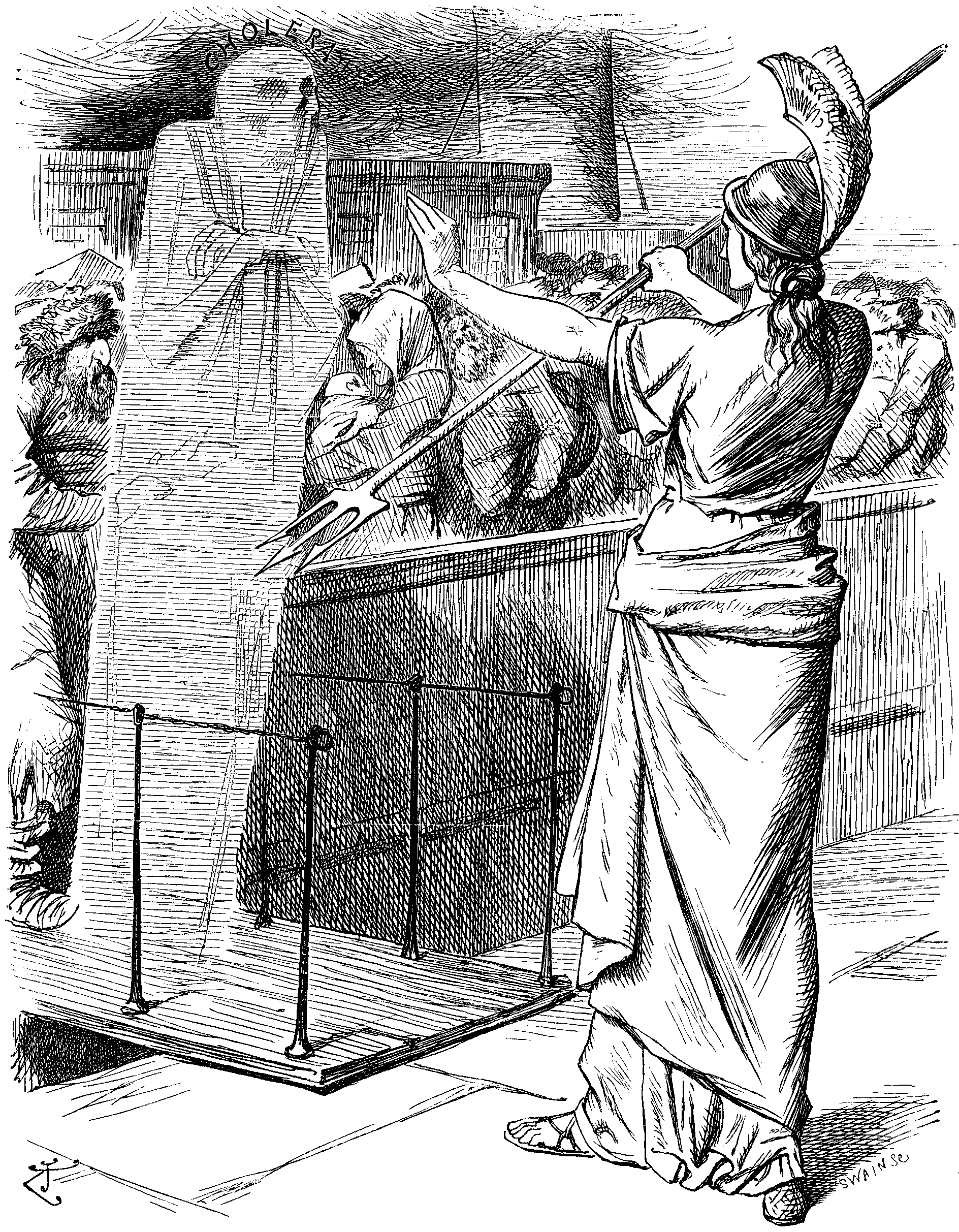
The politics of cholera
While Kipling’s sympathies in “Cholera Camp” clearly lie with the British soldier, his work cannot be divorced from the colonial context and its inherent racial politics. The British frequently blamed the spread of cholera on “native” habits—poor hygiene, religious pilgrimages, and crowded living conditions—while conveniently ignoring the role of colonial policies in creating structural inequalities and environmental degradation. Kipling often reflected this condescending view, treating Indian beliefs about disease with a mixture of curiosity and dismissal.5
Yet the shared experience of the epidemic complicates this binary view. In the face of agonizing death, the rigid hierarchies of the colonial system could become porous. In “Cholera Camp,” the soldier’s voice is notable for its lack of racial blame; his despair is existential, directed at the disease itself and at the helplessness of his situation rather than at a human scapegoat. This shared suffering represents a crack in the imperial façade, a moment where the illusion of the invulnerable, all-knowing colonizer collapses.
“Cholera Camp” presents the British Empire at its most fragile. Disease lays bare the limitations of military might, medical science, and imperial hubris. The meticulously ordered world of the British Army, with its marching drills, inspections, and clear chain of command, proved impotent against an unseen biological foe. Maintaining order in the midst of chaos became an act of resistance and a source of dignity. Kipling’s contribution lies in his focus on the human experience within the vast, impersonal machinery of empire. The soldiers of “Cholera Camp” are not mere agents of colonial power but individuals grappling with fear, loyalty, and their own mortality. In Kipling’s hands, cholera transcends its clinical definition to become a powerful metaphor for the uncertainty and peril that haunted the British presence in India, documenting not only the spread of illness but also the erosion of authority, the redefinition of bravery, and the uneasy coexistence of empire and entropy.
References
- Kipling R. Cholera Camp. The Kipling Society. 2017. https://www.kiplingsociety.co.uk/readers-guide/rg_choleracamp1.htm
- Roden RF. Rudyard Kipling and his collectors. The Literary Collector, 1903. p. 174–177.
- Gilmour D. The Long Recessional: The Imperial Life of Rudyard Kipling. Macmillan; 2003.
- Kipling R. The Letters of Rudyard Kipling. University of Iowa Press; 1990.
- Bragman LJ. Rudyard Kipling on public health. American Journal of Public Health. 1926;16(6):609–611. https://ajph.aphapublications.org/doi/pdf/10.2105/AJPH.16.6.609
- McNeill WH. Plagues and Peoples. Anchor Press; 1976.
- Pollitzer R. Cholera studies: 1. History of the disease. Bulletin of the World Health Organization. 1954;10(3):421–461. https://www.ncbi.nlm.nih.gov/pmc/articles/PMC2542143/pdf/bullwho00557-0108.pdf
- Downs J. Maladies of Empire: How Colonialism, Slavery, and War Transformed Medicine. Harvard University Press; 2021.
- Waller J. The Discovery of the Germ: Twenty Years that Transformed the Way We Think About Disease. Columbia University Press; 2002.
CRISTÓBAL S. BERRY-CABÁN, PhD, has over 30 years’ experience conducting research on military health as an epidemiologist at Womack Army Medical Center, Fort Bragg, North Carolina and the Geneva Foundation, Tacoma, Washington. He is the author of over 140 research articles, including several on the history of medicine.