
Óscar Lamas Filgueira
Valencia, Spain
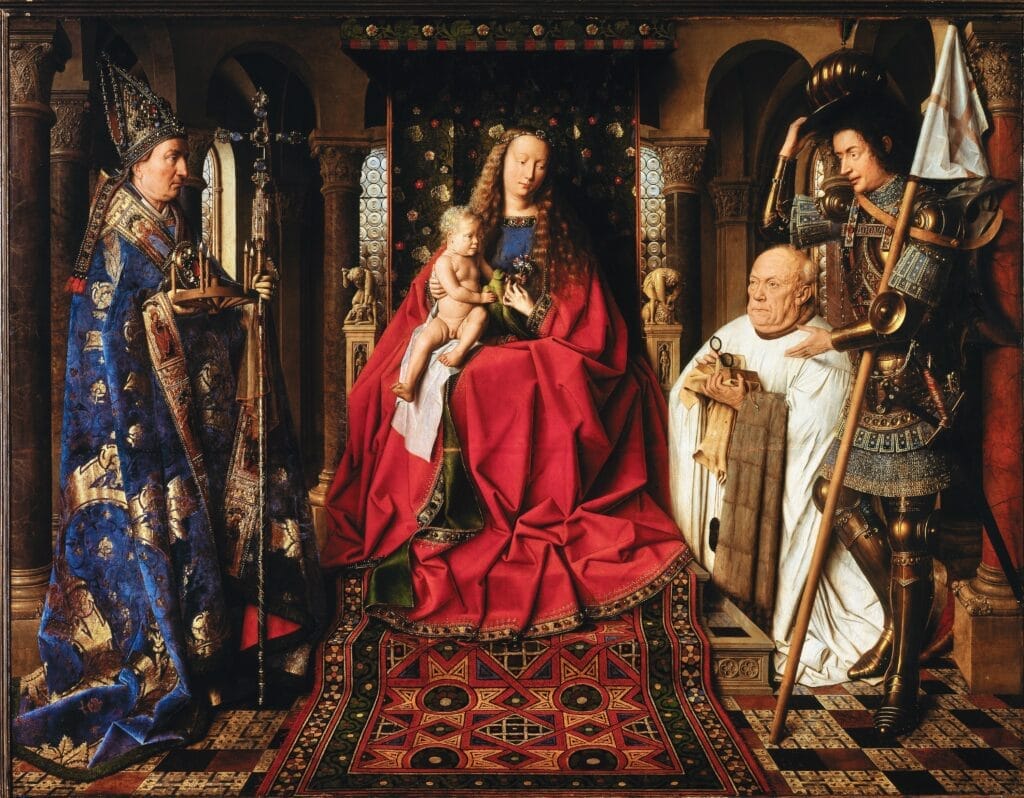
In medicine, we rely on images every day—photographs, X‑rays, scans—that reveal truths our eyes alone cannot grasp. But centuries ago, physicians and healers had no such tools. Their understanding of illness had to be drawn from observation, testimony, and sometimes, from the works of artists who captured the marks of disease on the human body. Paintings and sculptures, if we look closely, are more than symbols of devotion or beauty; they are echoes of suffering, whispers from patients long gone.
The canon Joris van der Paele, immortalized by Jan van Eyck in his great altarpiece, may be one such voice. Through the painter’s meticulous hand, we glimpse signs that, to a modern eye, suggest the toll of a relentless illness. In this work, the canon displays physical findings of giant cell arteritis, including dilatation of the left temporal artery. Yet beyond speculation or diagnosis, what strikes us is the humanity that persists—the frailty of the body, the persistence of faith, and the search for meaning in the face of decline.
I would suggest that Canon Van der Paele might have written about his condition and the vision depicted in the painting this way:
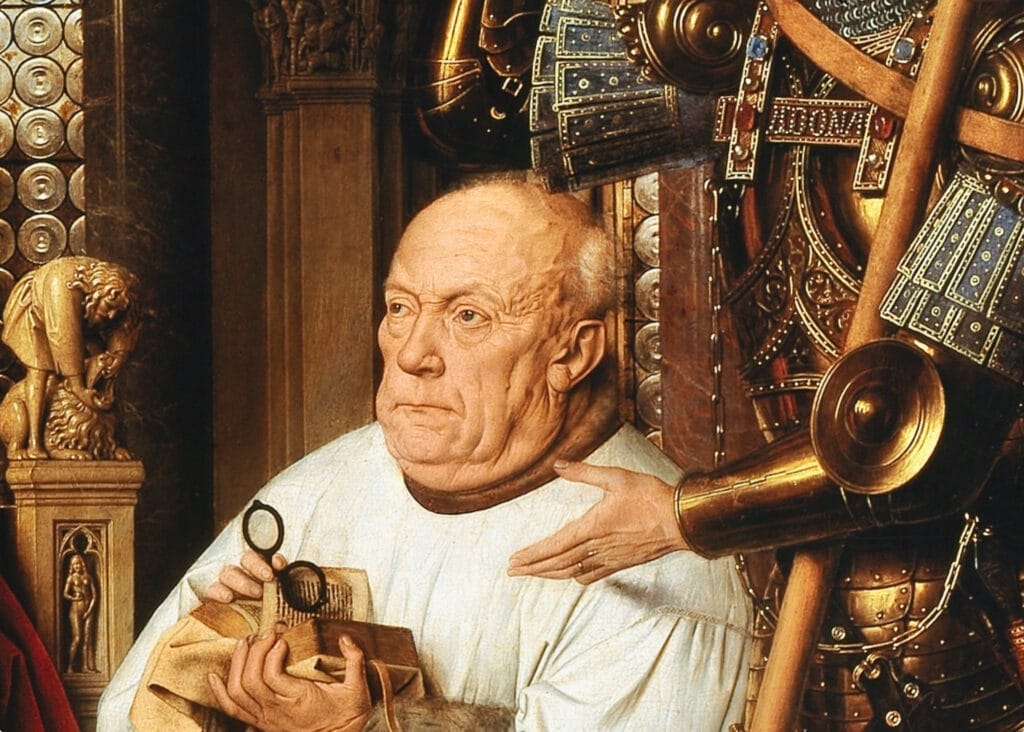
I awoke today before the bells could call me. Not the rooster’s cry nor the sun’s light roused me, but the insistent pain tightening my temples, as if a band of heated iron clasped my skull. Each dawn is the same: a battle with fire that refuses to leave me.
I tried to rise slowly, but my shoulders resisted. They felt burdened with a weight I could not see, as though even the air had turned to lead. Dressing was a trial; the habit that once flowed easily around my frame now clung like a stone, and my hands trembled as I tied the cord at my waist.
At table, the bread turned to stone in my mouth. Chewing brought pain—my jaw stiffened, weary from the simplest act. The voices of my brothers at meal drifted past me as I stared at the board, my sight clouding. A whitish veil covers my right eye, and I fear the left will follow. When I read in the choir, the letters dissolve, and the world reduces itself to haze.
I sought comfort in the library, where ordering the codices once calmed me. Today my hands burned, the tremor so fierce I feared I would tear the parchment. The lamp’s light did not aid me; it pierced my eyes. I closed the volume, resting my brow against the cool page, begging relief from its chill.
Walking the cloister proved no easier. Each step betrayed the weakness in my legs, the quiver in my knees, the fatigue pressing on my chest like stone. The birds sang, but their voices seemed far away, as if even sound sought to abandon me. Yet in the silence, a longing stirred: the desire to go to Her.
At dusk I gathered what little strength remained and entered the chapel. The air within was heavy, almost sacred. And then I saw her. The Virgin, seated upon her throne, clothed in crimson that spilled over a patterned carpet, the Child in her arms playing with a parrot of green and clutching flowers in his hand. Her garments glowed like flame, casting light across Saint George’s shining armor. Beside him stood Saint Donatian, bearing the patriarchal cross and the wheel with its candles, symbol of the miracle that spared him from the river. All shone with a clarity my failing eyes should not grant me—and yet I saw more vividly than ever.
I knelt, clumsy and trembling in every joint. The pain in my head did not cease, nor the burning in my muscles, yet in her presence my torment felt lighter. The Child looked at me; in His gaze was compassion, not reproach. I silenced my laments and prayed in the stillness: “Grant me one more moment of sight—just a single instant—to behold the beauty that flows from You.”
To the right of her throne, I perceived Samson with the lion carved in the wood. To the left, Cain striking Abel. Near Saint George, perhaps it was fever, perhaps truth, I thought I glimpsed a man in a red turban, brush in hand, painting the very scene before me.
Did She answer? My eyes remained clouded, my body frail. Yet something within me lightened. I understood then that I sought not the healing of flesh, but the promise of another vision—truer, purer, beyond the darkness awaiting me.
I remained prostrate, tears upon my cheeks, and knew: She is not here to deliver me from suffering, but to open the door to eternity.
ÓSCAR LAMAS FILGUEIRA is a 6th year medical student at Universidad Católica de Valencia, Spain. His writing explores the dialogue between art, history, and medicine, with a particular interest in narrative medicine.