
Jen He
Vivian McAlister
London, Ontario, Canada

The influence of art on medicine has been emphasized—it separates a physician with clinical acumen from a scholar with medical knowledge, as well as man from machine. Less frequently explored is the historic role that medicine and its innovations have played in advancing the arts.
In a small provincial village in 1895, German physics professor Wilhelm Conrad Röntgen was experimenting with cathode rays. He observed that by covering a Lenard tube with black paper, the cathode rays, which produced fluorescence within the tube, could pass on to illuminate a screen painted with barium platino-cyanide.1 It was in this dark room that Röntgen discovered a new application of a formerly unknown form of electromagnetic radiation, which he called the X-ray. After eight weeks of rigorous and secretive experimentation, he published his seminal work, “On a new kind of rays”, which included the iconic radiograph of his wife’s hand adorned with a ring.2 In the first year of its discovery, there were forty-nine books and more than one thousand articles published on the X-ray.1 Naturally, the sudden ability to see through objects lent itself to practical applications in medicine. The X-ray could now aid in diagnosing and characterizing the extent of diseases and injuries of the bones, in localizing a foreign body, and even in guiding therapies.
A decade following the discovery of the X-ray, a transformation was occurring in the modern art world. Key among its features was the change in representation of the natural world as it appears to our eyes. While the Impressionists had previously used loose brushwork, captured the effects of natural light, and painted from a linear, fixed perspective, Post-Impressionists experimented with form, color and composition to stray from strict representation in favor of an artist’s subjective interpretation. This experimentation laid the groundwork for Cubism (1907–1914), led by Pablo Picasso and Georges Braque, often described as the most important and radical artistic revolution since the Renaissance. Its first phase, Analytic Cubism, focused on fragmentation and abstraction rather than the representation of fleeting moments or the subjective expression that defined preceding movements. Procedurally, this involved looking at a three-dimensional object, fracturing it into its geometric shapes and, on the canvas, representing it from multiple viewpoints simultaneously.
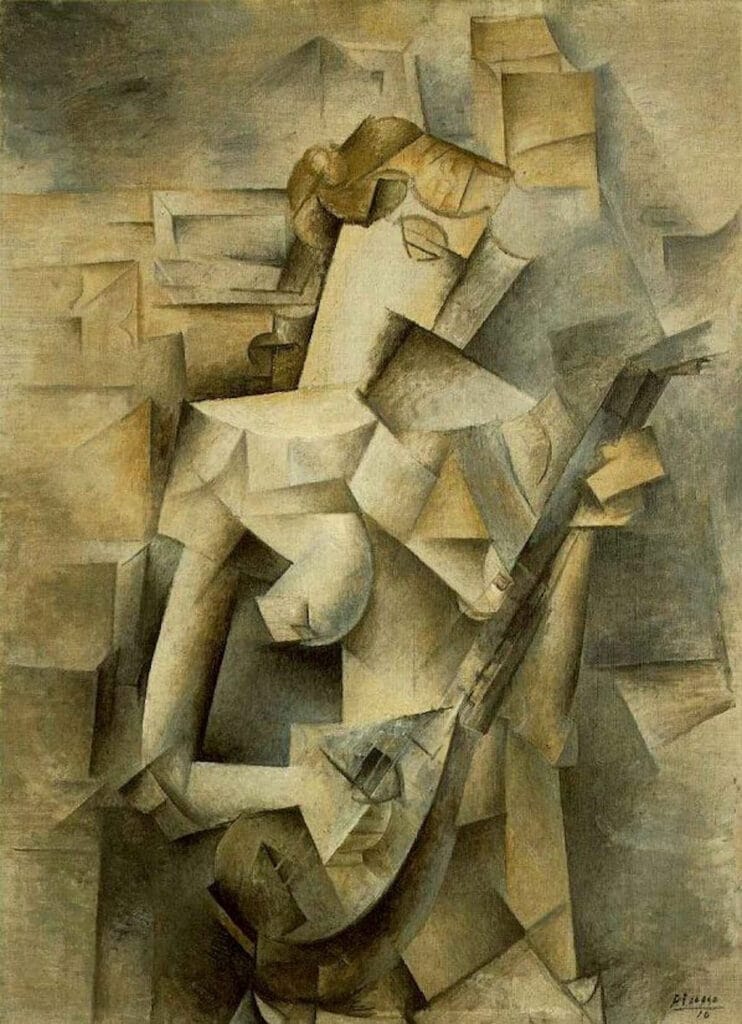
French poet and art critic Guillaume Apollinaire once said, “Picasso studies an object as a surgeon dissects a cadaver.” Painted in the spring of 1910, Picasso’s Girl with a Mandolin serves as a prototypical work of Analytic Cubism. Though it was considered unfinished, Girl with a Mandolin clearly illustrates Picasso’s evolving Cubist technique: an abstracted way of representing its subject, expressed using a muted color palette.
A common theme emerged with the rising popularity of both the X-ray and Analytic Cubism: the notion of a search. What were we searching for? In the years following the X-ray, the search was concerned with what lay beyond the visible. Many started to challenge previous boundaries of visibility and to scrupulously question whether vision itself was reliable.4 Many viewed Analytic Cubism as a new way of seeing that also catalyzed a search. Nikolay Berdyaev, the Russian philosopher, described Cubism as “a reaction against the softening of form in Impressionism, a search for the geometrical quality of the objective world, for the hard underlying structure of things.”5
Although few historical documents explicitly made the connection between X-ray and Cubism, art historians like Stephen Kern had speculated that X-ray must have had something to do with the Cubist “rendering of the interior of solid objects.”4 Unifying this notion of a search between these two movements were endless references to the fourth dimension. At the end of the nineteenth and beginning of the twentieth century, there was a deep fascination with the supernatural. With its discovery, many spiritualist and psychical researchers equated the X-rays to a kind of clairvoyancy or “second sight”, providing a window to the fourth dimension.4 Similarly, there were endless references to the fourth dimension in Cubist literature; Manolo once observed that “Picasso used to talk a lot then about the fourth dimension and he carried around the mathematics books of Henri Poincare.”5
Beyond catalyzing a search within Analytic Cubism, the discovery of the X-ray may have inspired the development of a language, from which Cubists drew inspiration. This language could be defined by elements such as planes, geometric shapes, spacing, and colors. Firstly, the X-ray provided the ability to capture multiple vantage points of a still subject, referred to as an X-ray’s views. Another important feature was its ability to reveal geometric distortions such as a displaced bone fracture, or a dilated loop in a bowel obstruction. Cubism’s adoption of this “language” is evident in its fracturing and reducing of a subject to many planes, then placing them together to denote volume. Regarding the elements of space and color, X-ray images are limited in their contrast resolution (i.e., discriminating between structures with different physical properties), however lauded for their spatial resolution (i.e., delineating the borders of structures). In the same vein, Analytic Cubism chose to focus on what John Locke described as primary, intrinsic qualities (e.g., form and position in space), rather than secondary, perceptible qualities (e.g., tactile and color quality), which would only serve as a distraction within art that was meant to inspire analysis rather than subjective experience.6 This is a stark contrast to the experimentation of bright colors that defined its precedent, Fauvism.
The X-ray not only redefined the vision and expression of Cubists but may have changed the experience of interpretation. Analytic Cubism is recognized as abstracted, however tethered tangentially to the representational. From an observer’s perspective, what elements tether us to the representational? One essential element of reading an X-ray is the acknowledgement of labels. The patient ID, anatomical region, and date are all used for orientation prior to reading. Likewise, in Cubism, the artwork is often so abstracted and indecipherable that the observer who is unfamiliar with this new language relies on a descriptive title: Bottle and Glass, Playing Cards and Dice, Girl with a Mandolin. H.G. Lewis referred to this as “preperception”, in which a title connects us with memory images that allow us to focus more easily on the painting’s subject.5
In addition to labels, the use of clues or “attributes” tethers us to the representational. These attributes may include fragments of pipes or strings of a mandolin that are recognizable to all and act as points of reference for the viewer to “construct the finished object in the mind.”7 The idea of finding a recognizable element to better characterize the image is instrumental in interpreting an X-ray. Classic radiological signs such as the steeple sign, Kerley B lines, and apple core sign are among the clues to recognizing the bigger clinical picture.
Fundamental aspects of radiological imaging are echoed in the principles of Analytic Cubism. Though no evidence exists that Picasso took direct inspiration from Röntgen’s discovery, there was undoubtedly background exposure to the X-ray craze within the art world. Whether or not it was ever acknowledged, the X-ray invoked a search of the invisible, created a new visual language, and introduced unconventional analytical processes which later came to define the Analytic Cubism movement.
References
- Glasser O. Wilhelm Conrad Röntgen and the Early History of the Roentgen Rays. Norman Publishing, 1993.
- Röntgen WC. On a New Kind of Rays. Science 1896; 3: 227–231.
- Apollinaire G. Les Peintres Cubistes (Méditations Esthétiques). Paris, France, 1913.
- Henderson LD. X Rays and the Quest for Invisible Reality in the Art of Kupka, Duchamp, and the Cubists. Art Journal. 1988.
- McCully M. A Picasso Anthology: Documents, Criticism, Reminiscences. Princeton, New Jersey: Princeton University Press, 1982.
- Locke J. An Essay Concerning Human Understanding: Book II. London, 1689.
- Kahnweiler DH. Der Weg zum Kubismus. Stuttgart, Germany: München Delphin, 1920.
JENNIFER HE is a final year medical student at Western University. She has been fascinated by the history of art. She is also interested in radiology, particularly how images inform clinical care when they are interpreted in the context of other domains such as anatomy and clinical knowledge.
VIVIAN C. MCALISTER is a professor emeritus in the Faculty of Medicine and the Department of History.