Florence Gelo
Philadelphia, Pennsylvania, United States
I am a medical humanities educator and museum docent. I use art images to teach clinical skills to family medicine residents. Images grab residents’ attention and simplify emotional learning by making it more engaging and accessible. A painting can transform the theoretical into vivid imagery.
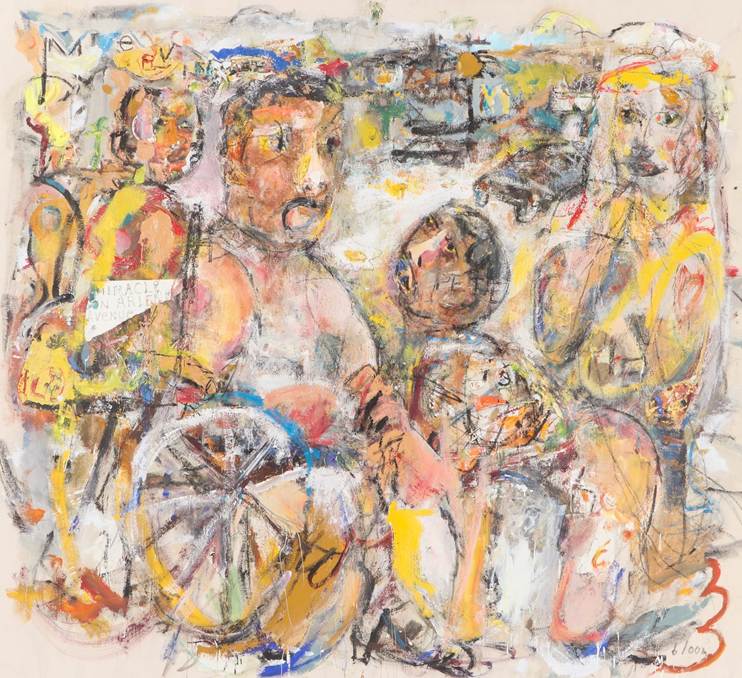
During a gallery tour at Woodmere, an art museum in Philadelphia, a group of twenty medical residents stood in front of a large painted canvas, Jim Bloom’s Miracle on Arles Avenue. The paintingblends figurative and expressionist styles and offers a lens to teach about the process of self-reflection.
I asked residents to identify and name what they saw. Repeated looking and close observation revealed a canvas composed of shapes, colors, and human figures, none too clear except for a central figure of a man in a wheelchair. His eyes stare forward and appear unfocused. Kneeling and looking up at this man is another figure, hands clutched, eyes intense, and face full of urgent expression.
Residents became curious about these two figures and raised questions. Who is the man in the wheelchair? Why is he painted larger than any other figure on the canvas? Who is the kneeling figure: a child, devoted friend, a lover?
I asked the residents to look carefully and closely at the image and name what else they saw. I guided them to look at the upper right background of the painting where images are small and clumped together, making it difficult for the viewer to recognize any one image definitively. Residents named the content as best they could: a family group, a small figure who may be a child, a car or a bed, lots of yellow, a woman with a distorted body and face.
It was then that I shared a story about the artist’s life.
Jim Bloom suffered a debilitating back injury as the result of an automobile accident in 2002, which resulted in a painful movement disorder. I suggested that in this self-portrait, Bloom is remembering the traumatic event that permanently limited his physical functioning. As he reflects, he realizes the moment that left him with a permanent physical injury was also a turning point in his creative life—one that led him to embrace painting as a form of artistic self-expression. At the top center of the painting, the artist recreates a memory of the car accident. Sitting in the wheelchair is a person whose physical and creative life changed radically. We imagine he sits and thinks again about his life.
In the same way Bloom reflects, I prompt residents to name an event in life or in medicine that influenced their thinking. One resident remembers the sudden and accidental death of a parent and a sibling, a first experience of loss and suffering. Another recalls the emotional distress of a patient’s premature loss of her twin pregnancy and his own fear of approaching the wailing woman. Another resident shares a story about a woman who gave birth alone because her spouse could not get a flight home in time, and reflected on how deeply the woman needed to express her anger and place blame in that moment. Another spoke about the fear they felt when a patient who had developed an autoimmune disorder suddenly lost all sensation in her legs and became completely paralyzed within days.
When a resident reflects on their own experiences, they must cultivate receptivity to thoughts and feelings that inevitably arise. When they encounter emotional or intellectual discomfort, they can cultivate skills that enable them to engage with the discomfort constructively, maintaining composure and avoiding becoming overwhelmed. Curiosity and openness may generate new knowledge, deepen understanding, and foster both professional and personal development.
Using paintings and other artwork can also prompt medical residents to engage in developing the ability for reflection. What residents witness when caring for patients can be reminders of the realities of illness, suffering, and death, or they can trigger a personal emotional reaction of, for example, stress or fear. A reflective moment is a moment when we look back and reexamine a decision, memory, or event to generate new insights. Reflection is a continuous learning process that heightens awareness, deepens understanding, and helps us find meaning in our experiences. It invites medical residents to cultivate curiosity and ask thoughtful questions such as:
- What could I have done differently?
- What uncertainties did I have?
- What felt unfinished?
- What were some of the challenges I faced?
- What about this situation was most difficult?
The ability to look and look more closely is the foundation upon which all medical care begins. With practice and increased awareness, residents can learn that understanding is not completed in one moment. Revisiting it over time allows for deeper insight into ourselves, others, and medical practice itself.
FLORENCE GELO is a medical humanities and behavioral science educator. She directed and produced “The HeART of Empathy: Using the Visual Arts in Medical Education,” and uses the visual arts as a teaching tool to enhance clinical skills. She has published numerous articles in professional journals about illness, death and dying.