
Hospitals, like their patients and their doctors, do not last forever. They close their doors and vanish into history. In Chicago, they failed because their patients moved to the suburbs, methods of reimbursement changed, and medicine itself keeps on evolving. Most of the hospitals listed here were not too long ago in the forefront of the medicine practiced in this great city:
Augustana Hospital (1882–1988) was founded in Chicago’s Uptown neighborhood by Swedish Lutherans who not only cared for the sick but preserved cultural ties with Scandinavia. Its school of nursing trained generations of young women, many of whom later returned to serve their communities.
Chicago Osteopathic Hospital (1941–1996), located in Hyde Park, was the flagship for osteopathic medicine in the Midwest, providing hands-on training for osteopathic physicians and offering general and specialty care. By the 1990s, osteopathic education had increasingly merged with mainstream allopathic systems.
Columbus Hospital (1905–2001) was a prestigious private hospital operated by the Sisters of Charity. Famous for the patient service it provided, it had a chapel open at all hours to care for their spiritual needs. After closing, it was redeveloped into a luxury housing facility.
Cook County Hospital, with over 4,000 beds, was, until the 1970s, the renowned training ground for almost every Chicago doctor, as well as for thousands from abroad, and the site of major medical breakthroughs, including the establishment of a blood bank. It was rebuilt in 1999 as the John H. Stroger Hospital.
Doctors Hospital (1916–2000), located in Hyde Park, was closely affiliated with the University of Chicago for most of its history.
Edgewater Hospital (1929–2001) was once an elegant North Side facility, now remembered as the birthplace of Hillary Rodham Clinton. It had a hyperbaric oxygen chamber long before other hospitals realized they needed one.
Englewood Hospital (1894 as Englewood Union Hospital – 1988), a formerly thriving South Side hospital, closed during the wave of urban disinvestment and demographic change in the 1980s, leaving a healthcare vacuum in one of Chicago’s most challenged neighborhoods.
Grant Hospital of Chicago (1883–2008), located in Lincoln Park, was founded by the German community and evolved into a general hospital with strong surgical services, critical during Chicago’s industrial expansion when workplace accidents were frequent.
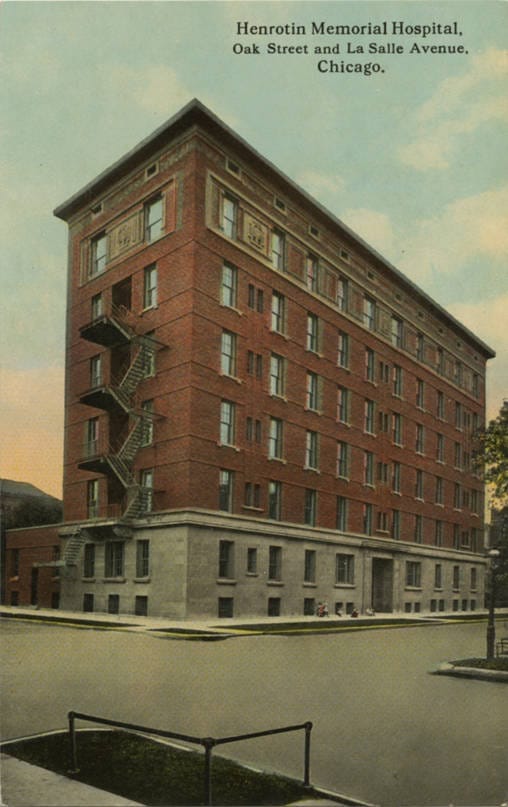
Henrotin Hospital (1884–1986) is remembered in musical circles because, in the 1930s, a famous opera star had her tonsils removed there. Before being acquired by Northwestern Hospital, it had an excellent medical staff that was treated to steak and lobster at its monthly meetings.
Mary Thompson Hospital for Women and Children (1865–1988) was the first hospital for women patients and doctors in Chicago, but later became a general hospital. It appointed its first male physician in the early 1960s and provided care to a large outpatient population.
Mercy Hospital and Medical Center (1852–2021) was the oldest chartered hospital in Chicago. It served the South Side for nearly 170 years and carries the distinction of being the birthplace of Pope Leo XIV. It was purchased in 2021 and renamed to Insight Hospital and Medical Center.
Michael Reese Hospital (1881–2009) was one of the most distinguished hospitals in Chicago, renowned for its teaching, research, and reputation as a referral center. Many of its staff members joined the University of Chicago or the University of Illinois. Its legacy survives in the form of an active foundation that supports patient care and research.
Mother Cabrini Hospital (1910–2001) was an extension of Columbus Hospital operated by the Missionary Sisters of the Sacred Heart on the Near West Side and, at one time, catered particularly to Catholic immigrant families, especially those of Italian descent.
Passavant Memorial Hospital (1865–1972) was founded by the Lutheran pastor William Passavant and initially served German immigrants on Chicago’s Near North Side. Known for its charity care and surgical innovations, it expanded steadily through the 19th and early 20th centuries. However, by the 1970s, it merged with Wesley Memorial, becoming today’s Northwestern Memorial Hospital.
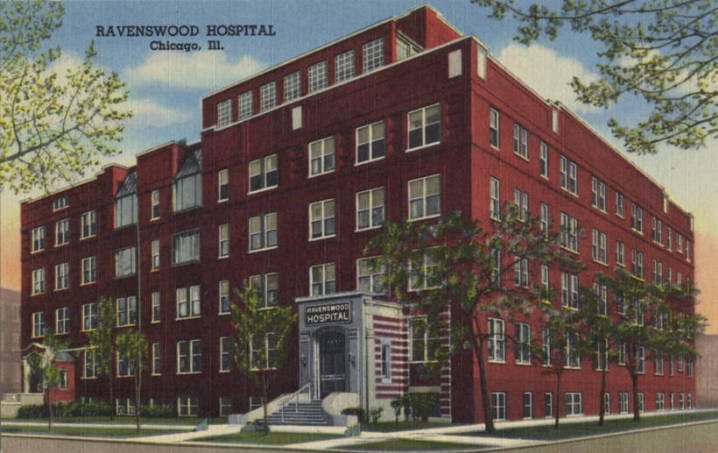
Ravenswood Hospital Medical Center (1907–2002), located in Lincoln Square, served Chicago’s North Side with a strong reputation for cardiology, orthopedics, and community care. At its peak, it had over 300 beds and served as a teaching site for medical residents.
Sacred Heart Hospital (1920s–2013) was a small institution on the West Side that served its community faithfully for decades. It collapsed in 2013 amid a scandal involving inappropriate financial procedures.
St. Anne’s Hospital (1904–1988) served a diverse mix of immigrant groups on Chicago’s West Side, especially Polish and Lithuanian families. Its maternity ward was especially well known, welcoming thousands of babies over the decades.
St. Elizabeth’s Hospital (1887–1988) was a hospital on the Near Northwest Side, founded by the Sisters of the Holy Family of Nazareth, primarily to serve Polish and German immigrants. It offered maternity and pediatric care and provided charity for struggling families.
St. Luke’s Hospital (1864–1956, as an independent entity) was founded during the Civil War era on the South Side and grew into a respected teaching hospital. In 1956, it merged with Presbyterian Hospital, forming the modern Rush University Medical Center.
Wesley Memorial Hospital (1888–1972) was established by Methodists who saw the need for a faith-based hospital in this rapidly growing city. It gained a reputation for compassionate nursing, particularly in internal medicine and surgical specialties. It merged with Passavant Hospital in 1972 to form the Northwestern University Medical Center.
The closures of Chicago hospitals after 1950 occurred during a period of demographic transformation and suburbanization, when large, university-affiliated hospitals consolidated their power, while smaller, community-based institutions often struggled to survive. Each hospital closure serves as a poignant reminder of the city’s dynamic medical history during an era of social change, scientific innovation, and a fundamental reevaluation of how individuals are treated when they become ill.