
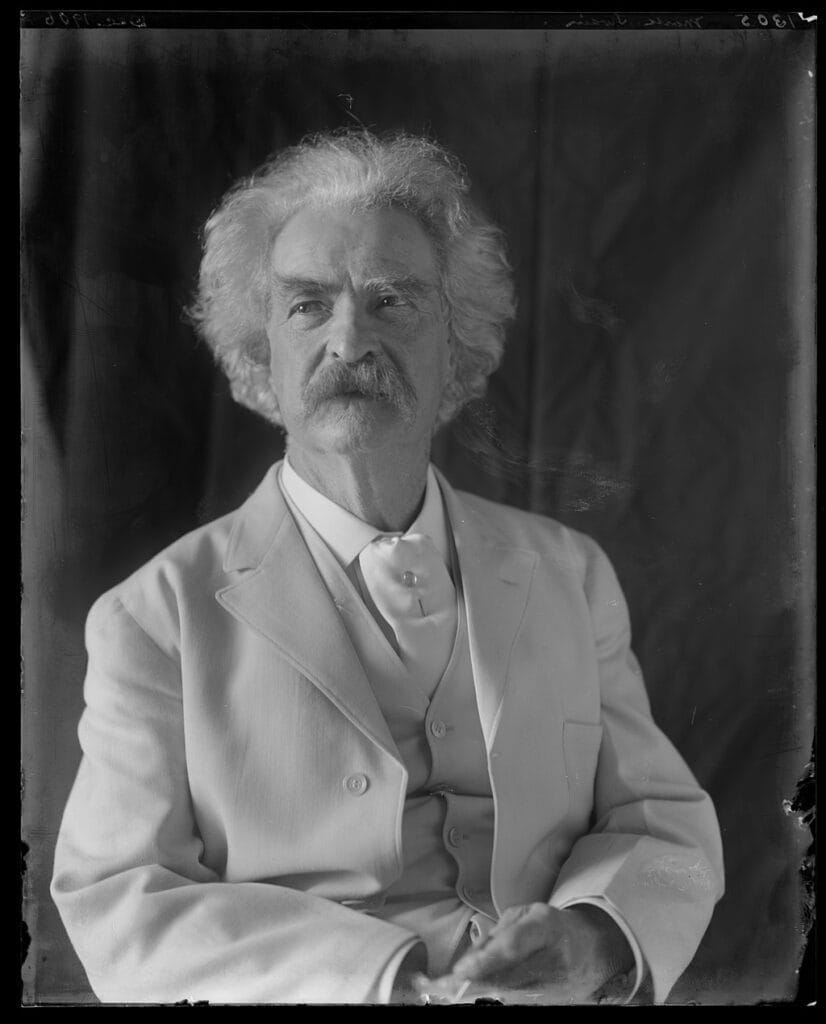
Mark Twain, born Samuel Clemens, is remembered predominantly for creating Tom Sawyer and Huckleberry Finn, the two boys whose adventures have delighted generations of readers. He rose from humble beginnings to being considered one of the funniest people of his time.
Twain was a premature baby, not expected to live. When he turned four, his parents moved to Hannibal, Missouri. This was a bustling port town on the Mississippi, eighty miles from St. Louis, where life was a constant encounter with disease. As a boy, Twain was sickly and often ill, especially during the hot summers when cholera and malaria were still prevalent, deaths from infectious diseases were common, and infant mortality was exceedingly high. Twain’s sister Margaret died of a fever when he was not yet four years old, and his brother Benjamin died three years later. When he was eight, a measles epidemic struck his community. In 1847, his father succumbed to pneumonia at age forty-nine. Yellow fever epidemics would also occasionally ravage river towns, reflecting the omnipresence of disease in the environment.
Mark Twain grew up in the small river town of Hannibal, which was neither culturally rich nor safe from gang activity. He became a printer’s apprentice at thirteen (1848), was paid poorly but was able to educate himself by reading extensively. Leaving Hannibal in 1853, he worked in the printing business in St. Louis, New York, and Philadelphia. In 1857, he became an apprentice pilot on the riverboats, and in 1895 earned his full qualification as a pilot. After his brother died in an accident when his steamboat’s boiler exploded in 1859, he briefly enrolled in the Confederate army but never saw action. He next went west, tried his hand at gold and silver mining, but in 1862 decided to become a newspaper reporter. By 1864, we find him working as a reporter in San Francisco, being fired from a newspaper, and left penniless and almost suicidal. His first success was writing The Notorious Jumping Frog of Calaveras County in 1865. It was followed by a report about a trip to Hawaii, a visit to the Middle East and the Holy Land in 1868, and his marriage to Olivia (Livy) Langdon soon after his return (1870).
Twain then became famous. He began to publish his experiences as travel books, “The Innocents Abroad,” “Roughing It,” “A Tramp Abroad” (with chapters on Opera, Wagner, and the “awful German language”), and “Following the Equator.” He wrote 28 books, as well as many short stories, letters, and other publications. In Old Times on the Mississippi (1875), The Adventures of Tom Sawyer (1876), Life on the Mississippi (1883), and The Adventures of Huckleberry Finn (1885), he described the youthful adventures of Tom and Huck, their feigning sickness and occasional encounters with the medical profession.
Unfortunately, Twain’s losses to illness continued throughout his life. His son died from diphtheria in 1872; his elder and favorite daughter succumbed to meningitis at the age of 24 (1896); and his wife died in 1904, perhaps from heart disease. Another daughter had epilepsy, his frustration over her care serving to sharpen his criticisms of the medical pretensions and failures, and when she died from a seizure, it broke his heart (1909).
Still, Twain maintained close friendships with physicians. He consulted many doctors for his ailments and corresponded with medical men. Yet his experiences clearly influenced his literary treatment of death and suffering, and account for his more pessimistic view of the medical profession. He was also intrigued by mental health. In his later writings, he would often grapple with despair and suicide, but also with epidemics, sanitation, and the social responsibilities of science, as well as fashionable illnesses such as “nervous exhaustion” and “neurasthenia.”
Twain suffered all his life from bronchitis and lung problems, worsened by smoking as many as 20 to 40 cigars per day. In his final years, his health declined significantly as he began to experience crippling bouts of angina pectoris, a sign of clogged coronary arteries and of an impending heart attack. No longer able to go out on the lecture circuit, his physical limitations forced him to curtail his active career. He battled with depression and grief, the earlier deaths of his wife and children making him acutely aware of the limits of medicine. He once quipped that doctors “are men who prescribe medicines of which they know little, to cure diseases of which they know less, for people of whom they know nothing.”
His travels exposed him to various medical systems, including Europe’s hospitals and traditional medicine in Asia. He expressed cautious optimism about vaccination and inoculation, which were becoming more widespread in his lifetime. He lived during a period of profound change in medicine, from the evolution of the miasma theory to the germ theory, from bleeding and purging to laboratory science, and from the introduction of the stethoscope, X-rays, and antiseptic surgery. He observed advances in surgical techniques and how the discovery of bacteria was promising to lead to effective treatments for infectious diseases.
Yet he retained his well-justified skepticism and was particularly scornful of quackery, phrenology, mesmerism, and patent medicines. He died of a heart attack in April 1910, at age 74, in an era that had changed much since his early days on the Mississippi.
Addendum
- Mark Twain once said he would like to live in Manchester, because the transition to death would be unnoticeable.
- He recommended that one should always obey one’s parents when they are present.
- He also said, “Respect your superiors, if you have any.”
- “Keep your mouth closed rather than let them think you are a fool.”
- “Never put off till tomorrow what may be done the day after tomorrow just as well.”
- “Whenever you find yourself on the side of the majority, it is time to reform (or pause and reflect).”
- “A ′Classic′—a book which people praise and don’t read.”
- “Never let one’s schooling interfere with one’s education.”
- “Don’t go around saying the world owes you a living. The world owes you nothing. It was here first.”
- “I did not attend his funeral, but I sent a nice letter saying I approved of it.”
- “God created war so that Americans would learn geography,” and
- “Books are for people who wish they were somewhere else.”