JMS Pearce
Hull, England
There is no better-known medical textbook than Gray’s Anatomy. No doctor’s interest can fail to be aroused by someone whose student career begins with the triennial essay prize of Royal College of Surgeons of England. Thus began the all too brief career of Henry Gray (? 1827–1861). The Wellcome librarian Noel Poynter commented: “He was once the author of a book, but he might more truly be regarded as the founder of an institution.”1 Unfortunately, few biographical details of Gray were published.2,3 And it is curious that no obituary appeared in Gray’s Anatomy until the twentieth century.
Henry Gray graduated MRCS from St. George’s Hospital, London, in 1848. In 1854 he was awarded the MB and in 1856 MD from London University. A posthumous article in the St. George’s Hospital Gazette in May 1908 described him as “a most painstaking and methodical worker, one who learnt his anatomy by the slow but invaluable method of making dissections for himself.” Appointed demonstrator and then lecturer in anatomy at St George’s Hospital,4 he worked sedulously to prepare the vast number of dissections and the text for his magnum opus. For a quite separate work, On the development of the optic and auditory nerves, he was elected Fellow of the Royal Society (FRS) at the precocious age of twenty-five in 1852.
In 1860 he became a Fellow of the Royal College of Surgeons of England. In November 1855 Gray had the idea for a new anatomy textbook for students, which he discussed with his colleague Henry Vandyke Carter at St. George’s.
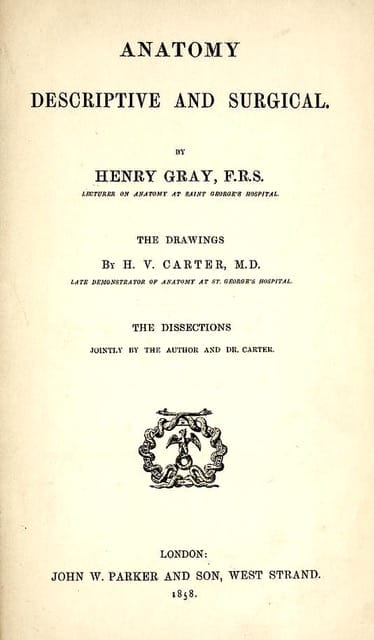
For two years Carter and Gray worked many long hours together. Gray did many of the dissections and wrote the text; Carter, a gifted artist, laboriously drew the minutely detailed, beautiful illustrations. The book was finished in November 1857. Another colleague, Timothy Holmes (editor after Gray), corrected the proofs. There is some evidence that Gray emphasized the secondary role of Carter,5 even insisting on a smaller type size for his name on the title page.
Gray’s Anatomy was clear and authoritative, but an outstanding feature was the quality of Carter’s accurate illustrations. Gray received a royalty of 150 pounds for every 1,000 copies sold; the impecunious Carter got a measly single fee of 150 pounds.6 The result was entitled: Anatomy descriptive and surgical. The drawings by H.V. Carter, M.D. The dissections jointly by the author and Dr. Carter. 1st ed. London: John W. Parker, 1858. The author’s preface reads:
This work is intended to furnish the Student and Practitioner with an accurate view of the Anatomy of the Human Body, and more especially the application of this science to Practical Surgery.
Gray’s Anatomy was an instant success7 and an American edition, edited by Richard James Dunglison, was swiftly published in 1859.
Gray died tragically young at age thirty-four of smallpox contracted while attending his nephew for that illness.
Henry Vandyke Carter
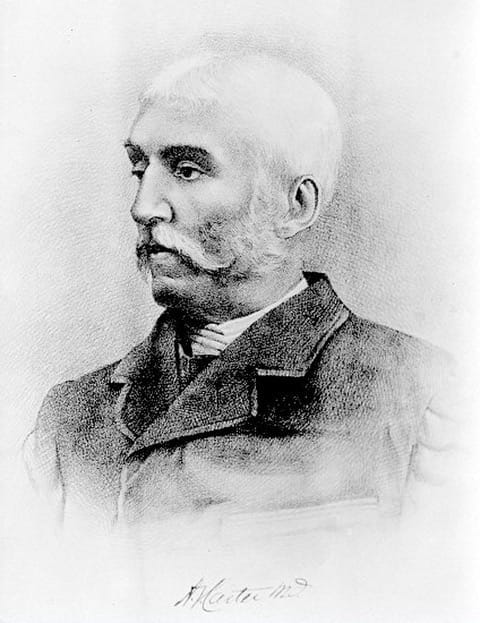
Henry Carter, born in Hull and christened in Scarborough, was the son of a landscape artist. He attended Hull Grammar School and qualified from St. George’s Medical School with the MRCS in 1853, then proceeded MB in 1854 and MD in 1856.
He was junior to Gray as a Demonstrator in Anatomy at St. George’s Hospital. Gray gave him credit in the preface of the first edition:
The Author gratefully acknowledges the great services he has derived in the execution of this work, from the assistance of his friend, Dr HV. Carter, late Demonstrator of Anatomy at St George’s Hospital. All the drawings from which the engravings were made were executed by him. In the majority of cases they have been copied from or corrected by recent dissections made jointly by the author and Dr. Carter.
Carter’s contribution8,9 however, has been greatly undervalued; his name is largely unknown. His 363 illustrations provided brilliant, scientific depictions of anatomical structures displayed at dissections. The well-prepared wood engravings, replete with detail and clarity, were superior to all other works at that time,10 though he received little credit for this.
From an artistic family, Carter’s passion was for both art and medicine. Just before the textbook appeared in print, possibly for financial reasons and because he had not received just recognition for his work in England, he left for India in the spring of 1858. He had passed the examination for medical officers in the East India Company and became professor of anatomy and physiology at the Grant Medical College at the University of Bombay. He was elected president of the Medical and Physical Society and Dean. He also helped to establish in 1884 a course for women doctors at Grant.

Clearly a man of great ability, Carter investigated Spirillum minus, the tick-borne spirochete Borrelia that causes relapsing fever. During his time in Bombay, he systematically recorded the clinical and anatomical features of leprosy. His first publication in 1874 was his Report on Leprosy and Leper Asylums in Norway, with Reference to India, based on his visit to Gerhard Armauer Hansen (1841–1912) in Bergen. Carter also described the fungal mass or mycetoma. He kept diaries, which reveal a fascinating personal journey.6
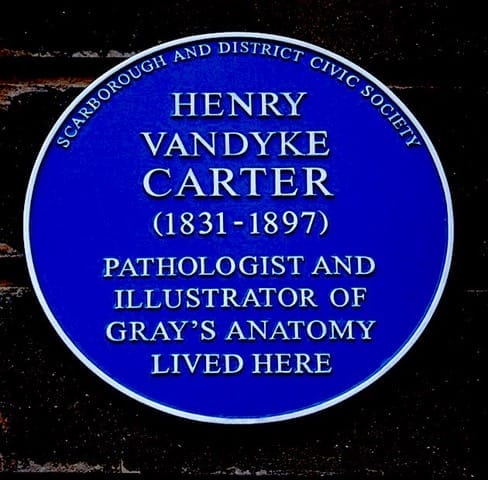
He retired from the Indian Medical Service in 1888 and returned to England to be appointed Honorary Deputy Surgeon General. In 1890 he was made Honorary Surgeon to Queen Victoria. He died in his native Scarborough on 4 May 1897, probably from longstanding tuberculosis. A blue plaque was erected in July 2008 at his home.
Just before his death, Gray had prepared a second edition. Many subsequent editions (paper and electronic) followed.3 The huge updated 42nd edition in 2020, edited by Susan Standring, is enhanced by “new state-of-the-art” X-ray, CT, MR, and ultrasonic images. The title has changed to Gray’s Anatomy: The Anatomical Basis of Clinical Practice.
References
- Poynter FNL. Gray’s Anatomy; the first hundred years. Br Med J. 1958;2:610-1.
- Goss CM. A Brief Account of Henry Gray F.R.S. and his Anatomy, Descriptive and Surgical. Lea & Febiger, 1959.
- Pearce JMS. Henry Gray’s Anatomy. Clinical Anatomy 2009;22(3):291-5.
- Dunea G. Henry Gray and his textbook of anatomy. Hektoen International Summer 2019.
- Richardson R. The Making of Mr. Gray’s Anatomy. Oxford University Press, 2008.
- Hayes W. The Anatomist. A True Story of ‘Gray’s Anatomy’. Ballantine, 2007.
- Goldwyn RM. Gray’s Anatomy. Plast Reconstr Surg. 1985;76:147-8.
- Roberts S. Henry Gray and Henry Vandyke Carter: creators of a famous textbook. J Med Biogr. 2000;8:206-12.
- Hiatt JR, Hiatt N. The forgotten first career of Doctor Henry Van Dyke Carter. J Am Coll Surg. 1995;181(5):464-6.
- Ghosh SK, Kumar A. The rich heritage of anatomical texts during Renaissance and thereafter: a lead up to Henry Gray’s masterpiece. Anat Cell Biol 2019;52(4):357-68.
JMS PEARCE is a retired neurologist and author with a particular interest in the history of medicine and science.