
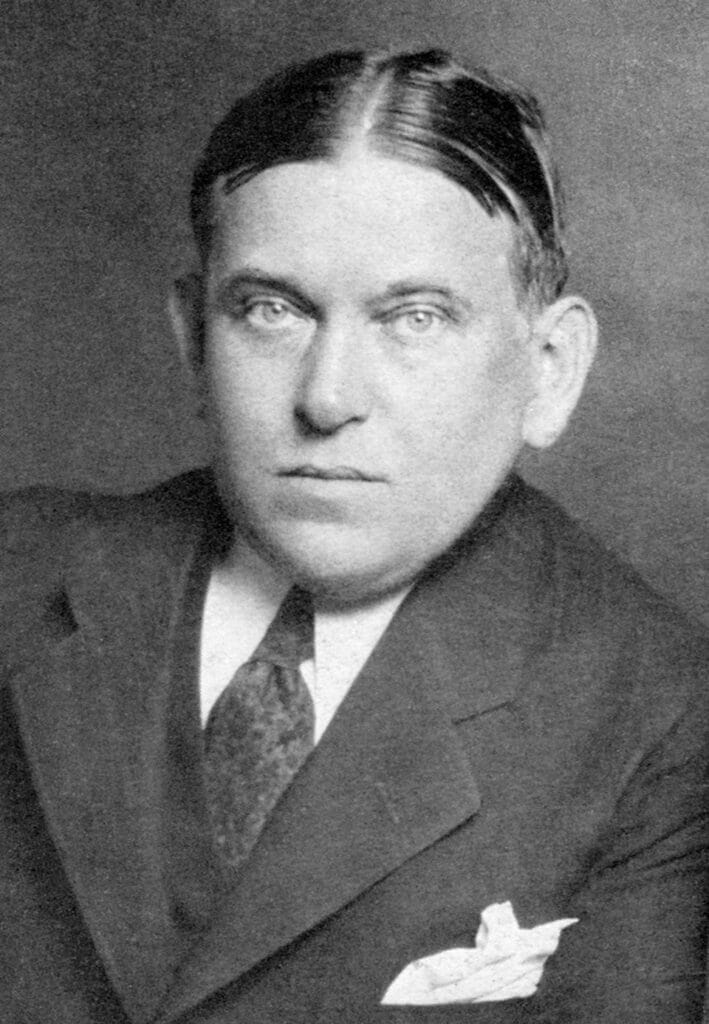
Henry Louis Mencken (1880–1956), the caustic “Sage of Baltimore,” earned lasting fame as journalist, critic, and satirist. Best remembered for The American Language (1919 and its subsequent expansions), his multi-volume study of how Americans shaped English, Mencken also trained his sharp gaze on medicine, physicians, and the very words of health and disease. Though he was not a physician, medicine ran like a current through his cultural commentary, his skeptical essays, and his final years after illness forced him into reliance upon the very profession he had alternately mocked and admired.
Mencken’s love for language was inseparable from his fascination with medicine. The American Language devoted entire sections to how Americans coined, borrowed, or corrupted medical terms. He catalogued the disappearance of older words—“consumption,” once the fearful label for tuberculosis, or “apoplexy,” covering a range of vascular disorders—and the arrival of scientific neologisms with Greek and Latin roots. Mencken marveled at how physicians created long polysyllabic inventions like “appendectomy” or “electrocardiograph,” yet also permitted patients to shorten them into colloquial “appendix out” or “cardiogram.”
On page 300 of the enlarged edition, in his section on “Forbidden Words,” Mencken noted that American prudery shaped medical terminology just as it shaped everyday speech. Physicians, however, often cut through euphemism, preferring direct description of the body when polite society recoiled. According to Mencken, this straightforwardness distinguished medicine from politics, religion, or advertising. Medical men, though sometimes pompous, prized accuracy- a virtue Mencken championed in all language.
Mencken’s attitude toward doctors was ambivalent but ultimately respectful. He enjoyed lampooning the authoritarian “Dr. Pillbox” with his white coat and confident manner, yet he acknowledged that medicine, unlike politics, rested upon evidence and experiment. In an era when homeopathy, mesmerism, and patent remedies still held sway, Mencken saw in modern medicine a counterweight of rationality. Doctors, in his view, embodied both human fallibility and intellectual rigor: a rare blend in a culture he thought riddled with quackery and sentimentality.
In newspaper essays for The Baltimore Sun, Mencken poked fun at the profession’s inflated Latin prescriptions and stiff bedside manners, but he also defended physicians against charlatans. He argued that while doctors might err, they at least operated within a framework of science —a discipline open to correction and progress.
Mencken was merciless in his attacks on medical fraud. During the 1920s and 1930s, he used his column to ridicule the booming market in miracle tonics, electrical belts promising virility, and secret “gland therapies” sold to the insecure. He observed that Americans, forever chasing youth, vitality, and cure-alls, provided fertile ground for hucksters. In one memorable essay, he compared patent medicine advertisements to revivalist sermons: both promised salvation, both preyed upon the desperate.
To Mencken, such quackery was symptomatic of a deeper national weakness: the preference for easy answers over hard truths. Physicians, by contrast, were bound—however imperfectly—to the discipline of experiment. He applauded that discipline, regarding it as one of the few bastions of rational thought in public life.
Irony struck hard in 1948, when Mencken suffered a massive stroke that paralyzed his left side and left him unable to read or write with ease. For a man who had written millions of words with unmatched fluency, the loss was catastrophic. He retained his mind but lost the ability to perform his craft. His once-ferocious pen fell silent.
The experience brought him face-to-face with medicine’s limitations. Doctors could prolong his life, manage his blood pressure, and prescribe therapies, but they could not restore the linguistic facility that defined him. He lived for eight more years, intellectually alert but dependent, unable to finish the projects he had outlined. Medicine, which he had praised as rational and progressive, could not conquer the damage of cerebrovascular disease. Mencken accepted this with stoic realism, embodying the skepticism he had always preached: science could alleviate, but never fully overcome, the frailty of the human condition.
Mencken also viewed medicine as a cultural mirror. The American obsession with health and vitality amused him, and he regarded it as another form of national insecurity. He mocked the health fads of his day: raw-food evangelists, sun-worshipping nudists, vitamin enthusiasts, and crusaders against alcohol or tobacco. In his view, these movements were less about health than about moral zealotry and self-advertising.
Yet Mencken also acknowledged that medicine and health practices revealed something profound about American identity. Just as language evolved into uniquely American forms, so too did medical fashions reflect the anxieties of modern democracy: fear of decline, hope for perpetual youth, and suspicion of authority. To write about medicine, for Mencken, was to write about America itself.
The “Mencken medical” perspective is an overlooked but vital strand of his legacy. Through his study of medical vocabulary, his sharp critiques of quackery, and his personal confrontation with illness, he articulated a philosophy that fused science, skepticism, and cultural analysis. Medicine, for Mencken, represented both the best of human rationality and the limits of human power.
Today, his insights still resonate. His warnings against charlatans anticipate modern debates over alternative medicine and misinformation. His reflections on medical language remind us how terminology shapes perception. His personal decline underscores the reality that even the greatest advances cannot eliminate suffering.
Henry Louis Mencken approached medicine with the same wit, skepticism, and intellectual curiosity that defined his journalism. He dissected medical words in The American Language, exposed the frauds of patent medicine, respected the rationality of physicians, and endured the indignities of stroke with characteristic stoicism. For Mencken, medicine was never merely about illness or cure. It was a cultural stage, a linguistic playground, a bastion of reason, and finally, a deeply personal trial. To read Mencken medically is to glimpse not only the evolution of American health culture but also the mind of a critic who insisted that even in the realm of suffering, truth was better than illusion.