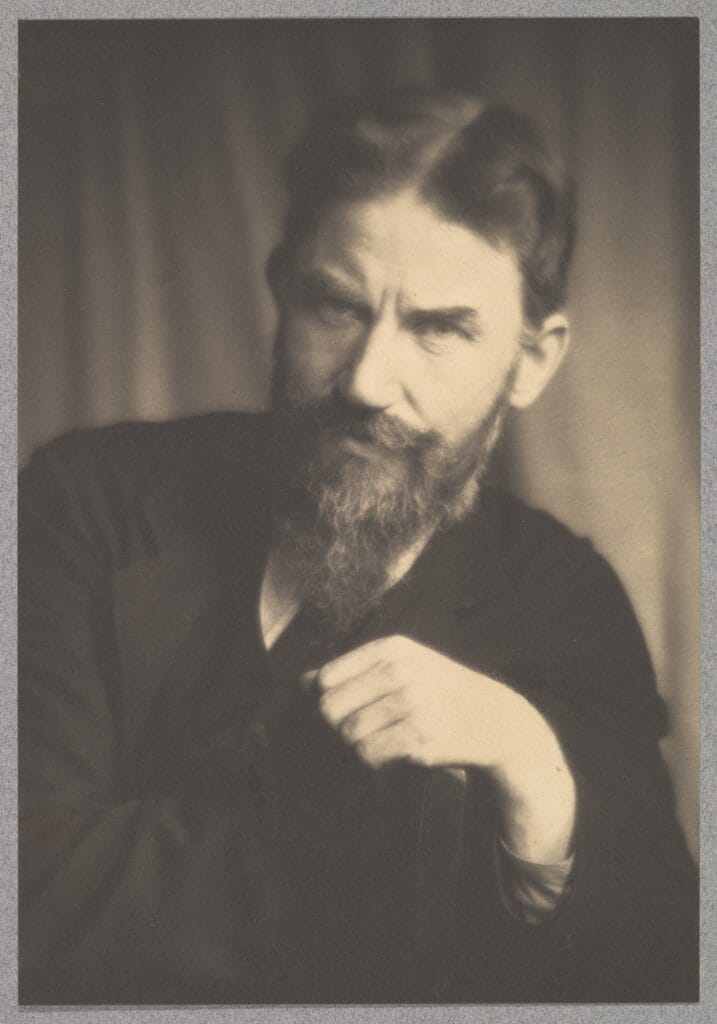
George Bernard Shaw (1856–1950), the Irish playwright, critic, polemicist, and Nobel Prize winner, was one of the great satirists of modern times. He left his mark not only on literature and theater but also on social and political thought. Among his many lifelong concerns, medicine and public health occupied a special place. Shaw was at once fascinated by medical science and fiercely critical of its institutions, questioning both the motives of doctors and the structures that governed healthcare. His writings reveal a thinker who anticipated many of the dilemmas that still animate debates on medicine today: the relationship between profit and care, the ethics of treatment, the power of prevention, and the role of the state in safeguarding health.
Shaw harbored a deep suspicion of doctors, which he expressed most famously in the long preface to his 1906 play The Doctor’s Dilemma. There he argued that medicine, as practiced in his day, was less a vocation of healing than a trade shaped by market forces. Physicians, he observed, were financially dependent on the continued presence of illness: “Every doctor has a natural enemy in the good health of his patients.” This was not meant as a personal attack on individual doctors but rather as an indictment of a system that incentivized cure over prevention.
His satire targeted what he saw as the complacency of a profession that resisted reform and monopolized authority. Shaw believed doctors could be blinded by self-interest, vulnerable to quack remedies, or overly enamored with the latest fashionable treatments. His skepticism reflected a broader critique of Victorian capitalism: when health became a commodity, human welfare was at risk.
The Doctor’s Dilemma dramatized Shaw’s concerns by presenting Sir Colenso Ridgeon, a physician with a revolutionary new cure for tuberculosis. Ridgeon can only treat a limited number of patients and must decide who lives and who dies. His choice between an unscrupulous but brilliant artist and a modest, virtuous doctor raises troubling questions: should medical resources be distributed according to social worth, artistic genius, or moral character?
Through this provocative setup, Shaw forced audiences to confront the ethical quandaries faced by physicians and societies alike. The play anticipated modern debates about triage, organ transplantation, and the rationing of healthcare resources. In portraying medicine as a field entangled with human prejudice, Shaw underscored the impossibility of separating clinical practice from moral and social judgment.
Shaw was not anti-science; indeed, he admired great medical innovators such as Joseph Lister, Robert Koch, and Louis Pasteur. What troubled him was the profession’s narrow focus on treatment rather than prevention. He argued that most disease was preventable through sanitation, education, nutrition, and lifestyle. “We have not lost faith,” he wrote, “but we have transferred it from priests to doctors, often without examining whether they deserve it.”
A passionate vegetarian, Shaw became an emblem of dietary reform. He abandoned meat in his twenties and credited his long life and vigor to vegetarianism. He was also a lifelong teetotaler and a vehement opponent of smoking, warning of their social and physical harms. These personal practices reflected his conviction that individuals bore responsibility for maintaining their own health, though he also insisted that governments had a duty to create conditions that made healthy living possible.
His advocacy resonates with modern public health campaigns that stress the importance of lifestyle, diet, and prevention. Shaw foresaw that medical systems which failed to emphasize prevention would forever be overburdened by curative care.
He ridiculed the British Medical Association (BMA), accusing it of defending professional privilege rather than public welfare. In essays and speeches, he suggested that the BMA opposed reforms such as state medicine because it feared loss of autonomy and income. His criticism was not always well received; many physicians regarded him as a meddlesome amateur.
Yet Shaw’s attacks were influential. By exposing the vested interests of medical organizations, he helped stimulate public debate about accountability and reform. His writings contributed to an atmosphere in which new policies, including public health programs and early forms of socialized medicine, could gain traction.
Long before Britain established the National Health Service in 1948, Shaw was an advocate for state-organized healthcare. He believed that health, like education, was a collective good that should be guaranteed for all citizens, not a privilege for the wealthy. His arguments anticipated those of later reformers such as Aneurin Bevan, architect of the NHS.
Shaw warned that unless medicine were socialized, inequality would persist: the poor would continue to suffer preventable illness while the rich enjoyed the best doctors and treatments. He pointed to tuberculosis, rampant in the crowded working-class neighborhoods of London, as proof that private practice could not address widespread public health crises. His stance placed him squarely in the socialist tradition of using the state to level the inequalities of capitalism.
Shaw lived an extraordinarily long and productive life, dying at ninety-four after complications from a fall. He remained mentally sharp and physically active well into old age. He attributed this vitality to his vegetarian diet, his abstinence from alcohol and tobacco, and his regular exercise. Friends and journalists often marveled at his stamina. To Shaw, his health was a living demonstration of the principles he espoused. Although his critics dismissed him as eccentric, his personal regimen embodied the very public health values he championed: prevention, moderation, and respect for the body.
George Bernard Shaw’s contributions to medicine lay not in scientific discoveries but in the force of his ideas. His plays, prefaces, and essays challenged medical complacency, exposed the dangers of profit-driven care, and insisted that prevention was the cornerstone of health. His criticism of the British Medical Association, his advocacy of vegetarianism, and his early support for state medicine anticipated many reforms that shaped twentieth-century healthcare.
Today, debates over healthcare costs, medical ethics, lifestyle disease, and the role of government echo themes Shaw articulated a century ago. His wit and satire remain potent reminders that medicine is never purely technical: it is entangled with society’s deepest values, fears, and hopes. For Shaw, medicine was not simply about healing the body but about re-imagining how communities could live healthier, fairer, and more humane lives.