Caligula, the third Roman Emperor, reigned from 37 to 41 CE and has been described in history as a cruel, perverted tyrant. His full name was Gaius Julius Caesar Augustus Germanicus. Born in 12 CE, he was the son of Germanicus (a beloved Roman general, nephew, adopted son of Emperor Tiberius, and grandson of Augustus) and of Agrippina the Elder (a granddaughter of Augustus). As a child, he accompanied his father on military campaigns to Syria and along the Rhine. Soldiers, amused by the small soldier’s boots, gave him the nickname Caligula, meaning “little boots.”
Suetonius and Dio Cassius provide the main descriptions of Caligula’s life story, but fragmentary material from other authors also exists. His childhood was beset with tragedy. After the suspicious death by poison of Germanicus in 19 CE, Agrippina and her children fell out of favor with Tiberius. The emperor did not allow her to remarry, fearing that her new husband could become his rival. Several of Caligula’s brothers died in exile or were executed, leaving him scarred by fear and loss. In 29 CE, Agrippina was exiled to the island of Pandateria, where she died of starvation four years later. Caligula moved to Capri to live with his great-grandmother, Livia, the mother of Tiberius. He survived by displaying obedience and cunning, living under Tiberius’s watchful eye and witnessing his cruelty and paranoia. When Tiberius died in 37 CE, Caligula, then twenty-four years old, was named co-heir with Tiberius’s grandson, Gemellus, but he quickly established himself as sole ruler.
In his youth, Caligula was described as a gentle though nervous young man, who may have been subject to epileptic fits. His accession was greeted with immense enthusiasm by the Roman people, who, weary of Tiberius’s austerity and secrecy, celebrated Caligula as the son of Germanicus and a hero of the people. His first months in power were indeed marked by generosity: he freed state prisoners, recalled the banished, and abolished unpopular taxes. He organized lavish games and popular spectacles. For a time, Rome rejoiced under what seemed to be a new golden age. But the optimism did not last. He appears to have offended society by forming a scandalous attachment to his favorite sister, Drusilla, and announced his intention to marry her (a proposal that even in the not-too-morally-squeamish Rome would have been received unfavorably). But Drusilla’s unexpected death in about the seventh year of Caligula’s reign seems to have changed him completely; he contracted a sudden illness from which he, according to Suetonius, changed from a prince to a monster.
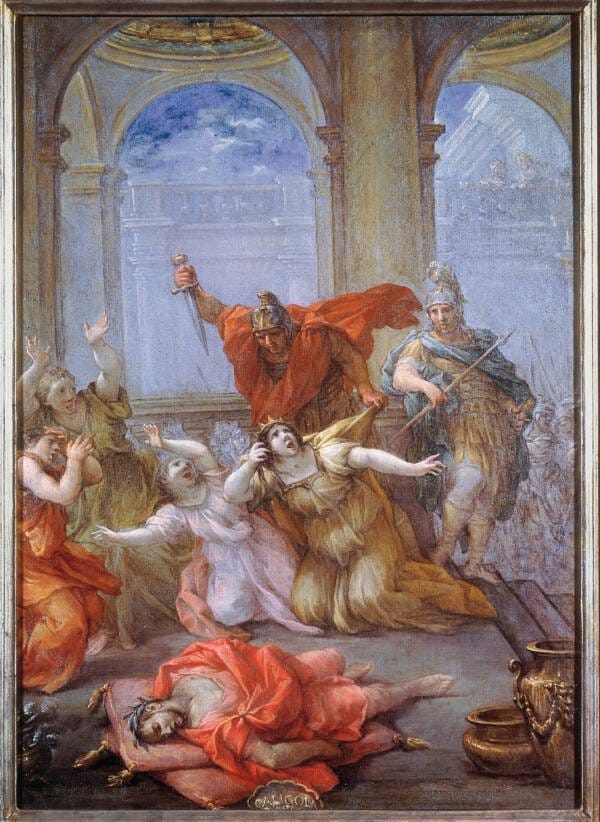
As described by Suetonius and also by Cassius Dio, he behaved like a madman. He declared himself a living god, ordered temples to be built in his honor, and demanded to be worshipped alongside Jupiter. His cruelty and eccentricity became legendary. He supposedly intended to make his horse Incitatus a consul, forced senators to run beside his chariot, and executed people for minor offenses or perceived slights. Sadistic and sexually perverted, he instituted trials for alleged treason and executed politicians and office bearers. He married four times. He wasted public funds on extravagant architectural projects and spectacles and staged absurd military displays. Eventually, on January 24, conspirator members of the Praetorian Guard, led by Cassius Chaerea, assassinated him by stabbing him to death. His wife and young daughter were also killed.
Most historians believe that Caligula was a monster and a lunatic whose behavior should serve as a warning of the dangers of absolute rule and the effects of mental illness on human behavior. Yet this portrait raises questions about exaggeration and bias. Much of our knowledge comes from hostile sources written decades after his death. Modern historians debate whether Caligula truly had mental illness—or whether his behavior reflected deliberate political theater, meant to intimidate Rome’s powerful elites while courting popular support. It is a point of view that calls at least for an open mind.
Further reading
- Benediktson, D. Thomas: “Caligula’s Madness: Madness or Interictal Temporal Lobe Epilepsy?”, The Classical World, Vol. 82, No. 5 (May – Jun 1989), pp. 370-375.
- Benediktson, D. Thomas: “Caligula’s Phobias and Philias: Fear of Seizure?”, The Classical Journal, Vol. 87, No. 2 (Dec 1991 – Jan. 1992), pp. 159-163.
- Charlesworth, MP. “The Tradition about Caligula,” The Cambridge Historical Journal, 4, No. 2 (1933), pp. 105-119.
- Katz, Robert S. “The Illness of Caligula,” The Classical World, Vol. 65, No. 7 (Mar 1972), pp. 223-225.
- Keaveney, A and M, and John A. “The Crimen Maiestatis under Caligula: The Evidence of Dio Cassius,” The Classical Quarterly, Vol. 48, No. 1 (1998), pp. 316-320.
- Kleijwegt, M. “Caligula’s ‘Triumph’ at Baiae,” Mnemosyne, Fourth Series, Vol. 47, Fasc. 5 (Nov.1994), pp. 652-671.
- Morgan, MG. “Caligula’s Illness Again,” The Classical World, Vol. 66, No. 6 (Mar 1973), pp. 327-329.
- Sidwell, B. “Gaius Caligula’s Mental Illness,” The Classical World, Vol. 103, No. 2 (Winter 2010), pp. 183-206.
- Strauss, WA. “Albert Camus’ Caligula: Ancient Sources and Modern Parallels,” Comparative Literature, Vol. 3, No. 2 (Spring 1951), pp. 160-173.
- Wardle, D. “Caligula and his Wives,” Latomus, T. 57, Fasc. 1 (Jan – Mar 1998), pp. 109-126.
- Wood, S. “Diva Drusilla Panthea and the Sisters of Caligula,” American Journal of Archaeology, Vol. 99, No. 3 (Jul 1995), pp. 457-482.
- Woods, D. “Caligula, Incitatus, and the Consulship,” The Classical Quarterly, New Series, Vol. 64, No. 2 (December 2014), pp. 772-777.
- Woods, D. “Caligula’s Seashells,” Greece & Rome, Vol. 47, No. 1 (Apr 2000), pp. 80-87.