Richard de Grijs
Sydney, Australia
Cholera—the “Blue Death” and, in the words of one witness, “one of the most ghastly experiences a disease could inflict on a human being”1—emerged in the early 1800s from the Ganges delta, traveling along the routes of global trade2 and religious pilgrimage.3 This waterborne disease could transform proud vessels into floating coffins, their decks slick with the effluvia of the dying, their holds echoing with the cries of the unfortunates. The story of cholera at sea is one of human suffering, scientific misunderstanding, and the desperate measures taken to stem a tide of death that seemed as relentless as the ocean itself. It found the perfect vehicle for global conquest in the holds of the East India Company’s merchantmen and British troop transports. The disease followed trade routes from India to Persia, then onward to Russia and Europe. By 1831, it had reached the ports of England; a year later, immigrant ships carried it across the Atlantic. The very networks that joined the world together in the early nineteenth century became highways for pestilence.
Sailing ships provided ideal conditions for the bacterium’s spread. Water casks, often refilled from questionable sources, became breeding grounds for Vibrio cholerae. Primitive sanitation systems meant that human waste frequently contaminated drinking water.4-6
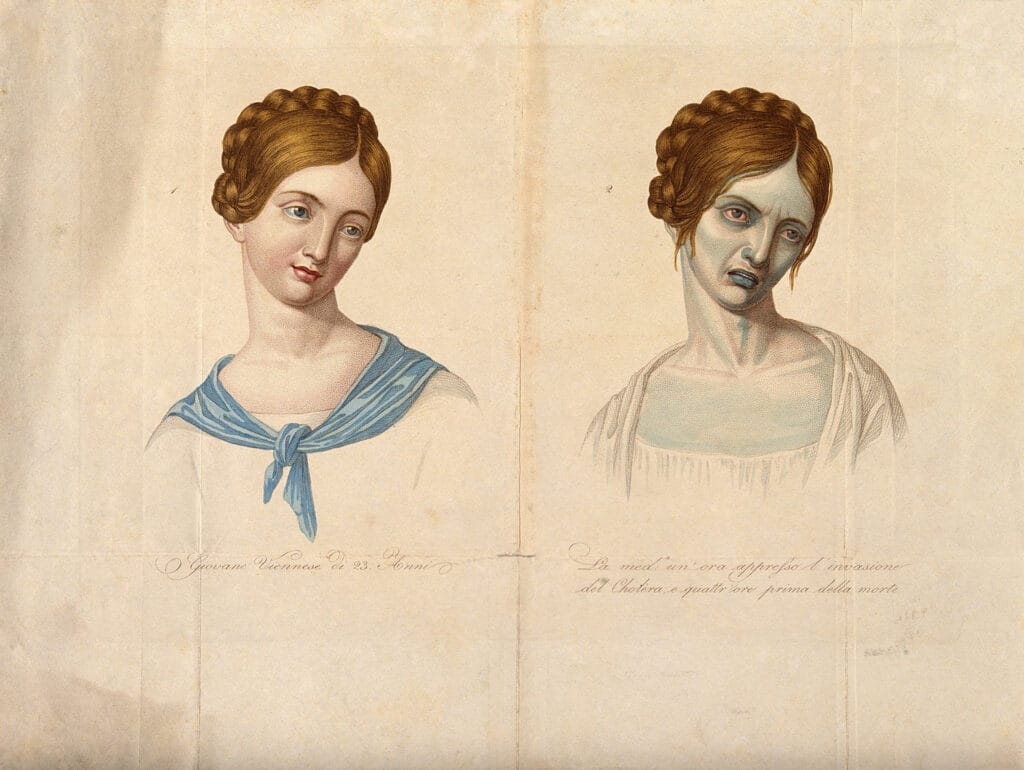
Once cholera took hold, there was no escape. In such cramped and unsanitary conditions, sickness spread with ruthless speed. The first signs of cholera often appeared within days. Those who witnessed the disease’s ravages never forgot the experience. It transformed the healthy into shrunken, blue-tinged corpses in a matter of hours. It began innocuously enough—a slight unease, a rumbling in the bowels. Then came the torrential diarrhea, the “rice-water” stools. Vomiting followed, leaving victims wracked with painful cramps and spasms.
As dehydration set in, the sufferers’ physical changes became ghastly to witness. Skin turned cold and took on a sallow, blue-grayish pallor. Eyes sank deep into their sockets, surrounded by dark circles that made victims’ heads resemble skulls before death had even claimed them. Fingers shriveled into “washerwoman’s hands”; the skin puckered and wrinkled from fluid loss. The voice became feeble and hollow, the pulse threadlike and erratic.
[Symptoms] consist of pain and uneasiness of the bowels, …; a weighty or vacant sensation, a tight fullness of that organ, diarrhoea, vomiting, the discharge generally watery, whitish, and fluculent [sic], sometimes dark brown or reddish; spasms generally more or less severe across the stomach, extending to the extremities …; coldness of the extremities and of the body; pale, purple or leaden colour of the skin; hands and feet moist; fingers shrivelled, withered and soaked in appearance; features livid; eyes sunken and surrounded with a dark zone; voice small, feeble, sepulchral; respiration very laboured; tongue … red, furry, covered with whitish slime, or a white erect scurff [flakes] …; in violent prostrated cases, tongue pale, cold, blueish; pulse in mild cases, sometimes tense, generally in all, soft, small, slow, gurgling, nearly imperceptible, or entirely so.7
Sufferers often remained conscious until the end, fully aware of their impending death as their bodies literally dried out from within. The disease’s psychological impact was profound. Unlike the slow wasting of consumption, cholera struck with terrifying unpredictability. A sailor might be joking with his mates at breakfast and be dead by supper. Families watched helplessly as loved ones succumbed, their bodies unceremoniously wrapped in canvas and committed to the deep.
One got used to it—it was nothing but splash, splash, all day long—first one, then another. There was one Martin on board, I remember, with a wife and nine children … Well, first his wife died , and they threw her into the sea and… then he died , and they threw him into the sea, and… then the children, one after t’other, till only two were left alive; the eldest, a girl about thirteen who had nursed them all, one after another, and seen them die—well, she died, and then there was only the little fellow left … 8
Faced with this invisible killer, ships’ captains and port authorities resorted to increasingly draconian measures; by the nineteenth century, lengthy quarantine, inspection, and the conditional granting of “pratique,” a clean bill of health, became the standardized process. The sight of a yellow quarantine flag fluttering from a ship’s mast became one of the most dreaded sights in any harbor. Such “Yellow Jacks” marked vessels as plague ships, condemned to ride at anchor far from shore while their occupants sickened and died: “The yellow flag, the abominable yellow flag, still marks our ship as ‘plague smitten.’ Every boat steers off from us, afraid of contamination.”9
New York’s “Cholera Bank”—a shallow section in the city’s harbor specifically designated for quarantined ships—became a watery purgatory where vessels might languish for weeks, their supplies running low as death tolls mounted: “there was a general scarcity of sea store. I saw a shilling offered for one pound of meal and a penny for a noggin [typically a quarter of a pint] of dirty water say, ten weeks old.”10
Medical treatments available offered little hope. Doctors trained in Galen’s humoral theory bled their patients in the mistaken belief that they were rebalancing bodily fluids. They often administered mercury-laced calomel to purge the bowels, unwittingly poisoning those they sought to heal. Opium was given to stop the diarrhea—a treatment that provided some comfort but did nothing to address the deadly dehydration. Some doctors prescribed brandy or other spirits, thinking alcohol would “strengthen” their patients; in reality, this only accelerated their decline.
The more observant physicians noticed that patients given small, frequent sips of water mixed with salt and sugar sometimes survived. This precursor to oral rehydration therapy occasionally worked, although no one understood why. Medical intervention was as likely to hasten death as prevent it, leaving crews and passengers to resort to prayer, folk remedies, and sheer luck. Containment usually failed, as seen in 1898 when a sanitary commissioner of the Government of India declared that a patient’s best cure would be found in a “hopeful disposition.”11
The doctor’s function was to give the impression of caring, through placebos, bathings, bleedings, and dietary recommendations. He … knew full well that he could not actually cure the illness.12
The demographic impact of cholera outbreaks was staggering. The Irish immigrants fleeing famine in the 1840s were particularly hard hit, their weakened constitutions making them uniquely vulnerable. The term “coffin ships” entered common usage as vessels arrived in North American ports with more dead than living aboard. In 1832, New York City lost 3,000 residents to cholera in just two months, while New Orleans saw 4,340 perish in three horrific weeks that October. Thirty to fifty percent of those who contracted the disease died within days.
The social consequences rippled outward. Nativist movements gained strength by blaming immigrants for disease outbreaks, leading to calls for immigration restrictions and the stigmatization of certain ethnic groups.13 Port cities implemented increasingly strict quarantine measures, some of which amounted to little more than maritime prisons where the sick were left to die in isolation. The economic impact was equally severe, as trade ground to a halt during outbreaks and insurance costs for shipping skyrocketed.
Nonetheless, the battle with cholera ultimately yielded some positive outcomes. John Snow’s (1813–1858) famous 1854 investigation of London’s Broad Street pump outbreak demonstrated the waterborne nature of cholera transmission and led to the birth of epidemiology—although his findings were initially met with skepticism. Robert Koch’s (1843–1910) identification of cholera vibrio in 1883 finally provided definitive proof of the germ theory of disease, revolutionizing medical science.
At sea, the lessons of the cholera years led to concrete improvements. Ship design gradually incorporated better sanitation and water purification methods. International agreements established standardized disease reporting between ports. The role of ships’ surgeons became more professionalized with better training and clearer protocols. Change came slowly, and often only after repeated epidemics had exacted their unfortunate toll.
Today, as we face new global health challenges, the story of cholera remains powerfully relevant. It reminds us that diseases respect no borders, that fear often outpaces understanding, and that true progress requires both scientific rigor and human compassion.
References
- Watts, S. Epidemics and History. Disease, Power and Imperialism. (New Haven, CT: Yale University Press, 1997): 173.
- Crosby, AW. The Columbian Exchange: Biological and Cultural Consequences of 1492. (Westport, CT: Greenwood Publishing Company, 1972).
- Kuhnke, L. Lives at Risk: Public Health in Nineteenth-Century Egypt. (Berkeley, CA: University of California Press, 1990): Chap. 5.
- Watts, op. cit.: 167–170.
- Marryat, F. Mountains and Molehills, Or, Recollections of a Burnt Journal. (London: Longman, Brown, Green, and Longmans, 1855).
- De Vere, SE. Letter to T. F. Elliot. In: British Parliament (House of Lords), Evidence before the Select Committee of the House of Lords on Colonisation from Ireland, 1847. (Irish University Press Series of British Parliamentary Papers. Emigration. No. 4, 1968): 458.
- Hunting, S. An essay on epidemics: as they appeared in Dutchess county, from 1809 to 1825; also, a paper on diseases of the jaw-bones; with an appendix, containing an account of the epidemic cholera, as it appeared in Poughkeepsie in 1832. (New York: Booth and Smith, 1832).
- Guillet, E. The Great Migration. The Atlantic Crossing by Sailing-Ship 1770–1860, 2nd ed. (Toronto: Association of Canadian University Presses, 1963): 90.
- Montague, E. Narrative of the Late Expedition to the Dead Sea. From a Diary by One of the Party. (Philadelphia: Carey and Hart, 1849): 79.
- John Burke (1786–1864) biography. WikiTree. https://www.wikitree.com/wiki/Burke-2770.
- Watts, op. cit.: 171.
- Ibid., XI–XII.
- e.g., “Turnips from Glasgow.” New York Times (February 24, 1856); https://www.maritimeheritage.org/ports/Scotland_Glasgow.html.
RICHARD DE GRIJS, PhD, is a professor of astrophysics and an award-winning historian of science at Macquarie University (Sydney, Australia). With a keen interest in the history of maritime navigation, Richard is a volunteer guide on Captain Cook’s (replica) H.M. Bark Endeavour at the Australian National Maritime Museum. He also regularly sails on the Museum’s replica Dutch East Indiaman, Duyfken.