The renowned Austrian painter Gustav Klimt lived and worked in Vienna during a period of unprecedented medical advances. The capital of the Austro-Hungarian Empire had become a world center for innovation in clinical medicine, therapeutics, and surgery. It had also become the site of a new understanding of psychiatry and psychology, in great part due to the pioneering work of Sigmund Freud. These advances created a cultural atmosphere that would also spill over to art, and as such to the work of artists such as Gustav Klimt.
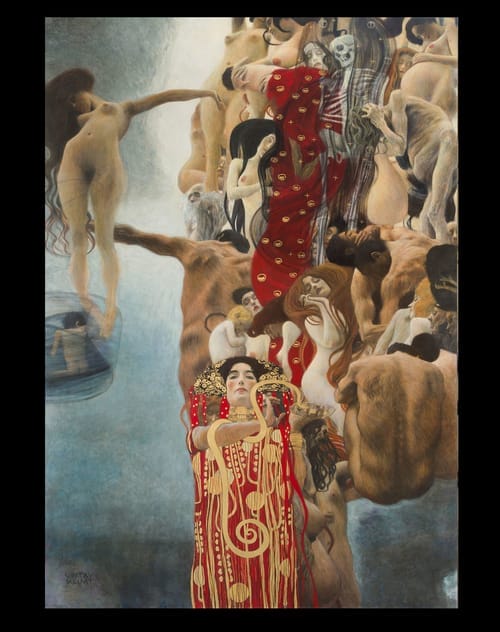
Klimt’s art leaned heavily towards the controversial. Of the three paintings commissioned for the ceiling of the University of Vienna’s Great Hall, the most provocative was the second, Medicine, presented at the tenth exhibition of the Secession group he had founded in 1897. It featured semi-nude and nude men and women representing life, a female with a newborn baby at her feet bringing forth new life, skeletons, and the goddess of health and hygiene with a snake coiled around her to symbolize death. The painting, sadly destroyed in World War II during the retreat of the German troops, survives only through photographs and a modern recreation (Fig 1).1
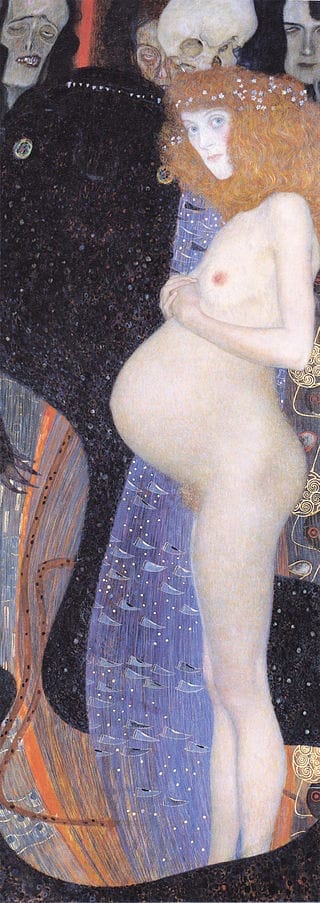
Klimt’s close association with Vienna’s scientific elite also influenced his overall painting output. He worked with the anatomist Emil Zuckerkandl and gave an occasional lecture at the Anatomical Institute, where anatomical specimens were displayed. This may be significant in works such as The Kiss (1907–1908), in which the decorative disk-like shapes have been interpreted as stylized representations of red blood cells. Other paintings, particularly of wealthy Viennese women, such as in the Portrait of Adele Bloch-Bauer I (1907), have been interpreted through a medical lens as studies in psychological states. His allegorical paintings frequently explored themes of disease, death, and regeneration. Death and Life (1910–1915) and his various depictions of the life cycle demonstrate an awareness of human vulnerability. In his work Hope I (1907–1908) (Fig 2), Klimt depicts a pregnant woman, unclothed and exposed, in which the presence of death reflects his view of the cycle of life and the ever-present shadow of mortality. In much of his work, women were the primary subject, and his art was at times regarded as pornographic.
Throughout his life, Klimt maintained a relatively robust constitution, although he was known for his ascetic lifestyle and intense work habits. He typically wore loose-fitting robes while painting, and maintained a strict daily routine centered around his art. However, the Klimt family history included significant mental health challenges: his brother Ernst, also an artist and close collaborator, died young in 1892. Moreover, mental illness ran in some of the members of the Klimt family. His death in February 1918 occurred during the Spanish influenza pandemic. However, already in January, he had suffered a stroke that left him partially paralyzed; he developed pneumonia and died on February 6 at the age of 55.
End note
- For more on the recreation project, see Factum Arte: https://www.factum-arte.com/pag/1171/medicine.