
Sam Woodworth
Portland, Maine, United States
Nearly a decade since graduating from medical school, some of the most enduring memories from that formative time are recollections of visiting the Metropolitan Museum of Art in New York City as a first-year medical student. Led by a young hospitalist, I attended weekly sessions with a group of other students. We quickly gained an appreciation for how visual art could reflect our nascent medical experiences. We made observations, exploring the diagnostic process and discussing the emotional potency of patient care. We were empowered to think about medicine in a different context. Even now, I can recall indelible images of moving around Alberto Giacometti’s The Cat. We sketched the sculpture before swapping drawing pads and places with one another. As we shared perspectives, we discovered uniquely valid interpretations. Outside the museum, we found that taking care of patients often followed a similar rhythm: the medical team gathers around a patient from distinct vantage points, and the most effective clinicians recognize that it is diversity of thought that moves the care forward.
Now a young hospitalist myself, I continually return to visual art as a way to explore the practice of medicine. I have created my own museum-based course for medical students, specifically designed to enhance their curiosity skills. I introduce the students to a multidimensional model of curiosity developed by the psychologist Todd Kashdan. Kashdan has defined curiosity as a human quality consisting of five dimensions: deprivation sensitivity (i.e., recognizing knowledge gaps), joyous exploration, stress tolerance, social curiosity, and thrill-seeking.1 I select artworks that speak to one or more of Kashdan’s curiosity dimensions, challenging students to practice distinct curiosity skills. I make direct connections to medicine, building a bridge between the museum and the students’ work in the hospital or clinic.
I have found our discussions about social curiosity in art and medicine to be the richest, often leading to unexpected revelations. Social curiosity is important to any medical student’s journey of finding their footing within a specific field of medicine. By reaching out to others, they will receive solace and support from peers who might be experiencing similar emotions or struggles, including impostor syndrome and burnout. Students should feel empowered to borrow effective clinical, educational, or life skills from established physicians as they build their own careers. They should also, however, identify examples of counterproductive social behaviors that could be deleterious to their practice.
While our conversations on social curiosity are steeped in the endeavors of other students or mentors, someone invariably upends this collective perspective and asks, “But how curious should we be about our patients?” According to the late Faith Fitzgerald, a renowned internist and educator, we should always be curious about our patients, very curious indeed. In her memorable 1999 essay “Curiosity,” Fitzgerald inspires clinicians to share their patients’ stories. Storytelling adds needed depth to medicine, shining light upon the nuanced and emotional experiences of being a patient or practitioner, making us altogether more human. Teaching physicians should “identify medical students with a gift for curiosity and take infinite pains not to suppress but to encourage that gift.”2 Sustaining curiosity is crucial to unearthing our patients’ stories, and focusing only on the science without an understanding of the person afflicted by illness is inadequate, as one perpetually influences the other. Following Fitzgerald’s example, being curious and learning more about our patients becomes essential to our work. Their stories help us build endurance and resilience, imbuing us with the motivation needed to get up tomorrow and do the hard work of medicine all over again.
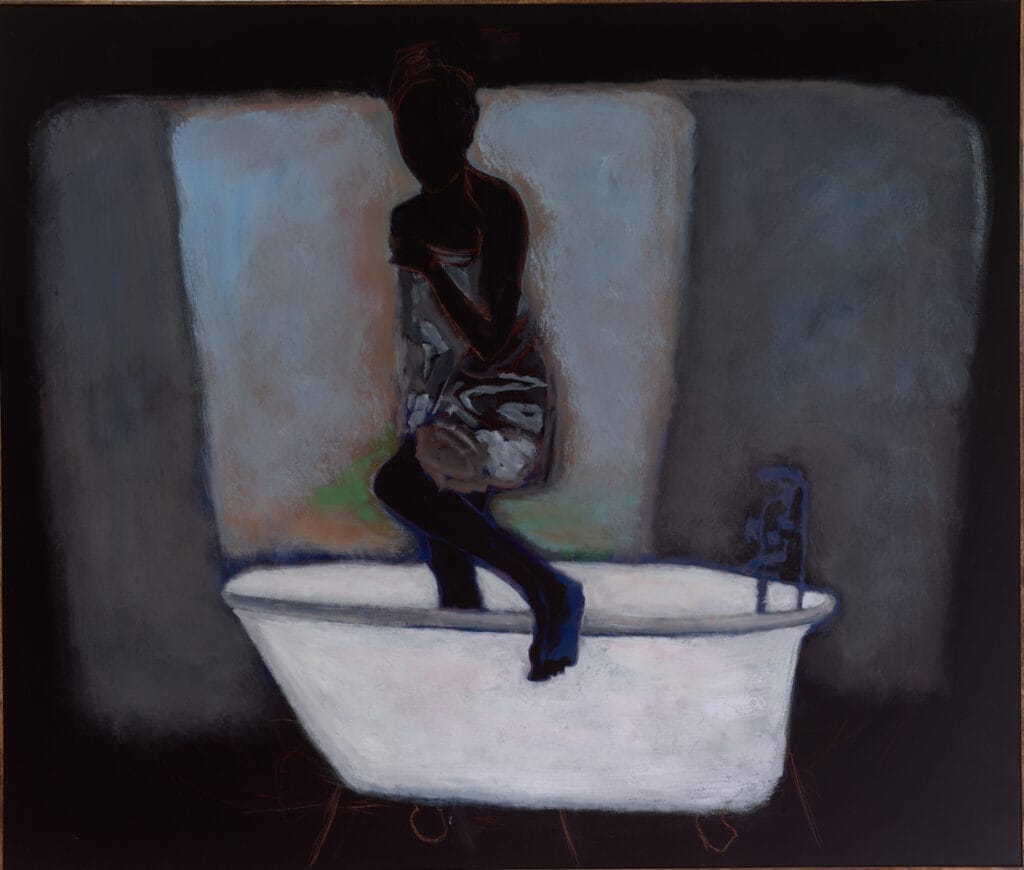
With social curiosity and the patient experience in mind, I have taken medical students to see Reggie Burrows Hodges’ Bathers and the Cleansed: Pearl (Figure 1). The painting is as arresting as it is dynamic, a single moment captured in time while the artist urges his viewers to contemplate what came before and what might happen next. Burrows Hodges works with a haziness and vagueness of detail despite creating an instantly recognizable picture. Profound intimacy is on display, though left out are defining facial features as the figure blends into a darkened border and foreground. Is the subject stepping into the bath or about to get out? Is she alone or being watched? Bathers and the Cleansed: Pearl has many paradoxes to offer.
The same can be said of the patient experience and the patient-physician relationship. Patients share personal details with providers who simultaneously scroll through cross-sectional imaging by the millimeter and calculate lab values out to multiple decimal places. This intricate transfer of information often occurs despite patients and physicians knowing little else about each other (e.g., during an initial ED or hospital evaluation). Patients are obligated to put trust in the unknown. It is also true that while each patient should expect a thoughtful diagnosis and discussion of possible treatments, the treating physician may have only seen a handful of comparable cases before or may have never seen the diagnosis in question present in such a unique way. The dissonance might seem insurmountable, but curiosity holds the key to pushing forward. We must build trusting relationships with our patients, and acting with curiosity allows us to understand them better as we recognize with humility that there may be questions to which we do not yet know the answers.
Visual art generates myriad opportunities to spark curiosity, an integral ingredient to the practice of medicine. In particular, an exploration of social curiosity can propel medical students to learn more about their patients and peers, enriching clinical and communication skills as they build strong foundations for career satisfaction. Uncertainty is commonly encountered in medicine, and competing data will forever be the norm. Students must recognize the existence of such paradoxes early on in their training, and experiences with visual art can help start the necessary discussion. Storytelling is essential, and curiosity will always be a welcome antidote. Reggie Burrows Hodges’ Bathers and the Cleansed: Pearl offers powerful examples of paradox, bridging a chasm between viewing an incredibly personal scene and being unable to make sense of the image’s soft edges. There is both definition and a lack of definition—what is known lies alongside the unknown. Bathers and the Cleansed: Pearl reflects the nuanced nature of the patient experience and the patient-physician relationship, calling on medical students to discover the person behind the pathology and never to cease being curious.
References
- Kashdan TB, Stiksma MC, Disabato DJ, et al. The five-dimensional curiosity scale: Capturing the bandwidth of curiosity and identifying four unique subgroups of curious people. J Res Pers. 2018;73:130-149. doi:10.1016/j.jrp.2017.11.011
- Fitzgerald FT. Curiosity. Ann Intern Med. 1999;130(1):70-72. doi:10.7326/0003-4819-130-1-199901050-00015
SAM WOODWORTH, MD, is a hospitalist at Maine Medical Center in Portland, Maine. He completed his internal medicine training at Beth Israel Deaconess Medical Center in Boston, Massachusetts. Dr. Woodworth has developed a museum-based arts course for medical students and believes that experiences with art can heighten curiosity.