
Stephen Martin
Thailand
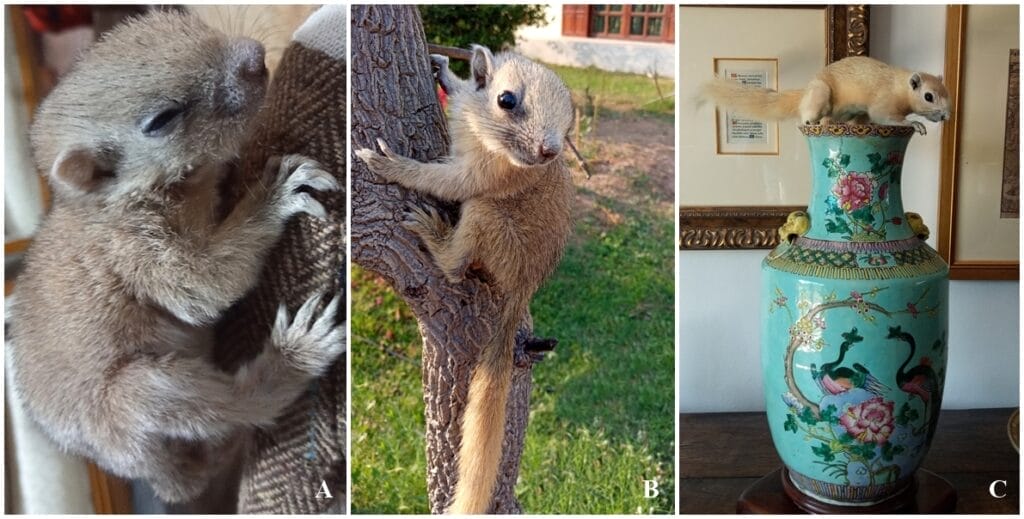
Part of running a museum in tropical Thailand is caring for distressed animals on the grounds. We have no choice, because the nearest wildlife rehabbers are in California. Sunshine drives life, so Thailand has a gloriously rich natural history. The museum’s animal patients range from skinks and turtles to Meissen the injured myna bird, Copeland the trapped golden tree snake, and Frankenthal the hyperthermic bamboo bat. We name them all after porcelain factories represented in the cabinets. The most extraordinary patient has been a little furry beast called Spode, who showed up fallen from his mother’s drey nest of leaves and sticks in the bamboo. Orphaned and injured three weeks after Christmas last year, his eyes were just opening, so he must have been born on or very near Christmas Day. Spode is a small, tropical squirrel. We soon realized that he used his tongue and vocal cords to make sounds with consistent meaning and he could ask for different things with gestures. This warranted historical and scientific study.
His real name turned out to be Callosciurus finlaysonii,1 but in typical Thai fashion, he sticks to his monosyllabic nickname. Plus, there was never a Finlayson’s porcelain factory. His long Thai name is grarork peuak, simply meaning “white squirrel.” He is not albino, but has very light creamy fur. Another scientific name is the variable squirrel, because the species actually has many different colors and patterns, and they change their coats seasonally for camouflage against differing background leaf colors.
Spode’s scientific discoverer was George Finlayson (1790–1823), a Scottish doctor and naturalist. Born in Thurso on the wild and barren far north coast, he became clerk to the head of the Army medical staff in Scotland during the Napoleonic Wars. He joined the Honorable East India Company as a surgeon, and in 1821 went from Calcutta to Siam with a trade mission led by Dr. John Crawfurd to meet the King of Siam in Bangkok. Crawfurd had graduated in medicine from Edinburgh in 1803, but he made the transition from East India Company surgeon to diplomat.
While Finlayson was the expedition medical officer, he was recruited more for his ability as a naturalist. Going on to investigate plants and animals, they sailed out of the river mouth from Bangkok to visit Ko Sichang Island. Here they observed a white squirrel, which Finlayson noted was “about eight inches in length, an active, lively and handsome animal.”2 He recorded a detailed biological description. Finlayson took extensive notes of the natural history of Siam (now Thailand) and Cochin China (now Vietnam) and drafted an introduction for a book. The team collected specimens, which were sent back to London.
Before he could publish, Finlayson’s health went downhill quickly with tuberculosis, and he wrote that he knew he only had limited time. He died trying to return home with a condition treatable today with antibiotics. Fortunately, Stamford Raffles, the new Governor of Singapore, was also keen on natural history and saw it as part of his job to publish regional academic findings to a high standard. Raffles included a short biography of Dr. Finlayson from his memoirs, when he edited Finlayson’s account of the voyage.2 Raffles had married Olivia Devenish, a surgeon’s widow. Although he returned to England, Raffles also died young at age forty-four. However, this was not death from tropical disease. An autopsy revealed a ruptured arteriovenous malformation.3 Nowadays that might have been treated with neurosurgery or interventional radiology, gluing the knot of fragile blood vessels.
Finlayson was not alone as a Regency medical naturalist. A specimen of Spode’s illustrious distant uncle from the Finlayson expedition was curated by Dr. Thomas Horsfield (1773–1859), an American physician originally from Pennsylvania. He qualified there in medicine in 1798. In addition to working as a Dutch East India Company doctor in Java, Horsfield was a tireless zoologist and geologist. He became the curator of the Museum of the East India Company in London. There are eighteen species named after Horsfield. In 1823, he also worked on Finlayson’s notes and formally named the squirrel after him: “I have introduced the new species discovered by Dr Finlayson in this catalogue of Indian Sciuri.”4 Horsfield accidentally wrote one too many “i”s on the end of Spode’s Latin name, which has stuck ever since.
When the museum closed, Horsfield’s zoological specimens went to the Natural History Museum, London, where Spode’s uncle now rests in a drawer in eternal slumber. Not to worry though, because Spode has less chromosomes than most squirrels, which looks very old indeed in evolutionary terms. That is also borne out by having many hard-wired instincts to survive tropical forest life, which he was certainly never taught, and must have evolved very slowly into genetically-determined brain nerves. Spode’s part of Thailand has never been under the sea or an ice sheet in the history of life on earth, so he has had plenty of time to evolve brain function that has turned out to be better than many primates. His body temperature is a degree higher than humans, so he can tolerate thick fur against mosquitos. That makes Spode vastly better adapted to the tropics than so many of Dr. Finlayson’s poor colleagues, who died quickly. Again, such highly complex adaptation did not evolve overnight.
When Spode broke his femur, his skeleton on X-ray was strikingly similar to several 150-million-year-old, small, long-tailed Jurassic squirrel-like fossils recently found in China. Another had a short tail,5 but you never know if it was bitten off or had bones swept away over time—the pitfalls of paleontology.These were not rodents. The age and form of interstates to modern squirrels and their true relation to later primates is the important mystery. Later small-mammal relatives survived the Cretaceous-Paleogene extinction, when the sky blacked out 66 million years ago. Bigger mammals went extinct. Modern squirrels stash thousands of pieces of food. Finlayson’s squirrels check and remember where they put them. They can drink by licking dew. All that would be very useful while the dinosaurs dropped. Small squirrels, or something like them, would have been very well placed to survive the great extinction.
Until the recent fossil discoveries, squirrels were only felt to be one or two million years old and descended from mountain beavers. Revealing squirrels’ exact age depends on fossils yet to be found. Spode has evolved consistently meaningful tongue and vocal cord sounds, multiple gestural language, throwing dust against snakes, and superlative fast coordination in high trees due to an extra brain lobule. He also stands up and undoubtedly knows how to turn on emotional appeal through being very bonny: witness his charming of Dr. Finlayson. Squirrel mothers adopt other squirrel orphans and in Thailand have repeatedly been noted to give their babies to humans when they are not coping.
The white squirrel in Spode’s region of Isaan is held in high cultural regard, being an object of wonder in local legend as an incarnation of Prince Naga, dragon demigod of the Mekong. A squirrel is also revered as an important pre-incarnation of Lord Buddha, so there is a traditional sense of a special animal. Though warranting more research, the little squirrel at which Dr. Finlayson quite rightly marveled, or a similar animal, might well have been a relative of the post-extinction early primates. Did Dr. Finlayson discover his own ancestor?
End notes
- Malcolm Peaker. “The Army Surgeon’s White Squirrel of Siam.” Zoology Jottings blog, 2024. https://zoologyweblog.blogspot.com/2024/01/the-army-surgeons-white-squirrel-of-siam.html
Callosciurus is a squirrel family, meaning “the beautiful squirrels.” - Stamford Raffles. The Mission to Siam and Hue the capital of Cochin China in the years 1821–1822. London: John Murray, 1826. Internet Archive.https://archive.org/details/missiontosiamhu00finlrich/page/260/mode/2up?view=theater&q=squirrel
Raffles had been recently appointed after the British took over running Singapore from the Dutch, whose East India Company had collapsed, while Horsfield’s Dutch Java persisted. - Kenneth Lyen. “What killed Sir Stamford Raflles?” SMA News, 2019. https://www.sma.org.sg/news/2019/August/what-killed-sir-stamford-raffles
- Horsfield T. Zoological Researches in Java and the Neighbouring Islands. London: Kingsbury, Parbury and Allen, 1824: 227-8. https://archive.org/details/Zoologicalresea00Hors/page/n5/mode/2up
- Chang-Fu Zhou, Shaoyan Wu, Thomas Martin, Zhe-Xi Luo. “A Jurassic mammaliaform and the earliest mammalian evolutionary adaptations.” Nature, 500 (2013): 163-7.
STEPHEN MARTIN is Honorary Professor of Psychiatry at Chiang Mai University and Specialist Lecturer at Kalasin Arts College. He was previously Professor in the Faculty of Arts, Mahasarakham University and founded Baan Dong Bang Museum, teaching and writing particularly about eighteenth-century portraits.