
Bologna is a frequent site for meetings by nephrologists. It is a lovely northern Italian city, easily accessible by air or by train. From the railway station, an easy walk under covered arcades takes the visitor to the center of town, to the San Petronio Cathedral, the two medieval towers, and to a modern shopping center. Spaghetti Bolognese, the pride of Bologna, is served in hundreds of restaurants worldwide. It is made from ground beef and pork, mixed with white wine, milk, and a little tomato. Other ragus contain more tomato sauce. Accordingly, all Bolognese are ragus, but not all ragus are Bolognese.
The city began as an Etruscan settlement named Felsina and then as a Roman colony called Bononia. In the Middle Ages, it became a commune, and after a long spell under papal rule, it was integrated in 1860 into the Kingdom of Italy. The University, conventionally founded in 1088, is one of the oldest in Europe. Copernicus worked there, and so did Luigi Galvani, Guglielmo Marconi, and Umberto Eco. The physician Mondino de’ Liuzzi1 conducted one of the first recorded human dissections in Bologna, and his treatise Anathomia (1316) was widely used for study for centuries. Surgeons in practice operated there during the Renaissance, including adventurous barber surgeons, distinguished academicians, and innovative plastic surgeons, some of whom are featured in this Journal.2-4 The Bologna school of painting is famous: it starts with Vitale da Bologna and Tommaso da Modena, through Francesco Francia and Francesco Primaticcio to Guido Reni, Lavinia Fontana, Domenichino, Guercino, and the three Carracci. Paintings of a butcher’s shop and of a man eating beans by Annibale Carracci stem from the pre-supermarket era.
Basilica di San Petronio dominates Piazza Maggiore with its incomplete yet magnificent facade. Construction began in 1390, and it was intended to surpass St. Peter’s Basilica in Rome, but political pressures ultimately curtailed its ambitious scale. Dedicated to Bologna’s patron saint, it stands as one of the largest churches in the world and is a masterpiece of Gothic architecture. During the plague outbreaks that periodically devastated Bologna, it became a refuge for patients fleeing the pestilence. The Archiginnasio Palace and Anatomical Palace, situated close to the San Petronio, were the seat of the University from 1563 to 1803, renowned for its contributions to medical education and anatomy. It pioneered systematic anatomical research and medical education, including the physiological effects of tower climbing.
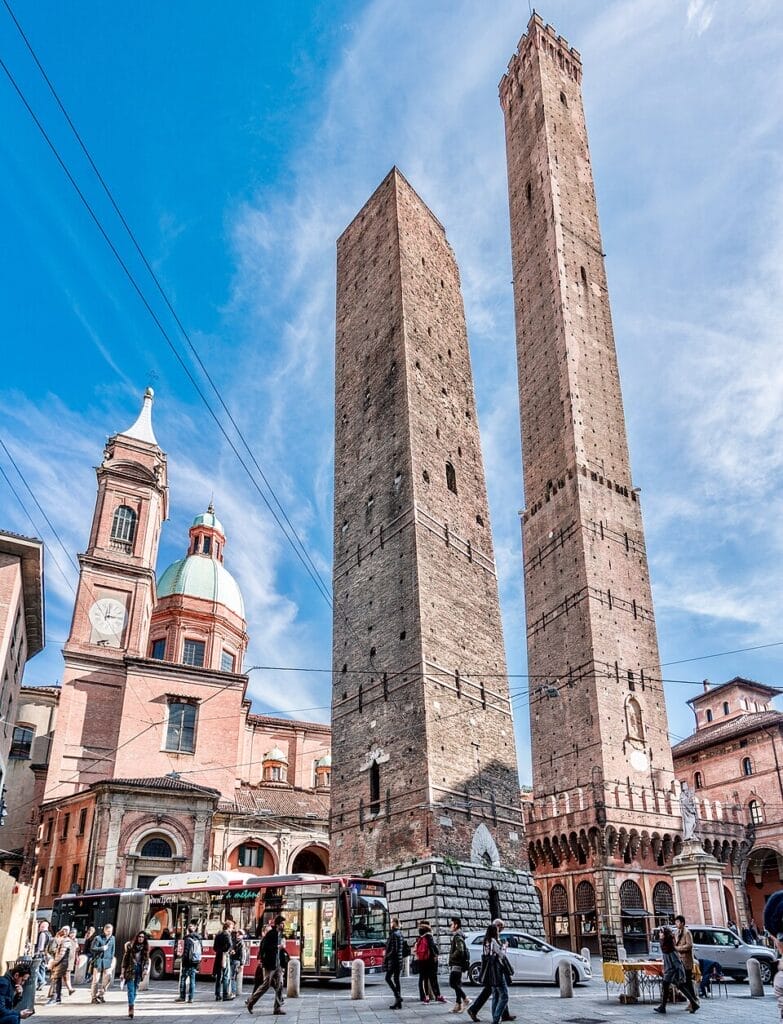
The Asinelli and Garisenda towers, built in the early 12th century by rival noble families, reach heights that challenged contemporary understanding of human tolerance for elevation. They served both military and civic purposes, including defense, watchtower duties, and the display of wealth by the families who commissioned them. The Torre degli Asinelli, standing at 97.2 meters, is one of Italy’s tallest medieval towers. The tower was used in the 17th century for physics experiments by Giovanni Battista Riccioli, who dropped different weights from its summit to study gravitational acceleration. Climbing its 498 steps provides modern visitors with direct experience of at least mild altitude-related sickness. The tower’s design of narrow windows and restricted passages is believed to have helped prevent vertigo and acrophobia (the fear of height). The neighboring Garisenda tower, shorter at 48 meters, dramatically leans at 3.2 degrees. Its pronounced tilt can create a spatial disorientation syndrome, and visitors often report feeling unsteady even while standing at its base, as the visual system conflicts with gravitational cues from the inner ear’s vestibular organs. The height of the towers also provided clear vantage points for observing approaching threats, enemy armies, or plague-bearing merchants, and allowed time for quarantine preparations.
As a nephrologist, I was honored to be invited as a visiting professor by Dr. Vittorio Bonomini,5,6 who had moved there from Parma in 1953 when nephrology was emerging as a specialty. He initially studied renal physiology and later played a key role in introducing renal biopsy, hemodialysis, and renal transplantation to Italy in 1967. He became renowned for advocating early dialysis initiation, even when the Glomerular Filtration Rate had declined to 15%. He served as Dean of the Faculty of Medicine from 1994 to 1998, and in 2003, he received the prestigious Archiginnasio d’oro from the Municipality of Bologna as an “illustrious representative of the Medical School that brings honor to our city.”6 He passed away in 2008, leaving behind a distinguished legacy.
Further reading
- Anna Lantz. Mondino de’ Liuzzi. Hektoen International Winter 2016. https://hekint.org/2017/01/19/mondino-de-liuzzi/
- George Dunea. The hectic life of Leonardo Fioravanti. Hektoen International Fall 2020. https://hekint.org/2020/11/19/the-hectic-life-of-leonardo-fioravanti/
- George Dunea. Giulio Cesare Aranzi (1530–1589). Hektoen International Summer 2020. https://hekint.org/2020/07/20/julius-caesar-aranzi-anatomist-and-surgeon-of-bologna/
- George Dunea. The times of Gaspare Tagliacozzi, founder of plastic surgery. Hektoen International Spring 2020. https://hekint.org/2020/05/28/the-times-of-gaspare-tagliacozzi-founder-of-plastic-surgery/
- George Dunea. Renal reminiscences. Hektoen International Spring 2024. https://hekint.org/2024/04/18/renal-reminiscences/
- Mauro Sasdelli. Birth and Development of Bologna Nephrology School with Vittorio Bonomini and Pietro Zucchelli. Archives of Nephrology Volume 1, Issue 2, 2018. https://sryahwapublications.com/article/abstract/2639-3573.0102001