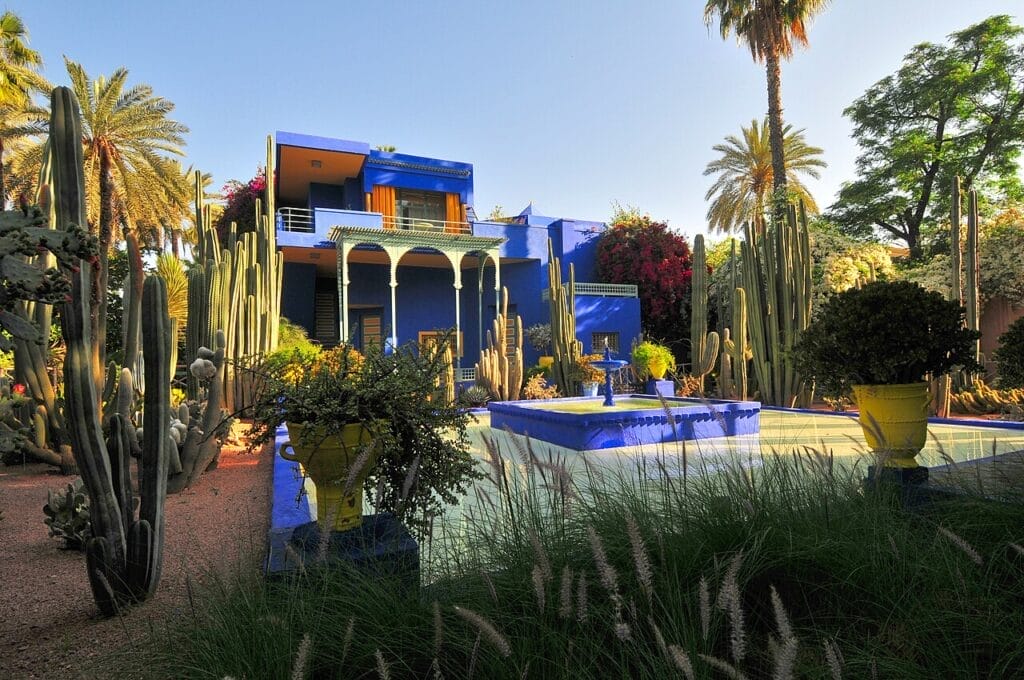

The Jardin Majorelle (Majorelle Garden) is the most famous garden in Marrakech, Morocco, a one-hectare botanical garden particularly famous for its “Majorelle blue” buildings and its extensive collection of cacti. The garden owes its name and early vision to Jacques Majorelle (1886–1962), a French Orientalist painter who fell in love with Morocco during the early 20th century. He purchased the land in the 1920s and devoted four decades to transforming it into a botanical masterpiece, combining local plants with imported exotic species such cacti from the Americas, bamboo from Asia, and bougainvillea from the Mediterranean. At the heart of the garden stands the iconic Cubist villa, designed by the architect Paul Sinoir in the 1930s and painted in a striking shade of cobalt blue—later known as “Majorelle Blue.”
The color was more than decorative; Majorelle believed in its psychological and physiological effects. In an era when chromotherapy—treating illness through color—was gaining attention in Europe, vibrant hues like blue were believed to have calming and restorative properties. The garden was thus not only an artistic venture but also an immersive therapeutic space, a sanctuary from the intense heat and bustle of Marrakech. After Majorelle’s death in 1962, the garden fell into disrepair until fashion designer Yves Saint Laurent and his partner, Pierre Bergé, discovered it in the 1980s. They purchased the property in 1980, meticulously restored it and expanded its botanical collection. Their intervention saved the garden from urban development and elevated it into a cultural icon.
Yves Saint Laurent often spoke of the garden as a place of solace and creativity, where he would retreat to escape the pressures of haute couture. His ashes were scattered in a rose garden on the property after he died in 2008, highlighting the deeply personal bond he shared with this Moroccan refuge. Today, the site is home to the Yves Saint Laurent Museum, which celebrates the designer’s work and the interplay between fashion, nature, and wellness.
Jardin Majorelle features over 300 plant species from five continents, meticulously arranged to stimulate the senses and promote relaxation. The sound of gently flowing water from fountains and channels complements the visual harmony, echoing the principles of traditional Islamic gardens that symbolized paradise and spiritual healing. The aromatic plants and vibrant colors offered sensory therapy, while shaded paths and benches encouraged rest and contemplation—an antidote to stress in the pre-air-conditioning era of Marrakech.
Today, the Jardin Majorelle is one of Morocco’s most visited attractions, drawing nearly a million visitors annually. It embodies a dialogue between cultures, merging French art with Moroccan local traditions, and championing environmental and educational causes. It is more than a garden—it is a therapeutic space that continues to captivate visitors.