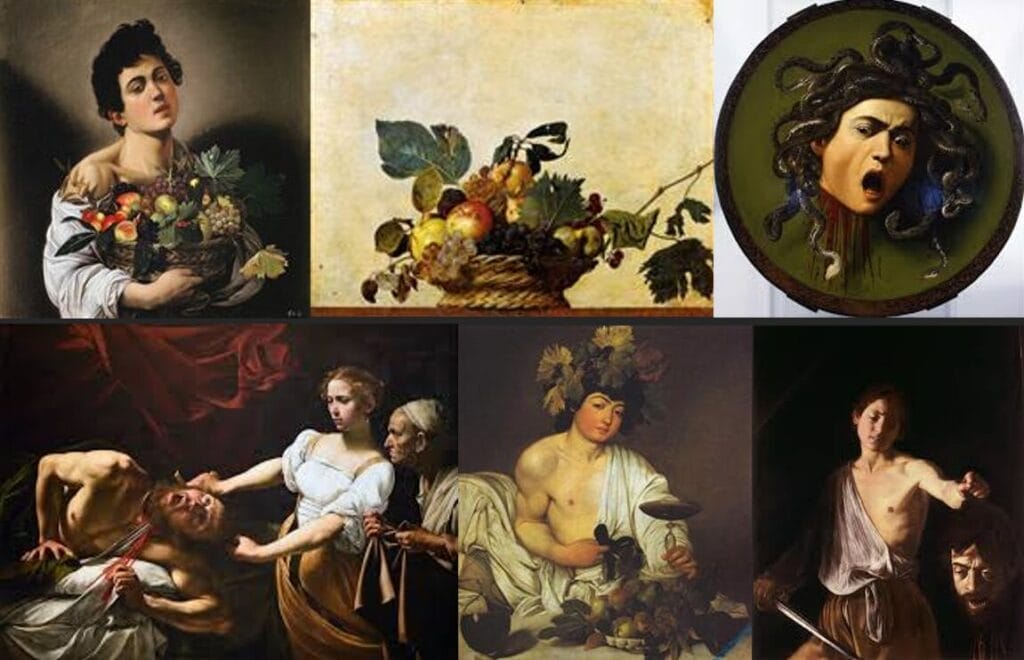
Born in Milan in 1571 and orphaned by the plague in 1577, Michelangelo Merisi da Caravaggio made his way to Rome in 1592, where he enrolled the lowlife of the city, its prostitutes, thieves, and other undesirables, in order to paint the Virgin Mary, Jesus, and the Apostles and saints of the New Testament and early Christianity—Matthew, Thomas, Peter, Paul, Agatha—as well as figures from the Old—David, Goliath, and Holophernes beheaded by Judith. Despite securing numerous prestigious commissions, he led In Rome a life marked by brawls, gambling, and constant brushes with the law.
In 1606 he killed a man in a street fight and would have suffered the fate of one his painted subjects but escaped to Naples, where his crime seems to have been regarded a mere peccadillo and he was employed to make more beautiful paintings. He also worked in Malta, where he also had a falling out and was imprisoned, but escaped, and then went to Sicily, where he continued to be awarded important and lucrative commissions.
In 1609, he returned to Naples to work, and, on account of his fame, was hoping for a papal pardon. In the summer of 1610, he took a boat to Rome, and died under unclear circumstances, possibly from malaria. It has also been speculated that he was murdered or suffered from lead poisoning (common among users of lead paint), neurosyphilis, staphylococcal sepsis, or some other infectious disease such as brucellosis from unpasteurized milk.
Caravaggio invented a new style in painting, characterized by alternating contrasting light and darkness, the chiaroscuro, imitated in due time by the so-called “Caravaggisti” Orazio and his daughter Artemisia Gentileschi, Bartolomeo Manfredi, and Carlo Saraceni in Italy; Hendrick ter Brugghen, Gerrit van Honthorst, and Dirck van Baburen in the Netherlands; Jusepe de Ribera in Spain; and Simon Vouet, Valentin de Boulogne, and Georges de La Tour in France. Their many oeuvres are regularly shown at modern exhibitions in conjunction with a few of the available master’s paintings. They reflect an era where art, violence, and illness were entwined—a reminder that beauty often can emerge from the less appetizing aspects of life.