Paige Edmiston
Seattle, Washington, United States

A black-and-white photograph of a man covered in tubing and wearing an unwieldy backpack-sized device (Figure 1) beamed from the screen at the front of the classroom. The nurse leading the diabetes education class walked from the podium to a table displaying the latest models of continuous glucose monitors and smart insulin pumps. She retrieved an object the size of a flip phone, a modern insulin pump that was considerably smaller than the prototype projected on the screen. “We’ve made a lot of progress!” she said.
Although there have been slight variations in the photograph’s description, most often the pictured device has been described as the first insulin pump prototype, dated to the 1960s and credited to a Los Angeles physician by the name of Dr. Arnold Kadish, who has occasionally (and, as I later learned, erroneously) been identified as the man in the photo. But as I looked at the prototype on this classroom screen, juxtaposed with the contemporary device in the instructor’s hand, it occurred to me just how little I knew about this widely circulating photo and the prototype it pictured.
Digging into the history of insulin pumps, I learned that Dr. Kadish’s device was not only the first insulin pump prototype; it was also the first prototype of a closed-loop insulin delivery system complete with a mechanism for continuous glucose monitoring.1–3 The existence of a project to create a closed-loop insulin delivery system struck me as remarkably ambitious for its time. In the 1960s when the prototype was developed, urine testing was the only way for patients to test their glucose levels at home. Glucometers would not become available for another decade.4 There was also no professional consensus in the 1960s about the clinical importance of “controlling” glucose levels. Even among its proponents, glucose control was considered more of a “philosophical concept than a phenomenon one can quantify.”5,6 How then, in a time before the glucometer (and the smart phone and personal computer), did a doctor end up embarking on a project to not only create an insulin pump, but to use information technology to control glucose levels?
It was because of this curiosity that I found myself driving one unseasonably gray summer day down a scenic serpentine road to meet Kadish’s eldest son, John, at his Pacific Northwest home. Sitting at his kitchen table accompanied by a friendly cat, John told me about his father, who had worked as an internist in Beverly Hills, treating the occasional celebrity (including Lou Costello) and developing a clinical interest in diabetes.7 Born in 1919 to a prominent labor organizer in Detroit, Kadish trained at Wayne University and the Mayo Clinic before moving to Los Angeles where he established a medical practice and met his wife, Elizabeth, who worked as a professional singer before marrying. The couple had four children: Francy, John, Henry, and Ann.
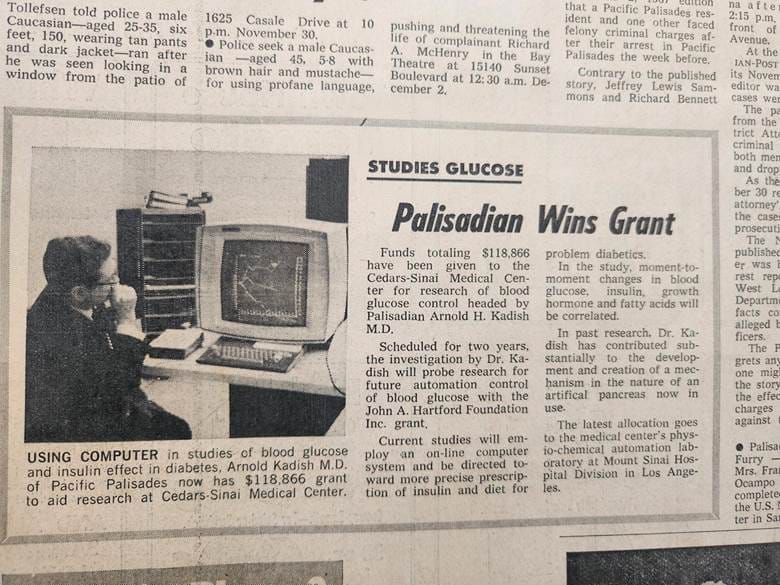
A family archive of newspaper clippings and professional correspondence that Elizabeth compiled when her husband retired helped fill in John’s and his siblings’ memories of Kadish’s medical and research career. In the early 1960s, Kadish won a grant from The John A. Hartford Foundation to establish a laboratory at the Cedars of Lebanon-Mount Sinai Hospitals dedicated to the development of an artificial pancreas. Influenced by his generation’s enthusiasm for cybernetics (he was a member of the Society of Cybernetics Medicine), Kadish believed it was possible to use computing technology to control blood sugar fluctuations—which he speculated caused the damage to the eyes, heart, nerves, brain, and kidneys observed at higher rates among people with diabetes—and set out, as a Mount Sinai Hospital press release put it, to develop a “feedback mechanism for automatic insulin release to be controlled by the blood sugar level.” In a 1961 article published in The Los Angeles Times about the project, Kadish expressed his hope that “various kinds of artificial devices” would one day reduce the “wide variations in blood sugar levels which [people with diabetes] experience, even under the best control.”8
The era’s enthusiasm for cybernetics, however, was not his only inspiration. John believed that his father’s interest in diabetes and his “obsession” with developing a technological solution was driven in part by his family’s personal experience with diabetes, a belief supported by Kadish’s correspondence. The doctor’s eldest child, Francy, was diagnosed with diabetes as a toddler. A year and a half Francy’s junior, John recalled that his family “always had a scale that Francy used for her meals… She had to have a snack between meals to regulate [her sugar] and there was always at nighttime a bowl of cereal.” Francy, John said, had to “have several insulin shots a day, had to check her glucose levels before she’d take her medication to balance things out.” He added: “It’s a pain for a kid to have to go through.”
Kadish’s research program continued into the 1970s, resulting in the backpack-sized prototype that has, in today’s “golden age of the insulin pump,” become a popular emblem of technological progress in diabetes treatment.9 While the project eventually came to a close, the family’s journey with diabetes continued. In the early 1980s, when she was in her early thirties, Francy needed a kidney transplant. John, then twenty-nine years old and recently married, was the closest match. “My father kept going, ‘Are you sure? Are you sure? Do you know what this is going to be like for you?’ He really wanted me to do it, but he wanted to make sure I really knew what the risks were.” For John it was not a difficult choice. “Once I was told I was a match, I was basically like, OK, I’ll do it. It wasn’t really a question. It’s either I do it or she’s not going to survive. That was my thinking.” The transplant was a success, and Francy continued living her life, working as a librarian and oral historian and becoming a parent herself.
Hearing John tell the story of the doctor—and family—behind the prototype, it struck me that Kadish’s invention was not only a forerunner of today’s automated insulin delivery systems in the technical sense; Kadish himself was also a pioneer in developing diabetes technology grounded in personal experience. Just as the first insulin pump was inspired by Francy’s diabetes, some of today’s cutting-edge technologies were first developed by parents of children with diabetes who, motivated by their child’s diagnosis, used their professional skills to develop new tools for managing the condition. Indeed, the first people to “close the loop”—using data from continuous glucose monitors to automate insulin delivery—were not corporate manufacturers, but parents and people living with diabetes who collaborated on do-it-yourself (DIY) and open-source software projects to create the tools they wanted to see in their own lives.10-12 Although he worked in a laboratory rather than with code, we might consider Kadish the original “D-dad” (or Diabetes Dad), a term used by some in the American diabetes community to refer to fathers of children with diabetes like those involved in the DIY diabetes community.13 Using the tools available in his time, Kadish endeavored to create new ways for people like his daughter to live with diabetes.
Neither Kadish nor Francy lived to see the doctor’s dream of automated insulin delivery materialize widely in clinical diabetes care; sadly, both died within several years of each other in the early 2000s. Their story joins others that have shaped the trajectory of diabetes technology, reminding us that behind every scientific discovery and innovation are people—real people with histories and loved ones and lives—whose experiences and resources, hopes and dreams, bring our technology and tools into being.14
Acknowledgments
My sincerest gratitude to the Kadish family for sharing their stories and memories with me. Research for this essay was made possible thanks to support from the National Science Foundation, the American Association of University Women, and the Carol B. Lynch Memorial Fellowship for Interdisciplinary Research.
References
- Alsaleh FM, Smith FJ, Keady S, Taylor KMG. Insulin pumps: from inception to the present and toward the future. Journal of Clinical Pharmacy and Therapeutics. 2010;35(2):127-138. doi:https://doi.org/10.1111/j.1365-2710.2009.01048.x
- Kadish AH, Hall DA. A New Method for the Continuous Monitoring of Blood Glucose by Measurement of Dissolved Oxygen. Clinical Chemistry. 1965;11(9):869-875. doi:10.1093/clinchem/11.9.869
- Kadish AH. Automation Control of Blood Sugar. In: Biomedical Sciences Instrumentation: Proceedings of the Annual Biomedical Sciences Instrumentation Symposium; 1963:171-176.
- Hirsch IB, Battelino T, Peters AL, Chamberlain JJ. Role of Continuous Glucose Monitoring in Diabetes. American Diabetes Association; 2018.
- Mauck AP. Managing Care: The History of Diabetes Management in Twentieth Century America. Dissertation. Harvard University; 2010.
- Ingelfinger FJ. Debates on Diabetes. N Engl J Med. 1977;296(21):1228-1230. doi:10.1056/NEJM197705262962111
- Ames W. From the Archives: Lou Costello, Famed Comedian, Dies at 52. Los Angeles Times. Published online March 4, 1959.
- Nelson H. Grant to Aid Research in Devices for Diabetes. The Los Angeles Times. July 27, 1961.
- Hirsch J. The Golden Age of the Insulin Pump. May 9, 2022. https://diatribe.org/golden-age-of-the-insulin-pump
- Edmiston P. A Historic FDA Clearance: Open Source Software and the Making of Tidepool Loop. In: Fishman S, ed. Advances in Diabetes Technology. Contemporary Endocrinology. Springer Nature Switzerland; 2024:181-207. doi:10.1007/978-3-031-75352-7_9
- Gottlieb SD. The Fantastical Empowered Patient. In: Healthcare Activism. Oxford University Press; 2021:198-223. doi:10.1093/oso/9780198865223.003.0008
- Kaziunas E, Lindtner S, Ackerman MS, Lee JM. Lived Data: Tinkering With Bodies, Code, and Care Work. Human–Computer Interaction. 2018;33(1):49-92. doi:10.1080/07370024.2017.1307749
- Dubois W. In Search of Diabetes Dads. Healthline. September 23, 2019.
- Haraway D. Situated Knowledges: The Science Question in Feminism and the Privilege of Partial Perspective. Feminist Studies. 1988;14(3):575. doi:10.2307/3178066
PAIGE EDMISTON recently completed her PhD in cultural anthropology at the University of Colorado, Boulder. Her research focuses on the digital transformation of the United States’ health system and how the automation of care, and specifically diabetes management, is playing out in practice for patients and health workers.