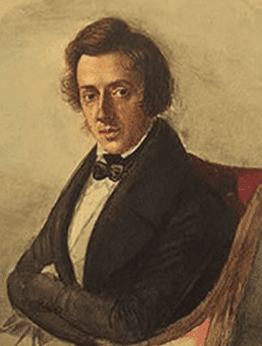
Frédéric Chopin was one of the greatest piano composers of the Romantic era. Born to a French father and a Polish mother, he grew up in a household that highly valued education and culture. By age six, he was already creating musical compositions, and at age seven, he wrote a polonaise. He received his formal musical education at the Warsaw Conservatory under Józef Elsner, who identified his remarkable talent and motivated him to create his distinctive musical style rather than imitate the established masters.
When Chopin became twenty years old, he decided to go on a short tour abroad but could not return home because an uprising for Polish independence had broken out. He went instead to Paris, where he met Franz Liszt, Hector Berlioz, and Eugène Delacroix. He also developed a ten-year-long romantic affair with the prominent Romantic novelist George Sand. This relationship, which started in 1838, supplied him with creative inspiration that affected his music during his most active professional period. He composed complex pieces characterized by exceptional technical mastery and expressive of deep emotional content. He wrote nocturnes, ballades, polonaises, and mazurkas drawn from his Polish roots but achieving universal approbation and fame.
Medical historians disagree about the cause of Chopin’s worsening health during his final years. As a tuberculosis patient from the 19th century, George Sand tried to help Chopin recover by living in Mallorca, where the warm climate was considered beneficial for the treatment of tuberculosis. The damp environment of their monastery accommodation in 1838–1839 became disastrous for Chopin’s health because it worsened his respiratory symptoms.
In recent times, medical researchers have challenged the idea that Chopin died from tuberculosis. They proposed temporal lobe epilepsy as a possible cause of his hallucinations and altered states of consciousness and suggested that he suffered from cystic fibrosis rather than tuberculosis. This genetic disease produces thick, sticky mucus that blocks the airways and obstructs the pancreatic ducts. This theory is supported by the fact that from birth until his death, Chopin had constant respiratory infections and digestive issues, as well as a family history of respiratory illnesses.
Another more recent hypothesis regarding Chopin’s ill health states that he had alpha-1 antitrypsin deficiency, a genetic disorder that leads to lung and liver disease. The hereditary nature of this condition matches the reports that Emilia Chopin, his youngest sister, suffered from similar respiratory symptoms, which led to her early death.
Chopin’s illness no doubt shaped the nature of his musical compositions. His physical condition limited him to writing salon pieces instead of big orchestral works. His nocturnes and ballades showed both melancholic beauty and technical innovation because they originated from his deep understanding of death and suffering. The cause of his early death remains a medical enigma. Scientists have preserved his heart in alcohol but failed to uncover the true cause of his life-long illness.