
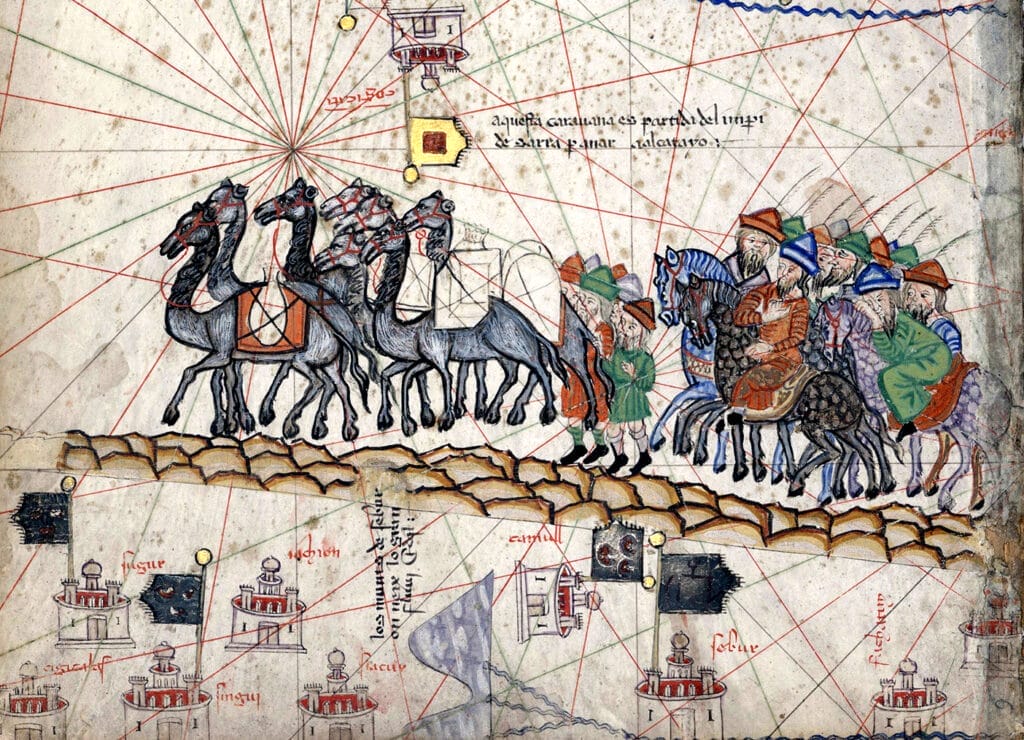
Marco Polo’s journey from Venice to the court of Kublai Khan and back spanned roughly 24 years, from 1271 to 1295. In his account, Il Milione (also known as The Travels of Marco Polo), he documents many aspects of life and medicine in his time. Leaving Venice at seventeen, he visited the arid deserts of Persia and Central Asia, the high-altitude passes of the Pamir Mountains (the “Roof of the World”), the humid lowlands of southern China and Southeast Asia, and the cold Mongolian steppes.
Crossing the Pamirs at elevations exceeding 4,500 meters exposed him to the risk of acute mountain sickness. Polo noted that the high plateau seemed to him the highest place in the world, and that fires burned less brightly and food cooked less well there, an effect of the reduced partial pressure of oxygen. He survived his exposure to various infectious diseases: plague, smallpox, cholera, and typhus. He may have contracted malaria in southern Persia but spent a year recovering in the highlands of Badakhshan (in modern Afghanistan), where the pure air and cool climate seemed to restore him. His route traversed some of the most food-insecure environments on Earth—the Taklamakan Desert and the steppe regions of Mongolia. He described surviving on dried meat, fermented mare’s milk (kumis), and whatever could be foraged or traded for along the route—a diet radically different from his Venetian upbringing. His text is a compendium of observed medical practices across Asia. He described Chinese and Mongol healers, herbal remedies, and ritualistic healing practices. He noted the use of rhubarb as a medicinal plant, later imported from China into Europe as a purgative. He also noted therapeutic baths, bloodletting practices, and the management of battle wounds.
Of particular interest is Polo’s account of the Black Death’s origins. He traveled through Central Asia roughly two generations before the great plague pandemic of 1347–1353 devastated Eurasia, and modern genetic and epidemiological research has confirmed that the bacterium Yersinia pestis was indeed circulating in Central Asian rodent populations—the very regions Polo passed through. His route traced the path that became the plague’s pathway westward and made the subsequent catastrophe possible.
Marco Polo’s resilience was remarkable. He spent nearly a quarter of a century far from home, endured physical hardship, legal captivity (he spent years in a Genoese prison after his return), and linguistic isolation. He lived in Venice until around 1324, suggesting that his survival across 24 years and roughly 24,000 kilometers of travel was a living experiment in human adaptation to adverse conditions.