
Brian O’Dea
Illinois, United States
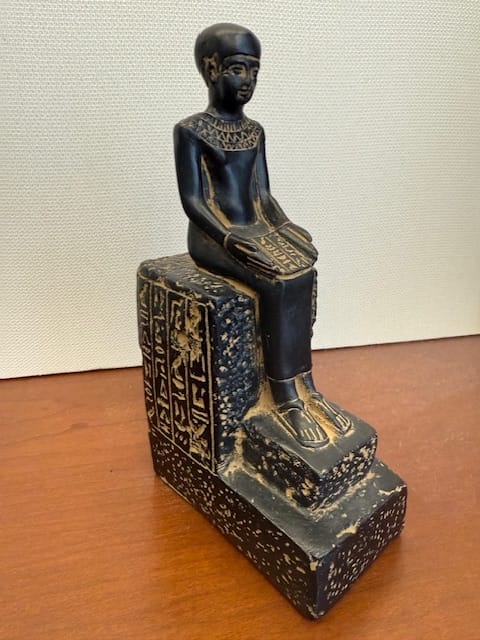
Imhotep is regarded as one of history’s first polymaths, a man whose genius transcended disciplines. Few figures in the ancient world stand as tall as Imhotep.
As vizier to the pharaoh Djoser of the third dynasty (c. 27th century BC), he envisioned the first major stone monument, the step pyramid at Saqqara. No one had ever imagined, let alone brought to fruition, this project. The pyramid’s design represents the pharaoh’s ascent to the divine realm, blending theology with technical mastery. This lasting monument changed Egypt’s architectural landscape and made possible the later stone monuments of Giza, Greece, and Rome.
Imhotep’s contributions to medicine are more difficult to document but resonate just as profoundly. Considered by some as the Father of Rational Medicine, he is credited as the author of texts that predate the Edwin Smith Papyrus, which itself dates back to 1600 BC but is believed to be a copy of a much earlier Imhotep-authored text.
These papyri are remarkable for their empirical, systematic approach to diagnosis and treatment. They detail surgical cases of trauma, fractures, wounds, and dislocations, each described according to a rational clinical approach: physical examination, diagnosis, prognosis, and treatment—methods that resemble those of modern clinical medicine. Unlike later mystical, magical, or theological texts, they demonstrated Imhotep’s observation-based method, devoid of superstition. Such rationality has led scholars to view Imhotep as the world’s first physician.
Imhotep’s medical legacy transcended Egypt’s borders and epochs. By the time of Greek and Roman antiquity, he was worshiped as Imouthes, a divine physician whose temples functioned as healing sanctuaries. Through this diffusion, Imhotep’s principles influenced the rational medicine of Hippocrates and the holistic medicine of Galen. By the New Kingdom, his temples in Egypt were likewise centers of healing, learning, and pilgrimage.
Imhotep’s achievements illuminate the origins of human inquiry, vision, and compassion. As architect, he transformed stone into symbol; as physician he transformed superstition into science. Nearly 4,700 years later, Imhotep’s name still evokes the spirit of intellectual curiosity and enduring pursuit of progress.

Library of Congress. Via Wikimedia.

Oil painting by Ernest Board. Wellcome Collection. Via Wikimedia. CC BY 4.0.

References
- “Imhotep.” World History Encyclopedia. Last modified January 28, 2016.
- “Imhotep”. Encyclopedia Britannica. September 27, 2025.
BRIAN O’DEA is CEO of Nephrology Associates of Northern IL/IN (NANI). In his 20 years with NANI, the practice has grown from 36 to 156 physicians in five states and is now the largest nephrology practice in the country. Brian is chairman of the RPA PAC, a board member and president for the National Kidney Foundation of Illinois, board member of Renal Network (ESRD Network 10), board member of Luninarts, and audit committee chairman for Hektoen Institute of Medicine, LLC. Brian earned his BA from the University of Illinois, his MBA from DePaul University, and is a CPA licensed to practice in Illinois.