
Mitchell Batavia
New York, New York, United States
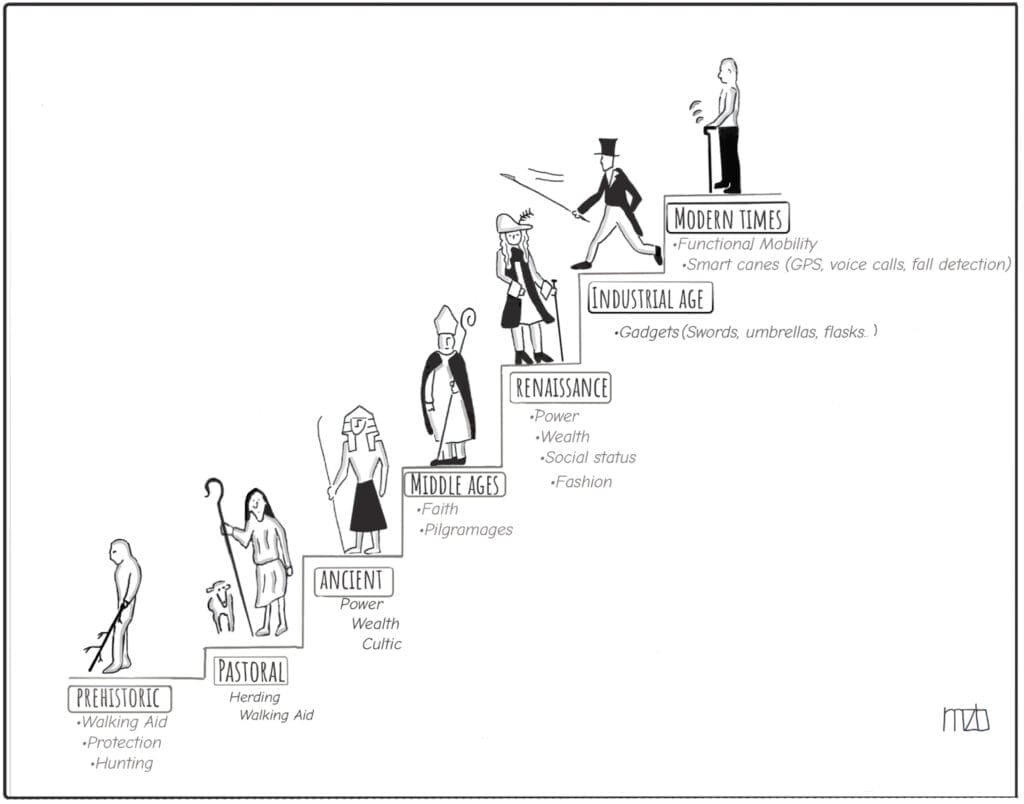
The walking stick, also referred to as a staff, crosier, shepherd’s crook, gadget cane, and cane, has fulfilled many roles over the centuries as a symbol for power,1-3 authority,2 weaponry,1,4 social status,1,4 faith,1,5 magic,1 smuggling,1 fashion,5 and physical support.6 Regardless of role, the stick has served as a social marker identifying individuals belonging to different groups within society.
Most scholars agree that the stick was one of the first tools used by prehistoric societies, used to hunt, defend, establish dominance, and aid in travel.2,3,7 There is limited physical evidence, however, since wood deteriorates over time.1,5,7 Rock paintings dating to 5000 BC, such as the engraved boulders at Niola Doa in the Sahara, depict individuals holding spears in the air, perhaps for hunting. But early evidence for the use of sticks as support aids, directed into the ground or used for balance, is not obvious.8
With the rise of pastoralism, the shepherd’s crook, used to guide and control livestock as well as to negotiate hilly terrain,9,10 probably emerged during the Neolithic period. These sticks had a curved handle at one end and a straight tip at the other. A ram’s horn, possibly the inspiration for the curved shape of the crook, functioned to capture the neck or the leg of a wandering sheep, while the straight end could defend against attacks.10 The curved staff has persisted in various forms throughout much of history, often signifying its dominion over some group.
The earliest recorded civilization, Mesopotamia, employed a type of curved staff called a gamlu. These implements, which may have originated with shepherds and hunters, were used in cultic rituals such as exorcisms to purify and to repel evil.9
Ancient Egypt illustrated many societal uses of sticks in hieroglyphics.11 However, portrayal of these devices in individuals with physical impairments was uncommon and limited to servants.2 But the celebrated discovery of King Tutankhamun’s tomb revealed over 130 sticks11 and staves, some showing wear, suggesting their use not only as a symbol of the king’s power but also as a physical aid for a foot or spinal disorder.4,12 Additional evidence of a stick used for support can be traced to an eighteenth- or nineteenth-dynasty stele depicting a doorkeeper with an atrophied, shortened leg and equinus deformity, leaning on a staff while making an offering. The doorkeeper possibly had poliomyelitis or a club foot.2
Staves for support were also used on long pilgrimages during the Middle Ages; only those fortunate enough to ride horseback had an alternative to walking.13 Long sticks, possibly forerunners of gadget canes, were used not only to negotiate rough terrain but also to hide money and other valuables during travel.4 In one documented case, Byzantine priests used their hollowed walking sticks to smuggle the first silk moth eggs out of China in AD 552.4,11
When the Catholic Church took hold in Europe during the Middle Ages, the bishop’s crosier served as an authority symbol, still used today.4 Its shape harkens back to pastoral roots, having curved features at one end.9 Used in ceremonies, these staves, like the shepherd’s crook of earlier times, serve metaphorically to guide a “flock.”
With the ascendancy of royal courts in Europe, the stick became not only a symbol of power and wealth, but also an insignia of social rank and fashion. First introduced in the late fourteenth century by Charles V of France3 and popularized by King Henry VIII of England in the fifteenth century7 and Louis XIV of France in the seventeenth century,4,11 ornate, gem-encrusted sticks were required attire for the elite. Unlike their sturdy staff predecessors, the court’s slimmer walking sticks were designed less for weightbearing and more for show, appropriate for the smooth surfaces of the royal courts.14 To retain the cane’s symbol of authority, walking sticks were limited to the aristocracy.
From the seventeenth to nineteenth centuries, socialites added different walking sticks to their fashionable wardrobes throughout the day.1,3 One would no sooner leave their home without a walking stick than they would a coat.6 These sticks took on a performative role during strolls down a promenade. Proper behavior on how sticks were handled outdoors during these walks was socially regulated and monitored. Carrying the stick horizontally or under one’s arm11 was criticized, as it could injure someone behind them.14 By the end of the eighteenth century, the use of walking sticks as a fashion statement permeated all levels of society.7
Walking sticks also demarcated the privileged from the oppressed. In the southern US, prior to the Civil War, the cane was a status symbol in upper-class white communities. Individuals in the free African American Village of Springfield, Georgia were restricted by law from using canes in public unless they were either blind or infirm.11,15
During the early Industrial Revolution, walking sticks became more accessible and affordable for the emerging middle class.14 Materials were mass produced, and with the growth of cities, roads became paved and more walkable. One utilitarian type of cane, the gadget or systems cane, offered multiple functionalities, much like the modern Swiss Army knife or smartphone. These canes either concealed something of importance or served a double purpose.16 The nineteenth century exploded with over 1,500 patents for gadget canes1,4,16 that could be used as a flask, tent, bicycle, fishing rod, seat, heroin sniffer, sundial, periscope, camera, violin, flashlight, paint set, water squirter, sewing kit, glove holder, wine taster, hatchet, ruler, sword stick, firearm, or stethoscope, to name a few.16 In fact, physicians carried walking sticks that also functioned as protection while visiting the sick. The cane housed vinegar or some other substance that, when held up to the nose, was believed to protect against airborne illnesses such as the plague.11 Considered an essential part of their uniform, the cane, like the caduceus, served as a recognizable emblem of the medical profession.6
Toward the end of the nineteenth century, with the introduction of the automobile and train, the walking stick’s popularity as a marker of group status began to wane.13 Storing and carrying the stick became more of an inconvenience during travel,6 and with the rising popularity of the attaché case,3 carrying both stick and case did not allow for free hand use. By 1920, with the rise of cigarette use and the decline of a fashion-conscious public, the demand for walking sticks dwindled.1
Attitudes also shifted dramatically following World War I when soldiers returned home with battlefield injuries requiring physical support. Fashion-conscious men, not wishing to be perceived as weak or in need of physical assistance, stopped using them. Canes were relegated for use during hikes and rehabilitation.1 Curiously, even physicians and their patients seemed to resist the long-term use of canes, perhaps believing that graduating from a cane implied successful treatment. One might hear a doctor say, “You may discontinue the cane as soon as you feel strong enough.”6 Economic incentives may have also been a factor, as an injured person would not be permitted to return to work if they still relied on physical support. In addition, these utilitarian devices lacked the splendor of the earlier walking stick.6 Nevertheless, with the adoption of the white cane for the visually impaired in the 1930s,17 the cane’s signifier as a medical device for the disabled was likely solidified.
With technological advances in the late twentieth and early twenty-first centuries, walking sticks evolved using new lightweight materials (carbon fiber), novel designs (off-set handles, ergonomic grips), and smart technology (GPS, fall alerts, obstacle detection).18,19 And, in an unexpected twist, walking sticks are attractive again.17, 20, 21
Through the centuries, the walking stick has served as a symbol of power, authority, social status, wealth, fashion, utility, and disability. In doing so, it drew a contrast between shepherd and flock, sovereign and subjects, faith leaders and followers, nobles and commoners, privileged and oppressed, and the able and disabled.
References
- Snyder JB. Canes From the Seventeenth to the Twentieth Century. Schiffer Publishing; 1993.
- Loebl WY, Nunn JF. Staffs as walking aids in ancient Egypt and Palestine. J R Soc Med. 1997;90(8):450-454.
- Von Boehn M. Modes and Manners Ornaments: Lace, Fans, Gloves, Walking Sticks, Parasols, Jewelry and Trinkets. JM Dent and Sons Ltd; 1929.
- Dike C. Walking Sticks. Shire Publications Ltd; 1990.
- Van den Brook GJ. The Return of the Cane: A Natural History of the Walking Stick. International Books; 2007.
- Blount WP. Don’t throw away your cane. J Bone Joint Surg Am. 1956;38(3):695-708.
- Boothroyd AE. Fascinating Walking Sticks. White Lion Publishers; 1973.
- British Museum. Niola Doa, Chad. African Rock Art. Accessed March 14, 2026. https://africanrockart.britishmuseum.org/country/chad/niola-doa/
- Ambos C, Krauskopf I. The curved staff in the Ancient Near East as a predecessor of the Etruscan lituus. Babesch. 2010;(suppl 16):127-153.
- Grand D, Hart E. Shepherds’ Crook and Walking Sticks. Dalesman Books; 1972.
- Snyder JB. Canes and Walking Sticks: A Stroll Through Time and Place. Schiffer Publishing; 2004.
- Hawass Z, Gad YZ, Ismail S, et al. Ancestry and pathology in King Tutankhamun’s family. JAMA. 2010;303(7):638-647. doi:10.1001/jama.2010.121
- Amato JA. A History of Walking New York. New York University Press; 2004.
- Andersson PK. The walking stick in the nineteenth-century city: conflicting ideals of urban walking. J Transp Hist. 2018;39(3):277-291.
- Joseph JW. Unwritten history of the Free African-American village of Springfield, Georgia. Archaeology and Ethnography in the Public Interest. 1997;2(1).
- Dike C. Cane Curiosa: From Gun to Gadget. Les Editions de l’Amateur; 1983.
- New Jersey Council of the Blind. The history of the white cane. Accessed March 16, 2026. https://www.njcounciloftheblind.org/brochures/history_of_white_cane.htm
- Bhatia T, Bhaduria M, Gupta SC. Internet of medical things: empowering mobility and health monitoring with a smart walking stick. In: Chauhan N, Yadav D, Verma GK, Soni B, Lara JM, eds. Machine Learning, Image Processing, Network Security and Data Sciences. MIND 2023. Communications in Computer and Information Science. Vol 2128. Springer; 2024.
- Integrating smart technology into walking canes: enhancing mobility and personal safety. Walking-Canes.net. Accessed March 19, 2026. https://www.walking-canes.net/blogs/news/integrating-smart-technology-into-walking-canes
- Demetriou D. ‘Design should be approachable for everyone’: a gathering of walking sticks and canes offers new ways of stepping out. Wallpaper*. May 11, 2024. Accessed March 17, 2026. https://www.wallpaper.com/design-interiors/keiji-takuchi-walking-sticks-and-canes-milan-design-week
- Neo Walk. Accessed March 17, 2026. https://neo-walk.com/en-us
MITCHELL BATAVIA PT, MA, PhD, is an associate professor at New York University with degrees in physical therapy, motor learning, research, and graphic design. He has penned five books, four short stories, and numerous editorial and educational cartoons. He is author of The Wheelchair Evaluation: A Clinician’s Guide (Jones & Bartlett). This essay is dedicated to the memory of disability activist Andrew I. Batavia.