
Howard Fischer
Uppsala, Sweden
“Are they afraid they’ll all turn black?
Is that why our blood they lack?”1
—From a poem by high school student Geraldyne Ghess
In 1941, US leaders suspected that the country would soon be in a war “against a German aggressor, obsessed with ethnic purity and the racial symbolism of blood.”2 Unfortunately, much American policy regarding blood transfusion could have been similarly described.
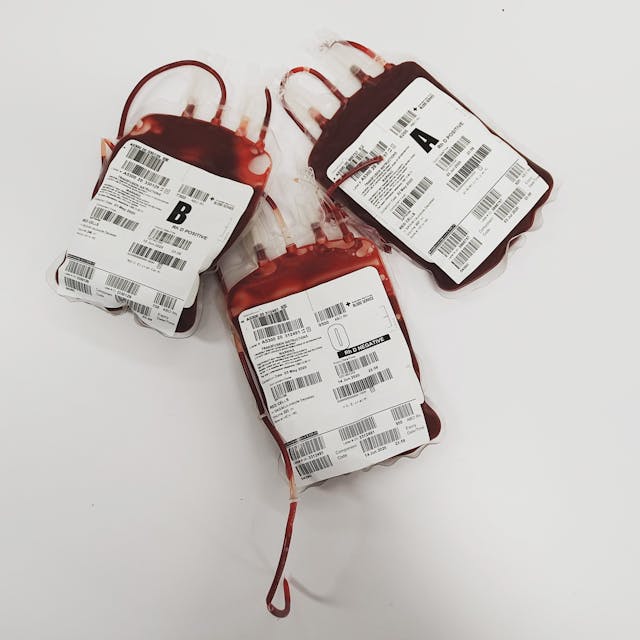
Blood banking started in the US in 1937 at Cook County Hospital in Chicago.3 Starting in 1941, blood was collected in quantity and stockpiled. Blood from African Americans was not accepted by the American Red Cross. These potential donors were told to give blood at local hospitals (serving Black patients), for on-site use.
By January 1942, the American Red Cross “permitted” Black people to donate blood for use by the American military, for transfusion to Black soldiers.4 These bottles of blood were labeled “N” for “Negro,” and were kept separate from the blood donated by whites. The Red Cross called it a “matter of tradition and sentiment rather than science.”5 In 2023, they indicated regret for their “decision to segregate blood based on race, accommodating the cultural norms of the time, rather than relying on scientifically based facts.”6
This humiliating, pointless policy resulted in protest. The National Association for the Advancement of Colored People (NAACP), and the Committee (later “Congress”) of Racial Equality made changing the policy a “top priority.”The president of the Detroit chapter of the NAACP called blood segregation “Hitler-like.”7 Labor unions, Jewish and Christian groups, the New Jersey State Legislature, and the Detroit Teachers’ Union also criticized the blood segregation policy.8 The Red Cross claimed that they were instructed to segregate donated blood by the Surgeons-General of the US Army and US Navy. The Surgeons-General and the military branches they represented denied ever making such demands.9
A detailed, well-reasoned criticism was written and published by the American Association of Physical Anthropologists. This critique was reprinted in its entirety in the journals Science, Scientific American, and, perhaps surprisingly, the Journal of the American Medical Association (AMA).10 The latter organization was conservative and racist at the time. There were no Black physician members of the AMA, since membership in the AMA was contingent upon being a member of a state medical society. Until the 1960s, state medical societies kept Black physicians out.
Journalist, poet, and playwright Langston Hughes channeled some of the anger and hurt of Black Americans in his newspaper column in the Chicago Defender.11 Light-skinned Blacks sometimes “pass” as whites for the social, educational, and material advantages derived from passing. Some of these white-appearing Blacks might have donated blood that would have been kept with the supply of blood from whites. Imagine, Hughes suggests, that a rabid white racist like the US Senator from Mississippi, Theodore Bilbo (1877–1947), gets transfused with some of this mislabeled blood: “One drop of black blood makes a man black in the South.”
Dr. Charles Drew, a Black man considered “the father of the blood bank,” a surgeon and blood plasma research pioneer, spoke out against the segregation of donated blood. His points were that the federal government should not “willfully humiliate its citizens,” that there is no scientific basis for the policy, and that blood is needed.12
Black people donated neither blood nor money to the Red Cross during the war. There was little evidence that white soldiers (as opposed to their families at home) cared about the source of their blood transfusion.13
The American Red Cross stopped segregating donated blood in 1950.14 The state of Louisiana, the last hold-out, ended the practice in 1972.15
References
- Thomas Guglielmo. “Desegregating blood: A civil rights struggle to remember.” PBS, February 4, 2018. https://www.pbs.org/newshour/science/desegregating-blood-a-civil-rights-struggle-to-remember
- Joshua Jordan. “A war on two fronts: Race, citizenship, and the segregation of the blood supply during World War II.” Penn Hist Rev, 24(2), 2019.
- Rose George. “The intersection of race and blood.” NY Times, May 14, 2019.
- Rose George. Nine Pints: A Journey through the Mysterious, Miraculous World of Blood. London: Granta Publications, 2019.
- George, Nine Pints.
- American Red Cross. “The color of blood: Red Cross reflects on its blood collection history.” July 25, 2023. https://www.redcross.org/about-us/news-and-events/press-release/2021/the-color-of-blood–red-cross-reflects-on-its-blood-collection-hiistory.html?srsltid=AfmBOopo3bW2zUxhfbLvvFmoyWN_i1TrX0Wtl4SsLh05iQQv0Xx6Vjo-
- Guglielmo, “Desegregating blood.”
- Melba Newsome. “Good blood, bad policy: The Red Cross and Jim Crow.” Undark, January 18, 2023.
- Jordan, “A war on two fronts.”
- John Rosenau. “White, black, and red all over: What blood segregation says about science and race.” National Center for Science Education, August 17, 2015. https://ncse.ngo/white-black-and-red-all-over-what-blood-segregation-says-about-science-and-race
- Langston Hughes. “Jokes on our white folks.” Chicago Defender, December 12, 1942.
- Spencie Love. One Blood: The Death and Resurrection of Charles R. Drew. Chapel Hill: The University of North Carolina Press, 1996.
- Newsome, “Good blood.”
- Guglielmo, “Desegregating blood.”
- George, Nine Pints.
HOWARD FISCHER, M.D., was a professor of pediatrics at Wayne State University School of Medicine, Detroit, Michigan.